http://www.cbsnews.com/stories/2010/09/18/business/main6879213.shtml
Latest Actions by FDIC Bring Year's Total Bank Failures to 125
(AP) Regulators on Friday shut down three Georgia banks and one each in New Jersey, Ohio and Wisconsin, boosting to 125 the number of U.S. bank failures this year amid the tough economic climate and growing loan defaults.
The Federal Deposit Insurance Corp. on Friday took over the Georgia banks: Bank of Ellijay, in Ellijay, with $168.8 million in assets; First Commerce Community Bank of Douglasville, with $248.2 million in assets; and Peoples Bank, based in Winder, with $447.2 million in assets.
The FDIC also seized ISN Bank in Cherry Hill, N.J., with $81.6 million in assets; Bramble Savings Bank of Milford, Ohio, with $47.5 million in assets; and Maritime Savings Bank, based in West Allis, Wis., with assets of $350.5 million.
Community & Southern Bank, based in Carrollton, Ga., agreed to assume the assets and deposits of Bank of Ellijay, First Commerce Community Bank and Peoples Bank. In addition, the FDIC and Community & Southern Bank agreed to share losses on $602.5 million of the three failed banks' loans and other assets.
Georgia, where the meltdown in the real estate market brought an avalanche of soured mortgage loans, has been one of the hardest hit states for bank collapses. The failures of the three banks Friday brought to 14 the number of Georgia banks that have fallen this year. Also high on the list of failure-heavy states are California, Florida and Illinois.
New Century Bank, based in Phoenixville, Pa., agreed to assume the assets and deposits of ISN Bank. New Century Bank does business as Customers Bank. The FDIC and New Century agreed to share losses on $64.8 million of ISN Bank's loans and other assets.
Foundation Bank, based in Cincinnati, is assuming the assets and deposits of Bramble Savings Bank.
And North Shore Bank, based in Brookfield, Wis., agreed to acquire all the deposits of Maritime Savings Bank and $177.6 million of its assets.
The failure of Bank of Ellijay is expected to cost the deposit insurance fund $55.2 million; that of First Commerce Community Bank, $71.4 million; that of Peoples Bank, $98.9 million; ISN Bank, $23.9 million; Bramble Savings Bank, $14.6 million; and Maritime Savings Bank, $83.6 million.
With 125 closures nationwide so far this year, the pace of bank failures exceeds that of 2009, which was already a brisk year for shutdowns. By this time last year, regulators had closed 94 banks.
The pace has accelerated as banks' losses mount on loans made for commercial property and development. Many companies have shut down in the recession, vacating shopping malls and office buildings financed by the loans. That has brought delinquent loan payments and defaults by commercial developers.
The number of bank failures is expected to peak this year and be slightly higher than the 140 that fell in 2009. That was the highest annual tally since 1992, at the height of the savings and loan crisis. The 2009 failures cost the insurance fund more than $30 billion. Twenty-five banks failed in 2008, the year the financial crisis struck with force; only three succumbed in 2007.
The growing bank failures have sapped billions of dollars out of the deposit insurance fund. It fell into the red last year, and its deficit stood at $20.7 billion as of June 30.
The number of banks on the FDIC's confidential "problem" list jumped to 829 in the second quarter from 775 three months earlier, even as the industry as a whole had its best quarter since 2007, making $21.6 billion in net income. Banks with more than $10 billion in assets - only 1.3 percent of the industry - accounted for $19.9 billion of the total earnings.
The FDIC expects the cost of resolving failed banks to total around $60 billion from 2010 through 2014.
The agency mandated last year that banks prepay about $45 billion in premiums, for 2010 through 2012, to replenish the insurance fund.
Depositors' money - insured up to $250,000 per account - is not at risk, with the FDIC backed by the government. That insurance cap was made permanent in the financial overhaul law enacted in July.
By AP Business Writer Marcy Gordon
Showing posts with label banks failure. Show all posts
Showing posts with label banks failure. Show all posts
Saturday, September 18, 2010
Saturday, July 24, 2010
U.S. Bank Failures This Year Surpass 100
http://www.cbsnews.com/stories/2010/07/24/business/main6709368.shtml
FDIC Closes Seven Banks in Seven States; Total Seizures in 2010 Now 103
(AP) U.S. bank failures this year have surpassed a bleak milestone of 100 as regulators shut down banks in Georgia, Florida, South Carolina, Kansas, Nevada, Minnesota and Oregon.
The seven bank seizures announced Friday bring to 103 the failures so far in 2010. The pace of bank closures this year is well ahead of that of 2009, which saw a total of 140 banks shuttered amid the recession and mounting loan defaults. That was the highest annual tally since 1992, at the height of the savings and loan crisis.
The pace has accelerated as banks' losses mount on loans made for commercial property and development. Many companies have shut down in the recession, vacating shopping malls and office buildings financed by the loans. That has brought delinquent loan payments and defaults by commercial developers.
The Federal Deposit Insurance Corp. said it took over Crescent Bank and Trust Co., based in Jasper, Ga., with about $1 billion in assets; Sterling Bank of Lantana, Fla., with $407.9 million in assets; Williamsburg First National Bank of Kingstree, S.C., $139.3 million in assets; Thunder Bank of Sylvan Grove, Kan., $32.6 million; SouthwestUSA Bank, with one branch in Las Vegas, $214 million; Community Security Bank of New Prague, Minn., $108 million; and Home Valley Bank of Cave Junction, Ore., $251.8 million.
Renasant Bank, based in Tupelo, Miss., agreed to assume the assets and deposits of Crescent Bank and Trust. Iberiabank of Lafayette, La., is acquiring the assets and deposits of Sterling Bank. First Citizens Bank and Trust Co. of Columbia, S.C., is assuming the assets and deposits of Williamsburg First National Bank, while Bennington State Bank in Salina, Kan., is taking the assets and deposits of Thunder Bank.
Roundbank of Waseca, Minn., is assuming those of Community Security Bank. Plaza Bank, based in Irvine, Calif., is acquiring the deposits of SouthwestUSA Bank and $137.3 million of the assets. The FDIC will retain the rest for eventual sale. South Valley Bank & Trust in Klamath Falls, Ore., is assuming the assets and deposits of Home Valley Bank.
The failure of Crescent Bank and Trust is expected to cost the deposit insurance fund about $242.4 million. The resolution of Sterling Bank is estimated to cost $45.5 million; that of Williamsburg First National Bank, $8.8 million; Thunder Bank, $4.5 million; SouthwestUSA Bank, $74.1 million; Community Security Bank, $18.6 million; and Home Valley Bank, $37.1 million.
By this time last year, regulators had closed 64 banks.
The number of bank failures is expected to peak this year and be slightly higher than the 140 that fell in 2009. Twenty-five banks failed in 2008, the year the financial crisis struck with force, and only three succumbed in 2007.
The growing bank failures have sapped billions of dollars out of the deposit insurance fund. It fell into the red last year, and its deficit stood at $20.7 billion as of March 31.
The number of banks on the FDIC's confidential "problem" list jumped to 775 in the first quarter, from 702 three months earlier, even as the industry as a whole had its best quarter in two years.
A majority of institutions posted profit gains in the January-March quarter. But many small and midsized banks are likely to continue to suffer distress in the coming months and years, especially from soured loans for office buildings and development projects.
The FDIC expects the cost of resolving failed banks to total around $60 billion from 2010 through 2014.
The agency mandated last year that banks prepay about $45 billion in premiums, for 2010 through 2012, to replenish the insurance fund.
Depositors' money - insured up to $250,000 per account - is not at risk, with the FDIC backed by the government. That insurance cap was made permanent in the financial overhaul legislation signed this week by President Barack Obama.
By AP Business Writer Marcy Gordon
FDIC Closes Seven Banks in Seven States; Total Seizures in 2010 Now 103
(AP) U.S. bank failures this year have surpassed a bleak milestone of 100 as regulators shut down banks in Georgia, Florida, South Carolina, Kansas, Nevada, Minnesota and Oregon.
The seven bank seizures announced Friday bring to 103 the failures so far in 2010. The pace of bank closures this year is well ahead of that of 2009, which saw a total of 140 banks shuttered amid the recession and mounting loan defaults. That was the highest annual tally since 1992, at the height of the savings and loan crisis.
The pace has accelerated as banks' losses mount on loans made for commercial property and development. Many companies have shut down in the recession, vacating shopping malls and office buildings financed by the loans. That has brought delinquent loan payments and defaults by commercial developers.
The Federal Deposit Insurance Corp. said it took over Crescent Bank and Trust Co., based in Jasper, Ga., with about $1 billion in assets; Sterling Bank of Lantana, Fla., with $407.9 million in assets; Williamsburg First National Bank of Kingstree, S.C., $139.3 million in assets; Thunder Bank of Sylvan Grove, Kan., $32.6 million; SouthwestUSA Bank, with one branch in Las Vegas, $214 million; Community Security Bank of New Prague, Minn., $108 million; and Home Valley Bank of Cave Junction, Ore., $251.8 million.
Renasant Bank, based in Tupelo, Miss., agreed to assume the assets and deposits of Crescent Bank and Trust. Iberiabank of Lafayette, La., is acquiring the assets and deposits of Sterling Bank. First Citizens Bank and Trust Co. of Columbia, S.C., is assuming the assets and deposits of Williamsburg First National Bank, while Bennington State Bank in Salina, Kan., is taking the assets and deposits of Thunder Bank.
Roundbank of Waseca, Minn., is assuming those of Community Security Bank. Plaza Bank, based in Irvine, Calif., is acquiring the deposits of SouthwestUSA Bank and $137.3 million of the assets. The FDIC will retain the rest for eventual sale. South Valley Bank & Trust in Klamath Falls, Ore., is assuming the assets and deposits of Home Valley Bank.
The failure of Crescent Bank and Trust is expected to cost the deposit insurance fund about $242.4 million. The resolution of Sterling Bank is estimated to cost $45.5 million; that of Williamsburg First National Bank, $8.8 million; Thunder Bank, $4.5 million; SouthwestUSA Bank, $74.1 million; Community Security Bank, $18.6 million; and Home Valley Bank, $37.1 million.
By this time last year, regulators had closed 64 banks.
The number of bank failures is expected to peak this year and be slightly higher than the 140 that fell in 2009. Twenty-five banks failed in 2008, the year the financial crisis struck with force, and only three succumbed in 2007.
The growing bank failures have sapped billions of dollars out of the deposit insurance fund. It fell into the red last year, and its deficit stood at $20.7 billion as of March 31.
The number of banks on the FDIC's confidential "problem" list jumped to 775 in the first quarter, from 702 three months earlier, even as the industry as a whole had its best quarter in two years.
A majority of institutions posted profit gains in the January-March quarter. But many small and midsized banks are likely to continue to suffer distress in the coming months and years, especially from soured loans for office buildings and development projects.
The FDIC expects the cost of resolving failed banks to total around $60 billion from 2010 through 2014.
The agency mandated last year that banks prepay about $45 billion in premiums, for 2010 through 2012, to replenish the insurance fund.
Depositors' money - insured up to $250,000 per account - is not at risk, with the FDIC backed by the government. That insurance cap was made permanent in the financial overhaul legislation signed this week by President Barack Obama.
By AP Business Writer Marcy Gordon


Saturday, April 24, 2010
FDIC Shuts Down 7 Illinois Banks
http://www.cbsnews.com/stories/2010/04/24/business/main6428128.shtml
Closures Bring Number of U.S. Bank Failures This Year to 57
Closures Bring Number of U.S. Bank Failures This Year to 57
Saturday, April 17, 2010
Feds Close 8 Banks in 5 States
http://www.cbsnews.com/stories/2010/04/17/business/main6406015.shtml
Regulators Shut Down Banks in Calif., Fla., Mass., Mich. and Wash.; Number of Failures This Year Now 50
(AP) Regulators on Friday shut down eight banks - three in Florida, two in California, and one each in Massachusetts, Michigan and Washington - putting the number of U.S. bank failures this year at 50.
The Federal Deposit Insurance Corp. took over the three Florida banks: Riverside National Bank in Fort Pierce, with $3.4 billion in assets; First Federal Bank of North Florida in Palatka, with $393.3 million in assets; and AmericanFirst Bank in Clermont, with assets of $90.5 million.
TD Bank Financial Group, a division of Canada's TD Bank, agreed to acquire the deposits and nearly all the assets of the three Florida banks.
The FDIC also seized Innovative Bank, based in Oakland, Calif., with about $269 million in assets; Tamalpais Bank of San Rafael, Calif., with about $629 million in assets; City Bank, based in Lynnwood, Wash., with about $1.1 billion in assets; Butler Bank in Lowell, Mass., with $268 million in assets; and Lakeside Community Bank in Sterling Heights, Mich., with $53 million in assets.
Los Angeles-based Center Bank agreed to assume the assets and deposits of Innovative Bank. San Francisco-based Union Bank is acquiring the assets and deposits of Tamalpais Bank. Whidbey Island Bank, based in Coupeville, Wash., is assuming the deposits of City Bank and $704.1 million of its assets. People's United Bank in Bridgeport, Conn., agreed to assume the assets and deposits of Butler Bank.
The FDIC couldn't find a buyer for Lakeside Community Bank. First Michigan Bank in Troy, Mich., will take over the failed bank's direct deposit operations for federal payments, such as Social Security and veterans' benefits.
The failure of Riverside National Bank is expected to cost the deposit insurance fund $491.8 million. For the other banks, the estimated costs: First Federal Bank of North Florida, $6 million; AmericanFirst Bank, $10.5 million; Innovative Bank, $37.8 million; Tamalpais Bank, $81.1 million; City Bank, $323.4 million; Butler Bank, $22.9 million; and Lakeside Community Bank, $11.2 million.
Depositors' money is insured up to $250,000 per account by the FDIC, which is backed by the government.
Last year, 140 banks failed in the U.S. That was the highest annual number since 1992 during the peak of the savings and loan crisis. The failures last year cost the FDIC's insurance fund more than $30 billion.
Twenty-five banks failed in 2008 and three in 2007.
FDIC Chairman Sheila Bair has predicted that the number of bank failures will peak this year and be slightly more than in 2009.
By AP Business Writers Tim Paradis and Marcy Gordon
Regulators Shut Down Banks in Calif., Fla., Mass., Mich. and Wash.; Number of Failures This Year Now 50
(AP) Regulators on Friday shut down eight banks - three in Florida, two in California, and one each in Massachusetts, Michigan and Washington - putting the number of U.S. bank failures this year at 50.
The Federal Deposit Insurance Corp. took over the three Florida banks: Riverside National Bank in Fort Pierce, with $3.4 billion in assets; First Federal Bank of North Florida in Palatka, with $393.3 million in assets; and AmericanFirst Bank in Clermont, with assets of $90.5 million.
TD Bank Financial Group, a division of Canada's TD Bank, agreed to acquire the deposits and nearly all the assets of the three Florida banks.
The FDIC also seized Innovative Bank, based in Oakland, Calif., with about $269 million in assets; Tamalpais Bank of San Rafael, Calif., with about $629 million in assets; City Bank, based in Lynnwood, Wash., with about $1.1 billion in assets; Butler Bank in Lowell, Mass., with $268 million in assets; and Lakeside Community Bank in Sterling Heights, Mich., with $53 million in assets.
Los Angeles-based Center Bank agreed to assume the assets and deposits of Innovative Bank. San Francisco-based Union Bank is acquiring the assets and deposits of Tamalpais Bank. Whidbey Island Bank, based in Coupeville, Wash., is assuming the deposits of City Bank and $704.1 million of its assets. People's United Bank in Bridgeport, Conn., agreed to assume the assets and deposits of Butler Bank.
The FDIC couldn't find a buyer for Lakeside Community Bank. First Michigan Bank in Troy, Mich., will take over the failed bank's direct deposit operations for federal payments, such as Social Security and veterans' benefits.
The failure of Riverside National Bank is expected to cost the deposit insurance fund $491.8 million. For the other banks, the estimated costs: First Federal Bank of North Florida, $6 million; AmericanFirst Bank, $10.5 million; Innovative Bank, $37.8 million; Tamalpais Bank, $81.1 million; City Bank, $323.4 million; Butler Bank, $22.9 million; and Lakeside Community Bank, $11.2 million.
Depositors' money is insured up to $250,000 per account by the FDIC, which is backed by the government.
Last year, 140 banks failed in the U.S. That was the highest annual number since 1992 during the peak of the savings and loan crisis. The failures last year cost the FDIC's insurance fund more than $30 billion.
Twenty-five banks failed in 2008 and three in 2007.
FDIC Chairman Sheila Bair has predicted that the number of bank failures will peak this year and be slightly more than in 2009.
By AP Business Writers Tim Paradis and Marcy Gordon
Friday, December 18, 2009
FDIC fighting for survival
http://online.wsj.com/article/SB126091986848592805.html
This Wall Street Journal article tells how Sen. Chris Dodd and Treasury Secretary Geithner try to strip the FDIC of practically of all bank supervisions even though FDIC chair Sheilar Bair was the only government official who predicted a wave of foreclosures back in 2007 when she directed her staff to study securitized subprime loans from 2004-2005 and discovered that 75% of them carried balloon payments due in a few years.
The article described a July meeting called by Geithner with Bair and Fed chairman Ben Bernanke in attendance where Geithner used profanity. Here is an excerpt from the article, "Mr. Geithner immediately lit into the regulators in an expletive-laced fury, at times raising his voice to the verge of shouting, according to several people familiar with the meeting."
Remember Geithner cheated on his tax return and had to pay back taxes during his confirmation hearing.
That article says 133 banks had failed year to date. But 7 more banks failed on Friday, making the total at 140.
This Wall Street Journal article tells how Sen. Chris Dodd and Treasury Secretary Geithner try to strip the FDIC of practically of all bank supervisions even though FDIC chair Sheilar Bair was the only government official who predicted a wave of foreclosures back in 2007 when she directed her staff to study securitized subprime loans from 2004-2005 and discovered that 75% of them carried balloon payments due in a few years.
The article described a July meeting called by Geithner with Bair and Fed chairman Ben Bernanke in attendance where Geithner used profanity. Here is an excerpt from the article, "Mr. Geithner immediately lit into the regulators in an expletive-laced fury, at times raising his voice to the verge of shouting, according to several people familiar with the meeting."
Remember Geithner cheated on his tax return and had to pay back taxes during his confirmation hearing.
That article says 133 banks had failed year to date. But 7 more banks failed on Friday, making the total at 140.
Tuesday, November 10, 2009
FDIC Disowns Geithner Embarrassment
http://www.thestreet.com/_yahoo/story/10624514/1/fdic-disowns-geithner-embarrassment.html
By Dan Freed
WASHINGTON, D.C. (TheStreet) -- The Treasury Department, not the Federal Deposit Insurance Corp., should be held responsible for a public relations gaffe last month in which the FDIC closed a Chicago bank just hours after it received an award from Treasury Secretary Tim Geithner, according to FDIC spokesman David Barr.
Park National Bank of Chicago received $50 million in tax credits to encourage investment in poor communities at an Oct. 30 ceremony attended by Geithner. Hours later, though, it was seized along with eight other banks around the country that formed part of a holding company called FBOP Corp. and sold to U.S. Bancorp (USB).
One financial services executive, who did not want to be on the record for fear of running afoul of regulators, accused the FDIC of timing the closure as it did in a deliberate effort to embarrass Geithner.
FDIC Chairman Sheila Bair has tangled with Geithner before over issues such as her approval of Wells Fargo (WFC)'s acquisition of Wachovia after the failed bank had initially struck a deal with Citigroup (C), according to a Bloomberg News report last year. The report said Geithner tried to push Bair out of office.
FDIC Spokesman Barr says questions over the issue should be directed to John Dugan, the Comptroller of the Currency, which is a bureau within the Treasury Department. Barr says Dugan sits on the FDIC's board and could have warned Geithner of the impending closure, since the FDIC took bids on FBOP Bank October 20 -- 10 days before the bank was closed.
"Why aren't you asking John Dugan's people why they didn't call up their own boss, since they're a bureau within the Treasury Department and the FDIC is an independent regulatory agency?," Barr told TheStreet.com.
However, in a follow-up e-mail, Barr noted that there are "statutory firewalls..that insulate the Treasury officials from knowing about impending failures." Asked why this firewall did not apply to Dugan, Barr wrote "ask them (the OCC) how it works."
A spokesman for the Office of the Comptroller of the Currency declined to comment.
Though Park National was relatively healthy, it was shuttered because it could not cover the losses of other banks in the FBOP holding company.
In addition to the usual real estate loans gone bad that have dogged virtually every institution from Bank of America (BAC) to Goldman Sachs (GS), the FBOP banks had big losses on preferred shares of Fannie Mae (FNM) and Freddie Mac (FRE), according to a report in the Wall Street Journal last week.
Treasury spokespeople did not respond to calls or e-mail messages
--Written by Dan Freed in New York.
By Dan Freed
WASHINGTON, D.C. (TheStreet) -- The Treasury Department, not the Federal Deposit Insurance Corp., should be held responsible for a public relations gaffe last month in which the FDIC closed a Chicago bank just hours after it received an award from Treasury Secretary Tim Geithner, according to FDIC spokesman David Barr.
Park National Bank of Chicago received $50 million in tax credits to encourage investment in poor communities at an Oct. 30 ceremony attended by Geithner. Hours later, though, it was seized along with eight other banks around the country that formed part of a holding company called FBOP Corp. and sold to U.S. Bancorp (USB).
One financial services executive, who did not want to be on the record for fear of running afoul of regulators, accused the FDIC of timing the closure as it did in a deliberate effort to embarrass Geithner.
FDIC Chairman Sheila Bair has tangled with Geithner before over issues such as her approval of Wells Fargo (WFC)'s acquisition of Wachovia after the failed bank had initially struck a deal with Citigroup (C), according to a Bloomberg News report last year. The report said Geithner tried to push Bair out of office.
FDIC Spokesman Barr says questions over the issue should be directed to John Dugan, the Comptroller of the Currency, which is a bureau within the Treasury Department. Barr says Dugan sits on the FDIC's board and could have warned Geithner of the impending closure, since the FDIC took bids on FBOP Bank October 20 -- 10 days before the bank was closed.
"Why aren't you asking John Dugan's people why they didn't call up their own boss, since they're a bureau within the Treasury Department and the FDIC is an independent regulatory agency?," Barr told TheStreet.com.
However, in a follow-up e-mail, Barr noted that there are "statutory firewalls..that insulate the Treasury officials from knowing about impending failures." Asked why this firewall did not apply to Dugan, Barr wrote "ask them (the OCC) how it works."
A spokesman for the Office of the Comptroller of the Currency declined to comment.
Though Park National was relatively healthy, it was shuttered because it could not cover the losses of other banks in the FBOP holding company.
In addition to the usual real estate loans gone bad that have dogged virtually every institution from Bank of America (BAC) to Goldman Sachs (GS), the FBOP banks had big losses on preferred shares of Fannie Mae (FNM) and Freddie Mac (FRE), according to a report in the Wall Street Journal last week.
Treasury spokespeople did not respond to calls or e-mail messages
--Written by Dan Freed in New York.
Saturday, November 7, 2009
New round of bank closures to cost FDIC $1.5 billion
http://www.marketwatch.com/story/five-bank-closures-to-cost-fdic-fund-15-bln-2009-11-07
SAN FRANCISCO (MarketWatch) -- A California-based bank that focused on the Chinese-American market was the largest of five failures on Friday that cost U.S. taxpayers more than $1.5 billion.
United Commercial Bank of San Francisco, whose parent company was UCBH Holdings Inc. (UCBH 0.84, -0.02, -2.33%) , was shut down by federal banking regulators late Friday, along with four other banks. The shutdown of the five banks brings the number of bank failures for 2009 to 120.
The 63 U.S. branches of United Commercial were set to reopen Saturday under the ownership of Pasadena, Calif.-based East West Bancorp Inc. (EWBC 8.65, +0.27, +3.22%) . United Commercial, which specialized in serving the Chinese community throughout the U.S. and American companies doing business in China, had assets of $11.2 billion and deposits of $7.5 billion as of Oct. 23.
The seizure of the bank by regulators comes after it had already received $299 million in federal financial aid last year. Its closure will cost the insurance deposit fund $1.4 billion, said the Federal Deposit Insurance Corp.
The company had a banking license in China, a branch in Hong Kong and a subsidiary in Shanghai, and those will be assumed by East West Bancorp. The Hong Kong Monetary Authority said deposits at UCB Hong Kong will be fully covered, according a report on Saturday by the Xinhua news agency.
East West said in a statement that the United Commercial transaction will create the largest bank in the U.S. focusing on the Asian American community, and the second-largest independent bank based in California. East West operates 137 branches throughout the U.S. and China.
"This is a transformational event for both institutions and represents an exciting growth opportunity for East West," East West Chairman and Chief Executive Dominic Ng said in a statement.
The closures of United Security Bank of Sparta, Ga.; Home Federal Savings Bank of Detroit; Gateway Bank of St. Louis and Prosperan Bank of Oakdale, Minn., will cost the deposit insurance fund an estimated $132.7 million.
SAN FRANCISCO (MarketWatch) -- A California-based bank that focused on the Chinese-American market was the largest of five failures on Friday that cost U.S. taxpayers more than $1.5 billion.
United Commercial Bank of San Francisco, whose parent company was UCBH Holdings Inc. (UCBH 0.84, -0.02, -2.33%) , was shut down by federal banking regulators late Friday, along with four other banks. The shutdown of the five banks brings the number of bank failures for 2009 to 120.
The 63 U.S. branches of United Commercial were set to reopen Saturday under the ownership of Pasadena, Calif.-based East West Bancorp Inc. (EWBC 8.65, +0.27, +3.22%) . United Commercial, which specialized in serving the Chinese community throughout the U.S. and American companies doing business in China, had assets of $11.2 billion and deposits of $7.5 billion as of Oct. 23.
The seizure of the bank by regulators comes after it had already received $299 million in federal financial aid last year. Its closure will cost the insurance deposit fund $1.4 billion, said the Federal Deposit Insurance Corp.
The company had a banking license in China, a branch in Hong Kong and a subsidiary in Shanghai, and those will be assumed by East West Bancorp. The Hong Kong Monetary Authority said deposits at UCB Hong Kong will be fully covered, according a report on Saturday by the Xinhua news agency.
East West said in a statement that the United Commercial transaction will create the largest bank in the U.S. focusing on the Asian American community, and the second-largest independent bank based in California. East West operates 137 branches throughout the U.S. and China.
"This is a transformational event for both institutions and represents an exciting growth opportunity for East West," East West Chairman and Chief Executive Dominic Ng said in a statement.
The closures of United Security Bank of Sparta, Ga.; Home Federal Savings Bank of Detroit; Gateway Bank of St. Louis and Prosperan Bank of Oakdale, Minn., will cost the deposit insurance fund an estimated $132.7 million.
- United Security Bank had total assets of $157 million and total deposits of $150 million as of Sept. 14, according to the FDIC. Ameris Bank of Moultrie, Ga. agreed to assume United Security's deposits, and will pay the FDIC a premium of 0.36% of all the deposits.
- Home Federal Savings Bank as of Sept. 24 had total assets of $14.9 million and total deposits of $12.8 million. Liberty Bank and Trust Co. of New Orleans did not pay a premium to assume the deposits.
- Gateway Bank had total assets of $27.7 million and total deposits of $27.9 million as of Sept. 25. Central Bank of Kansas City didn't pay a premium for Gateway's deposits.
- Prosperan Bank had total assets of $199.5 million and total deposits of $175.6 million. Grand Forks, N.D.-based Alerus Financial will pay the FDIC a premium of 1.02% to assume all Prosperan's deposits and agreed to purchase $173.9 million of the failed bank's assets.
Sunday, November 1, 2009
Nine U.S. banks seized in largest one-day haul
http://www.reuters.com/article/newsOne/idUSTRE59U05420091031
Sat Oct 31, 2009 5:44am EDT
By Sam Mircovich and Edwin Chan
LOS ANGELES (Reuters) - U.S. authorities seized nine failed banks on Friday, the most in a single day since the financial crisis began and the latest stark sign that substantial parts of the nation's banking industry are being crippled by bad loans.
The move brought the total number of failed banks in 2009 to 115 -- their highest annual level since 1992 -- with analysts expecting more to come. Among the lenders seized Friday was Los Angeles-based California National Bank, in what was the fourth-largest U.S. bank failure this year.
The largest institution to fail in the current financial crisis was Washington Mutual, which boasted $307 billion in assets when it was shuttered in September 2008.
U.S. Bancorp on Friday acquired the nine banks that had been held by FBOP Corp, picking up $18.4 billion in assets and $15.4 billion of deposits.
Visibly worried employees lined up to file into Cal National's head offices in the heart of a deserted downtown Los Angeles on a chilly Friday evening, where they had their employers' fate explained to them, regulators said.
"We're getting ready to turn everything over to U.S. Bank," said Roberta Valdez, a spokeswoman for the Federal Deposit Insurance Corp, which helped supervise the transfer of FBOP's assets. "They will continue to operate as normal in the interim," she added, referring to lenders acquired from FBOP.
U.S. Bancorp -- which has been buying up distressed assets this year -- is picking up the lenders once owned by FBOP, a private Illinois group with over $18 billion in assets that owned banks in Texas, Illinois, Arizona and California.
Cal National is FBOP's largest bank by branches. Others that will now go under the U.S. Bancorp umbrella included BankUSA, Citizens National Bank, Madisonville State Bank, North Houston Bank, Pacific National Bank, Park National Bank, San Diego National Bank, and the Community Bank of Lemont.
"This transaction is consistent with the growth strategy that we have outlined many times in the past, which includes enhancing our existing franchise through low-risk, in-market acquisitions," said Rick Hartnack, vice chairman of consumer banking for U.S. Bancorp.
"This transaction adds scale to our current California, Illinois and Arizona footprints."
NEXT BIG HEADACHE
In the "near future," all nine lenders' branches will be re-branded U.S. Bank, which is the California-focused unit of U.S. Bancorp's that operates a network of more than 770 branches across Illinois, Arizona and California.
U.S. Bancorp did not specify what would happen to the new employees it inherits.
Cal National operates 68 branches across Southern California with more than $7 billion in assets. As of June 30, the lender maintained five times as much foreclosed property on its books and twice as many non-current loans as it had a year earlier, according to the Los Angeles Times, which first reported news of its evening takeover on Friday.
Cal National lost about $500 million on heavy investments in Fannie Mae and Freddie Mac preferred shares, the newspaper added, referring to securities rendered nearly worthless by the government takeover of the mortgage firms last year.
According to FDIC data, Cal National was the fourth biggest bank failure this year in terms of assets, just edging out Corus Bank, seized Sept 11 with a flat $7 billion of assets.
A bank official who answered the main number at Cal National's headquarters said they could not talk at the time.
Banks are still cleaning up their balance sheets from the recent credit boom that fueled banks' appetite to extend loans, many with poor underwriting and triggers that caused borrowers' payments to spike to unaffordable levels.
More lenders are expected to go under this year as the industry tries to get a handle on commercial real estate loans that will continue to worsen, as more strip malls go vacant and residential developments stall.
Banks held about $1.7 trillion in commercial real estate loans at the end of September, according to Federal Reserve data, or about 15 percent of their total assets. But to the extent these loans weaken, small banks are likely to be hit the hardest because larger banks were better diversified.
Banks that analysts say could risk big losses include Salt Lake City's Zions Bancorp, Columbus, Georgia's Synovus Financial Corp and Dallas-based Comerica Inc.
Before FBOP, U.S. Bancorp bought Downey Savings of Newport Beach and PFF Bank & Trust of Pomona when those thrifts failed last November, the newspaper said. Just this month, U.S. Bancorp bought 20 Nevada branches from BB&T Corp, which had acquired them as part of its deal to buy Colonial BancGroup Inc, it added.
(Additional reporting by Mary Milliken; Editing by Bernard Orr and Dean Yates)
Sat Oct 31, 2009 5:44am EDT
By Sam Mircovich and Edwin Chan
LOS ANGELES (Reuters) - U.S. authorities seized nine failed banks on Friday, the most in a single day since the financial crisis began and the latest stark sign that substantial parts of the nation's banking industry are being crippled by bad loans.
The move brought the total number of failed banks in 2009 to 115 -- their highest annual level since 1992 -- with analysts expecting more to come. Among the lenders seized Friday was Los Angeles-based California National Bank, in what was the fourth-largest U.S. bank failure this year.
The largest institution to fail in the current financial crisis was Washington Mutual, which boasted $307 billion in assets when it was shuttered in September 2008.
U.S. Bancorp on Friday acquired the nine banks that had been held by FBOP Corp, picking up $18.4 billion in assets and $15.4 billion of deposits.
Visibly worried employees lined up to file into Cal National's head offices in the heart of a deserted downtown Los Angeles on a chilly Friday evening, where they had their employers' fate explained to them, regulators said.
"We're getting ready to turn everything over to U.S. Bank," said Roberta Valdez, a spokeswoman for the Federal Deposit Insurance Corp, which helped supervise the transfer of FBOP's assets. "They will continue to operate as normal in the interim," she added, referring to lenders acquired from FBOP.
U.S. Bancorp -- which has been buying up distressed assets this year -- is picking up the lenders once owned by FBOP, a private Illinois group with over $18 billion in assets that owned banks in Texas, Illinois, Arizona and California.
Cal National is FBOP's largest bank by branches. Others that will now go under the U.S. Bancorp umbrella included BankUSA, Citizens National Bank, Madisonville State Bank, North Houston Bank, Pacific National Bank, Park National Bank, San Diego National Bank, and the Community Bank of Lemont.
"This transaction is consistent with the growth strategy that we have outlined many times in the past, which includes enhancing our existing franchise through low-risk, in-market acquisitions," said Rick Hartnack, vice chairman of consumer banking for U.S. Bancorp.
"This transaction adds scale to our current California, Illinois and Arizona footprints."
NEXT BIG HEADACHE
In the "near future," all nine lenders' branches will be re-branded U.S. Bank, which is the California-focused unit of U.S. Bancorp's that operates a network of more than 770 branches across Illinois, Arizona and California.
U.S. Bancorp did not specify what would happen to the new employees it inherits.
Cal National operates 68 branches across Southern California with more than $7 billion in assets. As of June 30, the lender maintained five times as much foreclosed property on its books and twice as many non-current loans as it had a year earlier, according to the Los Angeles Times, which first reported news of its evening takeover on Friday.
Cal National lost about $500 million on heavy investments in Fannie Mae and Freddie Mac preferred shares, the newspaper added, referring to securities rendered nearly worthless by the government takeover of the mortgage firms last year.
According to FDIC data, Cal National was the fourth biggest bank failure this year in terms of assets, just edging out Corus Bank, seized Sept 11 with a flat $7 billion of assets.
A bank official who answered the main number at Cal National's headquarters said they could not talk at the time.
Banks are still cleaning up their balance sheets from the recent credit boom that fueled banks' appetite to extend loans, many with poor underwriting and triggers that caused borrowers' payments to spike to unaffordable levels.
More lenders are expected to go under this year as the industry tries to get a handle on commercial real estate loans that will continue to worsen, as more strip malls go vacant and residential developments stall.
Banks held about $1.7 trillion in commercial real estate loans at the end of September, according to Federal Reserve data, or about 15 percent of their total assets. But to the extent these loans weaken, small banks are likely to be hit the hardest because larger banks were better diversified.
Banks that analysts say could risk big losses include Salt Lake City's Zions Bancorp, Columbus, Georgia's Synovus Financial Corp and Dallas-based Comerica Inc.
Before FBOP, U.S. Bancorp bought Downey Savings of Newport Beach and PFF Bank & Trust of Pomona when those thrifts failed last November, the newspaper said. Just this month, U.S. Bancorp bought 20 Nevada branches from BB&T Corp, which had acquired them as part of its deal to buy Colonial BancGroup Inc, it added.
(Additional reporting by Mary Milliken; Editing by Bernard Orr and Dean Yates)
Saturday, October 24, 2009
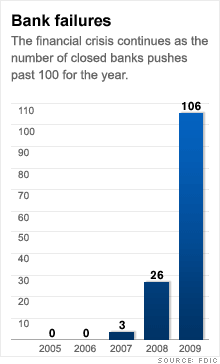
Bank failures stack up: Now 106 for 2009
http://money.cnn.com/2009/10/23/news/economy/bank_failure/index.htm
Banks in Florida, Georgia, Illinois, Minnesota and Wisconsin, were shuttered, costing the FDIC an estimated $356.6 million.
By Julianne Pepitone, CNNMoney.com staff reporter
Last Updated: October 23, 2009: 8:14 PM ET
NEW YORK (CNNMoney.com) -- The tally of bank failures easily broke past the No. 100 milestone on Friday night, with regulators announcing the year's 106th closure.
That's more than four times the number that were closed in 2008, and the highest total since 1992, when 181 banks failed.
Earlier on Friday evening the dubious honor of the 100th failure went to Partners Bank, of Naples, Fla., which had $65.5 million in assets, according to the Federal Deposit Insurance Corp.
The 101st failure was American United Bank, of Lawrenceville, Ga., which had $111 million in assets.
The 102nd failure was another Naples, Fla., institution: Hillcrest Bank Florida, which had $83 million in assets.
The 103rd closure was Bradenton, Fla.-based Flagship National Bank, with $190 million in assets.
The 104th was Bank of Elmwood, based in Racine, Wis., which had $327.4 million in assets.
The 105th failure was Riverview Community Bank of Otsego, Minn., with $108 million in assets.
The 106th failure was First Dupage Bank in Westmont, Ill., which had $279 million in assets.
Customers of all seven banks are protected, however. The Federal Deposit Insurance Corp., which has insured bank deposits since the Great Depression, covers customer accounts up to $250,000. This is funded through premiums paid by member banks.
In fact, to reassure borrowers, FDIC chair Sheila Bair posted a video message to the agency's Web site, saying "for the insured depositor, a bank failure is a non-event."
Still, Bair cautioned that "until the healing process is complete, there will be more bank failures."
What happens to the banks. Fort Lauderdale, Fla.-based Stonegate Bank will assume control of all Partners Bank's $64.9 million in deposits. It will also take over Hillcrest Bank's $84 million in deposits. The two branches of Partners Bank and six branches of Hillcrest will reopen on Monday as branches of Stonegate.
Moultrie, Ga.-based Ameris Bank will pay the FDIC a premium of 1.02% to take control of American United's $101 million in deposits. The FDIC and Ameris Bank entered into a loss-share transaction on $92 million of American United's assets, an agreement in which Ameris will share in the losses on the assets covered.
The single branch of American United Bank will reopen on Monday as a branch of Ameris.
Lake City, Fla.-based First Federal Bank will take over all of Flagship National Bank's $175 million in deposits. The four branches of Flagship will reopen Monday as branches of First Federal.
Bank of Elmwood's $273.2 million in deposits are now controlled by Tri City National Bank, based in Oak Creek, Wis. The five branches of Bank of Elmwood will reopen on Saturday as branches of Tri City.
Stillwater, Minn.-based Central Bank will take control of Riverview Community Bank's $80 million in deposits. The FDIC and Central Bank entered into a loss-share transaction on $75 million of Riverview's assets.
First Dupage Bank's $254 million in deposits are now being handled by First Midwest Bank of Itasca, Ill. The FDIC and First Midwest Bank entered into a loss-share transaction on approximately $247 million of First Dupage Bank's assets. The sole First Dupage branch will reopn Saturday as an outpost of First Midwest.
The failure of the six banks will cost the Deposit Insurance Fund an estimated $356.6 million, according to the FDIC.
Why regional banks are failing. While larger financial institutions have received aid from the federal government, smaller banks have found themselves left adrift. Like their larger counterparts, many of these banks made risky loans to individuals and real estate developers during the boom years and are now facing large numbers of defaults as the recession drags on.
Rising unemployment has made it difficult for many individuals to keep up with expenses, and businesses are feeling the crunch of consumers' reduced spending power. As a result, regional banks are left holding loans their customers can't repay.
Problem banks list looms. The FDIC keeps a list of "problem banks," though it does not disclose the names to the general public out of fear that depositors at those institutions may prompt a "run on the bank."
In June, the agency said 416 banks were at risk of failure -- the highest level in 15 years.
It's a whopping figure, to be sure. But even as the pace of failures accelerates, 2009's numbers remain far from what happened during the savings and loan crisis two decades ago. More than 1,900 financial institutions failed from 1987-1991, peaking at 534 closures in 1989.
Federal coffers running dry. An average of 10 banks have failed per month this year, and the federal coffer is thinning under the massive strain. The fund now stands at $7.5 billion, down significantly from $45 billion a year ago.
When the FDIC factors in expected closures, the agency says the fund is in the red and will likely remain there through 2012. Bank failure costs are expected to total $100 billion over the next four years, leaving regulators strapped for cash.
Last month, the FDIC discussed how to raise quick cash to replenish the fund. The agency proposed that banks prepay their deposit insurance premiums for the next three years. To top of page
First Published: October 23, 2009: 5:40 PM ET
__________
For an interactive map, see http://money.cnn.com/news/storysupplement/economy/bank_failures/index.htm
Friday, October 23, 2009
Bank failures hit 100 for year

http://www.marketwatch.com/story/bank-failures-hit-100-for-year-2009-10-23
By Greg Morcroft, MarketWatch
NEW YORK (MarketWatch) -- A Naples, Fla., bank failed Friday, marking the first year since 1992 that at least 100 have gone under
Experts suggest we could be no more than 10% of the way through this cycle of bank collapses, which is sure to be the worst run of closures since the Great Depression.
The parade of bank failures continued on Friday as the FDIC took control of Partners Bank of Naples after it was closed by the Office of Thrift Supervision. See http://www.marketwatch.com/story/california-bank-99th-to-fail-in-us-in-2009-2009-10-16.
So far 100 banks have failed in 2009. See FDIC timeline of 2009's failed banks.
CreditSights, which tracks the dismal data, predicts that in the current cycle, from 2008 through 2011, as many as 1,100 banks will fail. That would wipe out 13.4% of all U.S. banks, representing 7% of U.S. banking assets.
The last year in which the FDIC had that many banks to deal with was in 1992, at the tail end of the last real estate crisis. The FDIC rescued 122 in 1992, according to Keefe, Bruyette & Woods researchers.
The increasing stream of bank failures is likely to run through 2011 according to some industry experts, as the fallout from the credit crisis continues.
The panic that started in 2007 as a credit crisis quickly morphed into a full blown residential real estate collapse. The problems blossomed as prices on mortgage securities backed by ill-conceived loans then collapsed, triggering capital destruction at banks and a fear among firms to lend to each other.
The crisis worsened as tighter credit forced firms to lay off millions of workers, hitting retailers hard and triggering further spikes in credit card and mortgage defaults.
Most of the high profile large banks likely to fail already have, and the backlog of troubled banks now is concentrated at the regional and community level, and is weighed down by commercial real estate and construction loans.
Many smaller banks gorged on commercial real estate lending in the go-go 2000s, amid low interest rates and rising property values.
The fallout has been fast, and furious.
CreditSights' data show that commercial real estate loans made up almost half of all loans at most (80%) of the banks the research firm identified as troubled.
"Another wave of prolonged losses driven by weakness in commercial real estate could prove catastrophic to many of these weakened banks," CreditSights said.
FDIC-insured institutions have set aside just over $338 billion in provisions for loan losses during the past six quarters, an amount that is about four times larger than their provisions during the prior six quarter period, FDIC data show.
"While banks and thrifts are now well along in the process of loss recognition and balance sheet repair, the process will continue well into next year, especially for commercial real estate," FDIC chief Sheila Bair told Congress last week.
As a result, she said, the number of problem institutions increased significantly, to more than 400 during the second quarter.
Now, with unemployment near 10% and credit card default rates about the same, prime mortgage delinquencies are rising, stoking worries among the nation's banks that despite rising stock markets, fundamental banking industry health remains elusive.
Hundreds of billions of dollars of government support is helping to keep the biggest banks afloat, but many of the nation's smaller regional and community banks face failure.
"We expect the numbers of problem institutions to increase and bank failures to remain high for the next several quarters," Bair said.
That's created a devilishly vexing issue for the FDIC, the federal agency charged with making depositors whole.
10% of U.S. banks could fail
Before Friday's bank failures, the year-to-date total assets of the failed banks was $107.14 billion.
By comparison, the nation's four largest banks, excluding former investment banks Morgan Stanley and Goldman Sachs, Bank of America, J.P. Morgan Chase, Citigroup and Wells Fargo, have average annual revenue of about $100 billion.
By contrast, according to the FDIC, during the Great Depression, about 9,100 banks failed between 1931 and 1934 representing a full one-third of the nation's then total banking system.
In modern times, the savings and loan crisis of the late 1980s and early 1990s, defined by the years 1988 through 1992, saw 818 banks, or just under 5% of the industry at the time. The 1988-1992 periods saw 4.4% of the banking industry's assets lost, according to data from CreditSights and the FDIC.
As in all crises, some areas fare worse than others for various reasons.
In this cycle, Georgia has been hit hardest, with 19 failures, followed by Illinois with 16, and California with 10.
By CreditSights estimates, Georgia, Florida and Illinois have the most potentially troubled banks among the states, followed by banks, followed by Texas, Minnesota, Washington State and California.
But if there is a bright side, it's that some of the nation's well-managed smaller banks stand to benefit from picking up assets on the cheap.
"We continue to believe a select group of regional banks with sufficient capital, credit quality, and management talent stand to benefit by expanding their banking franchise through either rolling up failed institutions or acquiring market share and/or key lenders from the dislocation," analysts at Keefe Bruyette & Woods said earlier this month. See story about how regional banks are taking advantage of competitors' failures.
FDIC faces tough calls
The FDIC is facing its own money issues, as its Deposit Insurance Fund, which it uses to pay depositors' claims, fell to just $10.4 billion at the end of the second quarter. The FDIC estimates that its total cost for the 98 bank closings through Friday at $26.44 billion.
The problem the FDIC faces is that none of its options to raise money to fund its Deposit Insurance Fund are too appealing.
On the one hand, the FDIC has already hit banks with a special assessment earlier this year to beef up the fund, but that's not nearly enough to fill the expected void.
Also earlier this year, the agency's board approved a proposal to have the nation's banks prepay 3 three years of insurance premiums, but that too is unlikely to fill the gap the fund faces under CreditSights worst-case scenario.
And, while the FDIC could tap an emergency $500 billion line of credit from the U.S. Treasury, the agency appears loathe to do that given the likely political backlash.
"In the FDIC's view, requiring that institutions prepay assessments is also preferable to borrowing from the U.S. Treasury. Prepayment of assessments ensures that the deposit insurance system remains directly industry-funded and it preserves Treasury borrowing for emergency situations," FDIC chair Sheila Bair told Congress in last week's testimony. See Bair's full testimony.
"Additionally," she added, "the FDIC believes that, unlike borrowing from the Treasury or the FFB, requiring prepaid assessments would not count toward the public debt limit."
CreditSights' analysts agreed that a Treasury deal could prove politically tricky, and the debate sure to surround it could actually prolong the crisis,
"A request to draw down on the Treasury line may become yet another political football pitting banking interests versus small business interests. These types of debates seem to have in the past delayed regulatory action and this could be the case as well with an undercapitalized FDIC," the firm said.
Greg Morcroft is MarketWatch's financial editor in New York.
Sunday, October 11, 2009
Failures of Small Banks Grow, Straining F.D.I.C.
http://www.nytimes.com/2009/10/11/business/economy/11banks.html
By ERIC DASH
Published: October 10, 2009
A year after Washington rescued the banks considered too big to fail, the ones deemed too small to save are approaching a grim milestone: the 100th bank failure of 2009.
In what has become a ritual, the Federal Deposit Insurance Corporation has swooped down on a handful of troubled lenders almost every Friday, seizing 98 since January alone and putting their assets into the hands of another bank.
While the parade of failures still represents a mere fraction of America’s small banks, it underscores a growing divide between them and large institutions like Goldman Sachs, JPMorgan Chase and U.S. Bancorp, which are slowly growing stronger as the economy improves.
Burdened by worsening commercial real estate loans, many small banks’ troubles are just beginning. Many analysts say that the now-toxic loans could sink hundreds of small lenders over the next few years and place a significant drag on the economy.
Already, the bank failures are placing enormous strain on the F.D.I.C. and its fund, which keeps depositors whole. Flush with more than $50 billion only two years ago, the fund recently fell into the red.
The prospect of more failures has led the F.D.I.C. to seek new ways to replenish the fund with higher and earlier payments by healthy banks, even after setting aside reserves for future losses.
The initial wave of failures has also unsettled some communities, even though most of the troubled institutions have been bought by other banks rather than shuttered. While deposits are safe thanks to federal insurance, the new buyers often do not have the same ties to local businesses as the former owners.
In some cases, they tighten lending and make it harder for longtime customers to obtain loans or favorable terms. In other cases, managers of the new bank make other changes, like ending offers for high-interest certificates of deposit and calling in certain lines of credit. In the longer term, some new owners are likely to close branches of the bank they have acquired in order to cut costs.
“In the near term, bank failures can be painful,” said Sheila C. Bair, the chairwoman of the Federal Deposit Insurance Corporation. But a bank that is teetering on collapse is not going to lend, she said, and “that’s not good for the economy.”
Regulators expect closures to ripple through hundreds of small banks over the next couple of years, especially in the Midwest and Southeast, where lenders have been hard hit by the recession.
These banks loaded their balance sheets with loans to home builders and other property developers to make up for lost business in credit card and mortgage lending that bigger competitors wrested away. They eased their lending standards during the boom years and made big bets on new housing developments, strip malls and office projects. Now, many of those deals are falling apart, and the lenders are scrambling to raise capital to cushion the losses.
“These banks were big enough that they could do loans that were fairly sizable,” said John R. Chrin, a former investment banker who is now an executive in residence at Lehigh University. “If they go bad, they are toast.”
The pace of bank failures is expected to accelerate in the coming months. There were just 25 bank failures in 2008 and just 10 in the five previous years. But in September alone, regulators took over 11 banks in nine states that were saddled with soured commercial real estate loans, from Corus Bank, a $7 billion construction lender based in Chicago that financed projects across the country, to Brickwell Community Bank in Woodbury, Minn., which had just a single branch and $72.6 million in assets.
Three others were taken over this month, including Warren Bank, a small lender just outside Detroit. Regulators swept into the offices on a recent Friday night after brokering a sale to Huntington Bancshares of Ohio, a regional bank with a big presence in Michigan.
By Saturday morning, Huntington had taken control of the bank’s computer systems, started reassuring depositors and placed vinyl signs with its name outside some of the Warren Bank branches.
Even though the process went smoothly, customers still found it unnerving.
“People expect companies to go out of business, not banks,” said James R. Fouts, the mayor of Warren, Mich., whose working class city of 140,000 has had a front row seat to the collapses of General Motors and Chrysler. “That is something that you expect to hear about in the Great Depression, and it further exacerbates the feeling that financially, the country is not yet in stable shape.”
The banking system may also be facing a long recovery. About $870 billion, or roughly half of the industry’s $1.8 trillion of commercial real estate loans, now sit on the balance sheets of small and medium-size banks like these, according to an analysis by Foresight Analytics, a research firm. For most of the banks, this represents the biggest and riskiest part of their loan portfolio, since they lack the trading streams and fee businesses of their larger rivals. And as a group, small banks have written off only a tiny percentage of the losses that analysts expect them to incur.
In fact, applying only the commercial real estate loss assumptions that federal regulators used during the stress tests for the big banks last spring, Foresight analysts estimated that as many as 581 small banks were at risk of collapse by 2011.
By contrast, commercial real estate losses put none of the nation’s 19 biggest banks, and only about 5 of the next 100 largest lenders, in jeopardy.
Even Citigroup, the biggest and most troubled of the banks, has a relatively small portion of its loans tied to commercial real estate and may begin to recover faster than other rivals.
Gerard Cassidy, a veteran banking analyst, said the problems call to mind the wave of small bank failures in Texas and New England two decades ago during the savings and loan crisis — only on a national scale.
Back then, regulators closed more than 700 lenders in those regions. Today, Mr. Cassidy projects that as many as 1,000 small banks will close over the next few years and that their losses will be more severe. “It’s a repeat on steroids,” he said.
But Ms. Bair said the savings-and-loan crisis far surpassed the current situation. “We aren’t anywhere close to that today, and based on current projections, I don’t think we will get near that pace,” she said.
Even if hundreds of banks collapsed, they would not threaten to bring the financial system to its knees.
Together, the 8,176 smallest banks control just 15 percent of the industry’s $13.3 trillion in assets. And thanks to the expansion of the government’s deposit insurance program, regulators also appear to have squelched the threat of bank runs that brought down IndyMac Bank and Washington Mutual last year.
Consumer deposits are now insured up to $250,000 per account, and the F.D.I.C. offers unlimited coverage on noninterest payroll accounts used by businesses.
“We’ve passed the panic stage,” said Frederick Cannon, the chief equity analyst at Keefe, Bruyette & Woods in New York.
What is more, community bank supporters say the bulk of their institutions will emerge from the crisis stronger. “The community banks are picking up market share,” said Camden R. Fine, the head of the Independent Community Bankers of America.
“People are angry with all the shenanigans on Wall Street,” he said. “They believe their money stays local when they put it in a community bank, rather than sent off to Never-Never land.”
By ERIC DASH
Published: October 10, 2009
A year after Washington rescued the banks considered too big to fail, the ones deemed too small to save are approaching a grim milestone: the 100th bank failure of 2009.
In what has become a ritual, the Federal Deposit Insurance Corporation has swooped down on a handful of troubled lenders almost every Friday, seizing 98 since January alone and putting their assets into the hands of another bank.
While the parade of failures still represents a mere fraction of America’s small banks, it underscores a growing divide between them and large institutions like Goldman Sachs, JPMorgan Chase and U.S. Bancorp, which are slowly growing stronger as the economy improves.
Burdened by worsening commercial real estate loans, many small banks’ troubles are just beginning. Many analysts say that the now-toxic loans could sink hundreds of small lenders over the next few years and place a significant drag on the economy.
Already, the bank failures are placing enormous strain on the F.D.I.C. and its fund, which keeps depositors whole. Flush with more than $50 billion only two years ago, the fund recently fell into the red.
The prospect of more failures has led the F.D.I.C. to seek new ways to replenish the fund with higher and earlier payments by healthy banks, even after setting aside reserves for future losses.
The initial wave of failures has also unsettled some communities, even though most of the troubled institutions have been bought by other banks rather than shuttered. While deposits are safe thanks to federal insurance, the new buyers often do not have the same ties to local businesses as the former owners.
In some cases, they tighten lending and make it harder for longtime customers to obtain loans or favorable terms. In other cases, managers of the new bank make other changes, like ending offers for high-interest certificates of deposit and calling in certain lines of credit. In the longer term, some new owners are likely to close branches of the bank they have acquired in order to cut costs.
“In the near term, bank failures can be painful,” said Sheila C. Bair, the chairwoman of the Federal Deposit Insurance Corporation. But a bank that is teetering on collapse is not going to lend, she said, and “that’s not good for the economy.”
Regulators expect closures to ripple through hundreds of small banks over the next couple of years, especially in the Midwest and Southeast, where lenders have been hard hit by the recession.
These banks loaded their balance sheets with loans to home builders and other property developers to make up for lost business in credit card and mortgage lending that bigger competitors wrested away. They eased their lending standards during the boom years and made big bets on new housing developments, strip malls and office projects. Now, many of those deals are falling apart, and the lenders are scrambling to raise capital to cushion the losses.
“These banks were big enough that they could do loans that were fairly sizable,” said John R. Chrin, a former investment banker who is now an executive in residence at Lehigh University. “If they go bad, they are toast.”
The pace of bank failures is expected to accelerate in the coming months. There were just 25 bank failures in 2008 and just 10 in the five previous years. But in September alone, regulators took over 11 banks in nine states that were saddled with soured commercial real estate loans, from Corus Bank, a $7 billion construction lender based in Chicago that financed projects across the country, to Brickwell Community Bank in Woodbury, Minn., which had just a single branch and $72.6 million in assets.
Three others were taken over this month, including Warren Bank, a small lender just outside Detroit. Regulators swept into the offices on a recent Friday night after brokering a sale to Huntington Bancshares of Ohio, a regional bank with a big presence in Michigan.
By Saturday morning, Huntington had taken control of the bank’s computer systems, started reassuring depositors and placed vinyl signs with its name outside some of the Warren Bank branches.
Even though the process went smoothly, customers still found it unnerving.
“People expect companies to go out of business, not banks,” said James R. Fouts, the mayor of Warren, Mich., whose working class city of 140,000 has had a front row seat to the collapses of General Motors and Chrysler. “That is something that you expect to hear about in the Great Depression, and it further exacerbates the feeling that financially, the country is not yet in stable shape.”
The banking system may also be facing a long recovery. About $870 billion, or roughly half of the industry’s $1.8 trillion of commercial real estate loans, now sit on the balance sheets of small and medium-size banks like these, according to an analysis by Foresight Analytics, a research firm. For most of the banks, this represents the biggest and riskiest part of their loan portfolio, since they lack the trading streams and fee businesses of their larger rivals. And as a group, small banks have written off only a tiny percentage of the losses that analysts expect them to incur.
In fact, applying only the commercial real estate loss assumptions that federal regulators used during the stress tests for the big banks last spring, Foresight analysts estimated that as many as 581 small banks were at risk of collapse by 2011.
By contrast, commercial real estate losses put none of the nation’s 19 biggest banks, and only about 5 of the next 100 largest lenders, in jeopardy.
Even Citigroup, the biggest and most troubled of the banks, has a relatively small portion of its loans tied to commercial real estate and may begin to recover faster than other rivals.
Gerard Cassidy, a veteran banking analyst, said the problems call to mind the wave of small bank failures in Texas and New England two decades ago during the savings and loan crisis — only on a national scale.
Back then, regulators closed more than 700 lenders in those regions. Today, Mr. Cassidy projects that as many as 1,000 small banks will close over the next few years and that their losses will be more severe. “It’s a repeat on steroids,” he said.
But Ms. Bair said the savings-and-loan crisis far surpassed the current situation. “We aren’t anywhere close to that today, and based on current projections, I don’t think we will get near that pace,” she said.
Even if hundreds of banks collapsed, they would not threaten to bring the financial system to its knees.
Together, the 8,176 smallest banks control just 15 percent of the industry’s $13.3 trillion in assets. And thanks to the expansion of the government’s deposit insurance program, regulators also appear to have squelched the threat of bank runs that brought down IndyMac Bank and Washington Mutual last year.
Consumer deposits are now insured up to $250,000 per account, and the F.D.I.C. offers unlimited coverage on noninterest payroll accounts used by businesses.
“We’ve passed the panic stage,” said Frederick Cannon, the chief equity analyst at Keefe, Bruyette & Woods in New York.
What is more, community bank supporters say the bulk of their institutions will emerge from the crisis stronger. “The community banks are picking up market share,” said Camden R. Fine, the head of the Independent Community Bankers of America.
“People are angry with all the shenanigans on Wall Street,” he said. “They believe their money stays local when they put it in a community bank, rather than sent off to Never-Never land.”
Saturday, October 3, 2009
Bank failure tally tops 98 in 2009
http://money.cnn.com/2009/10/02/news/economy/bank_failure/index.htm
Three regional banks failed in Michigan, Minnesota and Colorado, raising the national tally. failures. The closures will cost FDIC $293.3 million.
By Hibah Yousuf, CNNMoney.com contributing writer
Last Updated: October 2, 2009: 9:39 PM ET
NEW YORK (CNNMoney.com) -- Three regional banks were closed by regulators on Friday evening, bringing the 2009 tally to 98.
Warren Bank, based in Warren, Mich., Jennings State Bank in Spring Grove, Minn., and Southern Colorado National Bank, Pueblo, Colo., were the latest to go down.
Customers of all three banks are protected, however. The Federal Deposit Insurance Corp., which has insured bank deposits since the Great Depression, currently covers customer accounts up to $250,000.
Michigan failure. The Huntington National Bank in Columbus, Ohio, will assume all of Warren's $501 million deposits, according to the FDIC. The bank will also purchase $83 million of the failed bank's $538 million in assets; the FDIC will retain the remainder for later disposition.
Warren Bank, the second bank failure in Michigan this year, will cost the FDIC an estimated $275 million.
Minnesota failure. Central Bank of Stillwater, Minn., will assume all of Jennings State Bank's $52.4 million deposits, according to the FDIC, and will purchase "essentially all" of the failed bank's $56.3 million in assets.
The FDIC said it entered a loss-share agreement with the acquiring bank for $37.7 million of the failed bank's assets. Such agreements are becoming more common place as the FDIC seeks leverage to convince stronger banks to take on failing institutions' risky asset portfolios.
This is the fourth time a Minnesota financial institution has been closed by regulators during 2009. The closure will cost the FDIC an estimated $11.7 million.
Colorado failure. Legacy Bank, Wiley, Colo., will assume all of the deposits of Southern Colorado National Bank's $31.9 million deposits. Legacy also agreed to buy nearly all of the $39.5 million of Southern Colorado's assets.
The FDIC signed a loss-share agreement with Legacy for $25.5 million of the failed Colorado bank's assets.
The closure marks the third bank failure for Colorado this year. The cost to the FDIC will total $6.6. million.
Accounts stay open. Customers of all three failed banks can access their money over the weekend by writing checks or using ATMs or debit cards. Checks will continue to be processed, and borrowers should make mortgage and loan payments as usual.
All branches of the failed banks will reopen on Saturday, but under their new monikers. Customers should continue using their existing branches until they receive notices that the takeovers have been completed.
An average of 10 banks have failed per month this year, nearly four times the number that failed in 2008. It's the highest tally since 1992, when 181 banks failed.
This year's failures have reduced the FDIC's insurance fund to $10.1 billion from $45 billion a year ago. In total, Friday's closures will cost FDIC $293.3 million.
Faced with dwindling funds, the FDIC discussed how to raise money to restock the fund earlier this week. The agency proposed that banks prepay their deposit insurance premiums for the next three years.
First Published: October 2, 2009: 6:53 PM ET
Three regional banks failed in Michigan, Minnesota and Colorado, raising the national tally. failures. The closures will cost FDIC $293.3 million.
By Hibah Yousuf, CNNMoney.com contributing writer
Last Updated: October 2, 2009: 9:39 PM ET
NEW YORK (CNNMoney.com) -- Three regional banks were closed by regulators on Friday evening, bringing the 2009 tally to 98.
Warren Bank, based in Warren, Mich., Jennings State Bank in Spring Grove, Minn., and Southern Colorado National Bank, Pueblo, Colo., were the latest to go down.
Customers of all three banks are protected, however. The Federal Deposit Insurance Corp., which has insured bank deposits since the Great Depression, currently covers customer accounts up to $250,000.
Michigan failure. The Huntington National Bank in Columbus, Ohio, will assume all of Warren's $501 million deposits, according to the FDIC. The bank will also purchase $83 million of the failed bank's $538 million in assets; the FDIC will retain the remainder for later disposition.
Warren Bank, the second bank failure in Michigan this year, will cost the FDIC an estimated $275 million.
Minnesota failure. Central Bank of Stillwater, Minn., will assume all of Jennings State Bank's $52.4 million deposits, according to the FDIC, and will purchase "essentially all" of the failed bank's $56.3 million in assets.
The FDIC said it entered a loss-share agreement with the acquiring bank for $37.7 million of the failed bank's assets. Such agreements are becoming more common place as the FDIC seeks leverage to convince stronger banks to take on failing institutions' risky asset portfolios.
This is the fourth time a Minnesota financial institution has been closed by regulators during 2009. The closure will cost the FDIC an estimated $11.7 million.
Colorado failure. Legacy Bank, Wiley, Colo., will assume all of the deposits of Southern Colorado National Bank's $31.9 million deposits. Legacy also agreed to buy nearly all of the $39.5 million of Southern Colorado's assets.
The FDIC signed a loss-share agreement with Legacy for $25.5 million of the failed Colorado bank's assets.
The closure marks the third bank failure for Colorado this year. The cost to the FDIC will total $6.6. million.
Accounts stay open. Customers of all three failed banks can access their money over the weekend by writing checks or using ATMs or debit cards. Checks will continue to be processed, and borrowers should make mortgage and loan payments as usual.
All branches of the failed banks will reopen on Saturday, but under their new monikers. Customers should continue using their existing branches until they receive notices that the takeovers have been completed.
An average of 10 banks have failed per month this year, nearly four times the number that failed in 2008. It's the highest tally since 1992, when 181 banks failed.
This year's failures have reduced the FDIC's insurance fund to $10.1 billion from $45 billion a year ago. In total, Friday's closures will cost FDIC $293.3 million.
Faced with dwindling funds, the FDIC discussed how to raise money to restock the fund earlier this week. The agency proposed that banks prepay their deposit insurance premiums for the next three years.
First Published: October 2, 2009: 6:53 PM ET
Sunday, September 27, 2009
Georgia bank is 95th U.S. failure of 2009
http://www.marketwatch.com/story/georgia-bank-is-95th-us-failure-of-2009-2009-09-25
By John Letzing, MarketWatch
SAN FRANCISCO (MarketWatch) -- Atlanta-based Georgian Bank was closed by regulators on Friday, marking the 95th U.S. bank failure of the year as the credit crunch continues claiming victims.
Georgian Bank had $2 billion in assets and $2 billion in deposits as of July 24, according to the Federal Deposit Insurance Corp.
Columbia, S.C.-based First Citizens Bank and Trust Company Inc. has agreed to assume the failed bank's deposits, the FDIC said in a statement.
The FDIC estimated that the cost of the bank's failure to the federal deposit insurance fund will be $892 million.
Georgian Bank is the 19th Georgia bank to fail this year.
John Letzing is a MarketWatch reporter based in San Francisco.
By John Letzing, MarketWatch
SAN FRANCISCO (MarketWatch) -- Atlanta-based Georgian Bank was closed by regulators on Friday, marking the 95th U.S. bank failure of the year as the credit crunch continues claiming victims.
Georgian Bank had $2 billion in assets and $2 billion in deposits as of July 24, according to the Federal Deposit Insurance Corp.
Columbia, S.C.-based First Citizens Bank and Trust Company Inc. has agreed to assume the failed bank's deposits, the FDIC said in a statement.
The FDIC estimated that the cost of the bank's failure to the federal deposit insurance fund will be $892 million.
Georgian Bank is the 19th Georgia bank to fail this year.
John Letzing is a MarketWatch reporter based in San Francisco.
Tuesday, September 22, 2009
FDIC May Borrow From Banks
http://www.nytimes.com/2009/09/22/business/22bailout.html
By STEPHEN LABATON
Published: September 21, 2009
WASHINGTON — Tired of the government bailing out banks? Get ready for this: officials may soon ask banks to bail out the government.
Senior regulators say they are seriously considering a plan to have the nation’s healthy banks lend billions of dollars to rescue the insurance fund that protects bank depositors. That would enable the fund, which is rapidly running out of money because of a wave of bank failures, to continue to rescue the sickest banks.
The plan, strongly supported by bankers and their lobbyists, would be a major reversal of fortune.
A hallmark of the financial crisis has been the decision by successive administrations over the last year to lend hundreds of billions of taxpayer dollars to large and small banks.
“It’s a nice irony,” said Karen Shaw Petrou, managing partner of Federal Financial Analytics, a consulting company. “Like so much of this crisis, this is an issue that involves the least worst options.”
Bankers and their lobbyists like the idea because it is more attractive than the alternatives: yet another across-the-board emergency assessment on them, or tapping an existing $100 billion credit line to the Treasury.
The Federal Deposit Insurance Corporation, which oversees the fund, is said to be reluctant to use its authority to borrow from the Treasury.
Under the law, the F.D.I.C. would not need permission from the Treasury to tap into a credit line of up to $100 billion. But such a step is said to be unpalatable to Sheila C. Bair, the agency chairwoman whose relations with the Treasury secretary, Timothy F. Geithner, have been strained.
“Sheila Bair would take bamboo shoots under her nails before going to Tim Geithner and the Treasury for help,” said Camden R. Fine, president of the Independent Community Bankers. “She’d do just about anything before going there.”
Bankers worry that a special assessment of $5 billion to $10 billion over the next six months would crimp their profits and could push a handful of banks into deeper financial trouble or even receivership. And any new borrowing from the Treasury would be construed as a taxpayer bailout that could open the industry to a political reaction, resulting in a wave of restrictions like fresh limits on executive pay.
Any populist furor could be avoided, the thinking goes, if the government borrows instead from the banks.
“Borrowing from healthy banks, instead of the Treasury, has the advantage of keeping this in the family,” said Karen M. Thomas, executive vice president of government relations at the Independent Community Bankers of America, a trade group representing about 5,000 banks. “It is much better for perceptions than having the fund borrow from somewhere else.”
Ultimately, officials say, the deposit insurance corporation could settle on a plan that replenishes the insurance fund by doing some of both: borrowing from healthy banks to shore up the shorter-term liquidity needs of the fund, and imposing a special fee on banks to increase the longer-term capital level of the fund.
Since January the F.D.I.C. has seized 94 failing banks, causing a rapid decline in the deposit insurance fund. Despite a special assessment imposed on banks a few months ago to keep the fund afloat, its cash balance now stands at about $10 billion, a third of its size at the start of the year. (Another $32 billion has been set aside for failures that officials expect to occur in the coming months.)
The fund, which stands behind $4.8 trillion in insured deposits, could be wiped out by the failure of a single large bank, although the deposit insurance corporation could always seek a taxpayer bailout by borrowing from the Treasury to stay afloat.
Officials say that the F.D.I.C. will issue a proposed plan next week to begin to restore the financial health of the ailing fund.
There is no consensus among the five board members, consisting of Ms. Bair, two other F.D.I.C. officials, and the heads of the Office of Thrift Supervision and the Office of the Comptroller of the Currency. Others may propose novel ways to replenish the fund, for example, by asking the banks to prepay the premiums that they were planning to make next year.
Borrowing from the industry is allowed under an obscure provision of a 1991 law adopted during the savings and loan crisis. The lending banks would receive bonds from the government at an interest rate that would be set by the Treasury secretary and ultimately would be paid by the rest of the industry. The bonds would be listed as an asset on the books of the banks.
By STEPHEN LABATON
Published: September 21, 2009
WASHINGTON — Tired of the government bailing out banks? Get ready for this: officials may soon ask banks to bail out the government.
Senior regulators say they are seriously considering a plan to have the nation’s healthy banks lend billions of dollars to rescue the insurance fund that protects bank depositors. That would enable the fund, which is rapidly running out of money because of a wave of bank failures, to continue to rescue the sickest banks.
The plan, strongly supported by bankers and their lobbyists, would be a major reversal of fortune.
A hallmark of the financial crisis has been the decision by successive administrations over the last year to lend hundreds of billions of taxpayer dollars to large and small banks.
“It’s a nice irony,” said Karen Shaw Petrou, managing partner of Federal Financial Analytics, a consulting company. “Like so much of this crisis, this is an issue that involves the least worst options.”
Bankers and their lobbyists like the idea because it is more attractive than the alternatives: yet another across-the-board emergency assessment on them, or tapping an existing $100 billion credit line to the Treasury.
The Federal Deposit Insurance Corporation, which oversees the fund, is said to be reluctant to use its authority to borrow from the Treasury.
Under the law, the F.D.I.C. would not need permission from the Treasury to tap into a credit line of up to $100 billion. But such a step is said to be unpalatable to Sheila C. Bair, the agency chairwoman whose relations with the Treasury secretary, Timothy F. Geithner, have been strained.
“Sheila Bair would take bamboo shoots under her nails before going to Tim Geithner and the Treasury for help,” said Camden R. Fine, president of the Independent Community Bankers. “She’d do just about anything before going there.”
Bankers worry that a special assessment of $5 billion to $10 billion over the next six months would crimp their profits and could push a handful of banks into deeper financial trouble or even receivership. And any new borrowing from the Treasury would be construed as a taxpayer bailout that could open the industry to a political reaction, resulting in a wave of restrictions like fresh limits on executive pay.
Any populist furor could be avoided, the thinking goes, if the government borrows instead from the banks.
“Borrowing from healthy banks, instead of the Treasury, has the advantage of keeping this in the family,” said Karen M. Thomas, executive vice president of government relations at the Independent Community Bankers of America, a trade group representing about 5,000 banks. “It is much better for perceptions than having the fund borrow from somewhere else.”
Ultimately, officials say, the deposit insurance corporation could settle on a plan that replenishes the insurance fund by doing some of both: borrowing from healthy banks to shore up the shorter-term liquidity needs of the fund, and imposing a special fee on banks to increase the longer-term capital level of the fund.
Since January the F.D.I.C. has seized 94 failing banks, causing a rapid decline in the deposit insurance fund. Despite a special assessment imposed on banks a few months ago to keep the fund afloat, its cash balance now stands at about $10 billion, a third of its size at the start of the year. (Another $32 billion has been set aside for failures that officials expect to occur in the coming months.)
The fund, which stands behind $4.8 trillion in insured deposits, could be wiped out by the failure of a single large bank, although the deposit insurance corporation could always seek a taxpayer bailout by borrowing from the Treasury to stay afloat.
Officials say that the F.D.I.C. will issue a proposed plan next week to begin to restore the financial health of the ailing fund.
There is no consensus among the five board members, consisting of Ms. Bair, two other F.D.I.C. officials, and the heads of the Office of Thrift Supervision and the Office of the Comptroller of the Currency. Others may propose novel ways to replenish the fund, for example, by asking the banks to prepay the premiums that they were planning to make next year.
Borrowing from the industry is allowed under an obscure provision of a 1991 law adopted during the savings and loan crisis. The lending banks would receive bonds from the government at an interest rate that would be set by the Treasury secretary and ultimately would be paid by the rest of the industry. The bonds would be listed as an asset on the books of the banks.
Saturday, September 19, 2009
Two Irwin Union Bank failures bring 2009 total to 94
http://www.marketwatch.com/story/irwin-union-bank-failures-bring-2009-total-to-94-2009-09-18
By John Letzing, MarketWatch
SAN FRANCISCO (MarketWatch) -- Two Irwin Union Bank subsidiaries in Kentucky and Indiana were closed by regulators Friday, bringing the total number of U.S. bank failures this year to 94 and punching an $850 million hole in the federal deposit insurance fund.
The Federal Deposit Insurance Corp. said that Irwin Union Bank and Trust Co. in Columbus, Ind., and Irwin Union Bank F.S.B. in Louisville, Ky., were each closed.
Irwin Union Bank and Trust Co. had $2.7 billion in assets and $2.1 billion in deposits as of Aug. 31, the FDIC said. Irwin Union Bank F.S.B. had $493 million in assets and $441 million in deposits as of Aug. 31.
Hamilton, Ohio-based First Financial Bank /quotes/comstock/15*!ffbc/quotes/nls/ffbc (FFBC 8.31, -0.05, -0.60%) has agreed to assume the failed banks' deposits. First Financial Bank said in a statement that assumption of the Irwin Union Bank subsidiaries brings with it 27 banking centers in nine states.
The effect on the subsidiaries' parent, bank holding company Irwin Financial Corp. /quotes/comstock/13*!ifc/quotes/nls/ifc (IFC 0.48, -0.02, -4.00%) , was not immediately clear. An external spokeswoman for the company was unable to comment. Shares of Irwin Financial tumbled more than 50% to 22 cents a share in late trading.
Irwin Financial had disclosed in a regulatory filing on Wednesday that it was told by the Federal Reserve Bank of Chicago and the Indiana Department of Financial Institutions that they disagreed with its view of the timing and recognition of certain loan losses at Irwin Union Bank and Trust Co., requiring it to submit amended reports to the FDIC.
The failures marked the first this year both in Indiana and Kentucky. However, bank failures have become a regular occurrence since the economic calamity late last year the ensuing credit crunch.
The FDIC said the last bank closed in Indiana was seized in 1992, while last closure in Kentucky occurred in 1991.
John Letzing is a MarketWatch reporter based in San Francisco.
By John Letzing, MarketWatch
SAN FRANCISCO (MarketWatch) -- Two Irwin Union Bank subsidiaries in Kentucky and Indiana were closed by regulators Friday, bringing the total number of U.S. bank failures this year to 94 and punching an $850 million hole in the federal deposit insurance fund.
The Federal Deposit Insurance Corp. said that Irwin Union Bank and Trust Co. in Columbus, Ind., and Irwin Union Bank F.S.B. in Louisville, Ky., were each closed.
Irwin Union Bank and Trust Co. had $2.7 billion in assets and $2.1 billion in deposits as of Aug. 31, the FDIC said. Irwin Union Bank F.S.B. had $493 million in assets and $441 million in deposits as of Aug. 31.
Hamilton, Ohio-based First Financial Bank /quotes/comstock/15*!ffbc/quotes/nls/ffbc (FFBC 8.31, -0.05, -0.60%) has agreed to assume the failed banks' deposits. First Financial Bank said in a statement that assumption of the Irwin Union Bank subsidiaries brings with it 27 banking centers in nine states.
The effect on the subsidiaries' parent, bank holding company Irwin Financial Corp. /quotes/comstock/13*!ifc/quotes/nls/ifc (IFC 0.48, -0.02, -4.00%) , was not immediately clear. An external spokeswoman for the company was unable to comment. Shares of Irwin Financial tumbled more than 50% to 22 cents a share in late trading.
Irwin Financial had disclosed in a regulatory filing on Wednesday that it was told by the Federal Reserve Bank of Chicago and the Indiana Department of Financial Institutions that they disagreed with its view of the timing and recognition of certain loan losses at Irwin Union Bank and Trust Co., requiring it to submit amended reports to the FDIC.
The failures marked the first this year both in Indiana and Kentucky. However, bank failures have become a regular occurrence since the economic calamity late last year the ensuing credit crunch.
The FDIC said the last bank closed in Indiana was seized in 1992, while last closure in Kentucky occurred in 1991.
John Letzing is a MarketWatch reporter based in San Francisco.
Friday, August 21, 2009
Regulators shut Guaranty Bank
http://www.philly.com/philly/wires/ap/business/20090821_ap_regulatorsshutguarantybank.html
MARCY GORDON
The Associated Press
WASHINGTON - Regulators on Friday shut down Guaranty Bank, a big Texas-based lender felled by losses on loans to homebuilders and borrowers, in the second-largest U.S. bank failure this year.
Guaranty's failure, along with those of three banks in Georgia and Alabama Friday, brought to 81 the number of U.S. bank failures in 2009, a mounting toll and the most in a year since 1992 at the height of the savings-and-loan crisis.
The Federal Deposit Insurance Corp. seized Guaranty Bank, with about $13 billion in assets and $12 billion in deposits, and sold all of its deposits and $12 billion of the assets to BBVA Compass, the U.S. division of Banco Bilbao Vizcaya Argentaria SA, Spain's second-largest bank. It was the first foreign bank to buy a failed U.S. bank. In addition, the FDIC agreed to share losses with BBVA on about $11 billion of Guaranty Bank's assets.
The collapse of Austin-based Guaranty Bank, whose parent company was Guaranty Financial Group Inc., was the 10th-largest bank failure in U.S. history. It is expected to cost the deposit insurance fund an estimated $3 billion.
The bank, with 162 branches in Texas and California, also suffered losses on mortgage-linked securities it bought from other banks.
Birmingham, Ala.-based BBVA Compass, with 600 branches from Florida to California, said the acquisition creates the 15th-largest commercial bank in the U.S., with about $49 billion in deposits. "This compelling transaction makes excellent strategic sense and represents an exciting growth opportunity for BBVA Compass as we continue to build the leading banking franchise in the high-growth Sunbelt region," Jose Maria Garcia Meyer, chairman of BBVA Compass, said in a statement.
In contrast to the big bank failures early in the financial crisis, many of the recently shuttered banks were undone not by exotic mortgage products but by garden-variety loans.
At the same time, a knot of big, complex banks collapsing in recent months is sapping billions from the federal deposit insurance fund that insures regular accounts up to $250,000, spurring regulators to court potential buyers from the world of private investment.
The FDIC last week seized Colonial Bank, a big lender in real estate development, and sold its $20 billion in deposits, 346 branches in five states and about $22 billion of its assets to BB&T Corp.
It was the biggest bank failure so far this year, and the sixth-largest in U.S. history, expected to cost the insurance fund $2.8 billion.
While losses on home mortgages may be leveling off, delinquencies on commercial real estate loans remain a hot spot of potential trouble, experts say. Many regional banks like Montgomery, Ala.-based Colonial hold large numbers of them. Many companies have shut down in the recession, vacating shopping malls and office buildings financed by the loans.
Also Friday, the FDIC seized two small banks in Georgia and one in Alabama: ebank, located in Atlanta, with $143 million in assets and $130 million in deposits; First Coweta, based in Newnan, Ga., with $167 million in assets and $155 million in deposits; and CapitalSouth Bank, based in Birmingham, Ala., with $617 million in assets and $546 million in deposits.
The agency expects bank failures will cost the fund around $70 billion through 2013. The fund stood at $13 billion , its lowest level since 1993 , at the end of March. It has slipped to 0.27 percent of total insured deposits, below the minimum mandated by Congress of 1.15 percent.
The costliest failure was the July 2008 seizure of big California lender IndyMac Bank, on which the fund is estimated to have lost $10.7 billion.
Among the 81 banks closed so far this year , compared with 25 last year and three in all of 2007 , were a stream of smaller institutions, many felled by losses on ordinary loans amid the souring economy, tumbling home prices and spiking unemployment. Their business was a far cry from the complex securities favored by Wall Street investment banks that precipitated the financial meltdown.
The average cost to the fund of a bank failure over the past 19 months has run higher than during the savings-and-loan debacle. That's partly due to smaller banks having higher resolution costs than larger ones, and because the steep decline in home prices that set off the current distress wasn't a factor in the earlier crisis, said Jim Wigand, deputy director of resolutions and receiverships at the FDIC.
Because of the tumble in prices, the loss rates on home loans and construction and development loans were higher for banks, with a domino effect on related securities, Wigand said.
Many of the smaller banks that failed in the recent run shared common attributes: rapid growth, heavy concentration of brokered deposits sold by securities firms to customers outside the bank's local area, and heavy lending in "hot markets" like Arizona, California, Florida and Nevada, noted Bert Ely, a banking consultant based in Alexandria, Va.
They are spread nationwide, though there is a concentration of banks in Georgia, where 17 have fallen since the beginning of last year, more than in any other state. That is a reflection of the local real estate market, whose distress has rippled throughout the economy there.
In Friday's other three closings, Stearns Bank, based in St. Cloud, Minn., agreed to buy the assets and deposits of ebank. United Bank, based in Zebulon, Ga., is assuming the deposits and $155 million of the assets of First Coweta; the FDIC will retain the rest for eventual sale. IberiaBank, based in Lafayette, La., is assuming the deposits and $589 million of the assets of CapitalSouth Bank.
Those failures are expected to cost the insurance fund an estimated $63 million for ebank, $48 million for First Coweta and $151 million for CapitalSouth Bank.
Last spring, the FDIC adopted a new system of special fees paid by U.S. banks and thrifts that shifted more of the burden to bigger institutions to help replenish the insurance fund.
The number of troubled banks on the agency's confidential list leaped to 305 in the first quarter, the highest number since 1994. Some analysts expect hundreds of banks to collapse over the next year or so.
Around 2,900 banks failed during the S&L crisis from 1980 through 1994.
MARCY GORDON
The Associated Press
WASHINGTON - Regulators on Friday shut down Guaranty Bank, a big Texas-based lender felled by losses on loans to homebuilders and borrowers, in the second-largest U.S. bank failure this year.
Guaranty's failure, along with those of three banks in Georgia and Alabama Friday, brought to 81 the number of U.S. bank failures in 2009, a mounting toll and the most in a year since 1992 at the height of the savings-and-loan crisis.
The Federal Deposit Insurance Corp. seized Guaranty Bank, with about $13 billion in assets and $12 billion in deposits, and sold all of its deposits and $12 billion of the assets to BBVA Compass, the U.S. division of Banco Bilbao Vizcaya Argentaria SA, Spain's second-largest bank. It was the first foreign bank to buy a failed U.S. bank. In addition, the FDIC agreed to share losses with BBVA on about $11 billion of Guaranty Bank's assets.
The collapse of Austin-based Guaranty Bank, whose parent company was Guaranty Financial Group Inc., was the 10th-largest bank failure in U.S. history. It is expected to cost the deposit insurance fund an estimated $3 billion.
The bank, with 162 branches in Texas and California, also suffered losses on mortgage-linked securities it bought from other banks.
Birmingham, Ala.-based BBVA Compass, with 600 branches from Florida to California, said the acquisition creates the 15th-largest commercial bank in the U.S., with about $49 billion in deposits. "This compelling transaction makes excellent strategic sense and represents an exciting growth opportunity for BBVA Compass as we continue to build the leading banking franchise in the high-growth Sunbelt region," Jose Maria Garcia Meyer, chairman of BBVA Compass, said in a statement.
In contrast to the big bank failures early in the financial crisis, many of the recently shuttered banks were undone not by exotic mortgage products but by garden-variety loans.
At the same time, a knot of big, complex banks collapsing in recent months is sapping billions from the federal deposit insurance fund that insures regular accounts up to $250,000, spurring regulators to court potential buyers from the world of private investment.
The FDIC last week seized Colonial Bank, a big lender in real estate development, and sold its $20 billion in deposits, 346 branches in five states and about $22 billion of its assets to BB&T Corp.
It was the biggest bank failure so far this year, and the sixth-largest in U.S. history, expected to cost the insurance fund $2.8 billion.
While losses on home mortgages may be leveling off, delinquencies on commercial real estate loans remain a hot spot of potential trouble, experts say. Many regional banks like Montgomery, Ala.-based Colonial hold large numbers of them. Many companies have shut down in the recession, vacating shopping malls and office buildings financed by the loans.
Also Friday, the FDIC seized two small banks in Georgia and one in Alabama: ebank, located in Atlanta, with $143 million in assets and $130 million in deposits; First Coweta, based in Newnan, Ga., with $167 million in assets and $155 million in deposits; and CapitalSouth Bank, based in Birmingham, Ala., with $617 million in assets and $546 million in deposits.
The agency expects bank failures will cost the fund around $70 billion through 2013. The fund stood at $13 billion , its lowest level since 1993 , at the end of March. It has slipped to 0.27 percent of total insured deposits, below the minimum mandated by Congress of 1.15 percent.
The costliest failure was the July 2008 seizure of big California lender IndyMac Bank, on which the fund is estimated to have lost $10.7 billion.
Among the 81 banks closed so far this year , compared with 25 last year and three in all of 2007 , were a stream of smaller institutions, many felled by losses on ordinary loans amid the souring economy, tumbling home prices and spiking unemployment. Their business was a far cry from the complex securities favored by Wall Street investment banks that precipitated the financial meltdown.
The average cost to the fund of a bank failure over the past 19 months has run higher than during the savings-and-loan debacle. That's partly due to smaller banks having higher resolution costs than larger ones, and because the steep decline in home prices that set off the current distress wasn't a factor in the earlier crisis, said Jim Wigand, deputy director of resolutions and receiverships at the FDIC.
Because of the tumble in prices, the loss rates on home loans and construction and development loans were higher for banks, with a domino effect on related securities, Wigand said.
Many of the smaller banks that failed in the recent run shared common attributes: rapid growth, heavy concentration of brokered deposits sold by securities firms to customers outside the bank's local area, and heavy lending in "hot markets" like Arizona, California, Florida and Nevada, noted Bert Ely, a banking consultant based in Alexandria, Va.
They are spread nationwide, though there is a concentration of banks in Georgia, where 17 have fallen since the beginning of last year, more than in any other state. That is a reflection of the local real estate market, whose distress has rippled throughout the economy there.
In Friday's other three closings, Stearns Bank, based in St. Cloud, Minn., agreed to buy the assets and deposits of ebank. United Bank, based in Zebulon, Ga., is assuming the deposits and $155 million of the assets of First Coweta; the FDIC will retain the rest for eventual sale. IberiaBank, based in Lafayette, La., is assuming the deposits and $589 million of the assets of CapitalSouth Bank.
Those failures are expected to cost the insurance fund an estimated $63 million for ebank, $48 million for First Coweta and $151 million for CapitalSouth Bank.
Last spring, the FDIC adopted a new system of special fees paid by U.S. banks and thrifts that shifted more of the burden to bigger institutions to help replenish the insurance fund.
The number of troubled banks on the agency's confidential list leaped to 305 in the first quarter, the highest number since 1994. Some analysts expect hundreds of banks to collapse over the next year or so.
Around 2,900 banks failed during the S&L crisis from 1980 through 1994.
Commercial Credit Crunch Means We May Not Be Out of This Yet
http://www.washingtonpost.com/wp-dyn/content/article/2009/08/20/AR2009082004252.html
By Steven Pearlstein
Friday, August 21, 2009
You've probably heard that the nation's financial system is out of the intensive care unit but still requires enough support that it's not ready to be released from the hospital. A big reason: the fear of a relapse caused by the collapse of the commercial real estate market.
To understand the problem, think back to the height of the credit bubble in 2007, when $230 billion worth of office buildings, hotels and shopping centers were financed through the magic of securitization -- that process in which loans were assembled into packages and sold off in pieces to investors.
Back then, the loans originated by banks and investment houses would typically be made at 80 percent of the market value of a property, at rates as low as 1.5 percentage points over the Treasury's 10-year borrowing rate. There was often a second mortgage, known as a mezzanine loan, to cover an additional 10 percent of the original purchase price. And to make things even easier, many of the loans were interest-only, on the theory that commercial property values could only go up.
Now, of course, the credit bubble has burst. Commercial property values have fallen an average of 35 percent, with further declines expected as the recession drives more tenants out of business or puts them behind in their rent payments. The process of securitizing new loans has ground to a complete halt, and the limited financing that's available now comes from banks and insurance companies on much tougher terms. Loans now are typically for no more than 60 percent of a property's current value, with an interest rate four percentage points above the Treasury rate. Borrowers must also repay principal, which is like adding another two percentage points to an interest-only loan.
All of this has been wrenching for the industry -- particularly for some of the biggest names, such as General Growth Properties, Maguire Properties and Tishman Speyer, which bought at the top of the market. Not only has their equity been pretty much wiped out, but those who financed their bubble purchases have lost anywhere from 35 cents to 100 cents on every dollar lent.
Unfortunately, this isn't just a tragedy for rich developers, bankers and investors. It's also a problem for the rest of us.
For starters, local and regional banks have so many souring commercial real estate loans that they have begun to fail at a rate not seen since . . . well, you know. The latest was Colonial Bank of Alabama, which was rescued last week at a cost to the Federal Deposit Insurance Corp. of about $2.8 billion, the sixth-largest bank failure in history. And over the coming year, it will be a rare Friday afternoon that the FDIC doesn't announce the takeover of some bank that lent too much to local builders and commercial real estate developers despite abundant evidence that a bubble had developed. It's a good bet the agency will have to replenish its coffers by drawing on its line of credit from the U.S. Treasury.
Then there's the matter of half a trillion dollars in securitized loans that were made during the bubble and will be coming due over the next few years. These will need to be refinanced. Unless the securitization machine can be cranked up again, there's simply not enough lending capacity at the banks and insurance companies to fill the gap. Moreover, there can be no refinancing until the current owners of the buildings come up with billions of dollars in fresh equity to make up for what has already been lost.
Consider the example of a hypothetical office building bought for $100 million back in the go-go days, with 90 percent of the purchase financed with borrowed money. Now, suddenly the loan needs to be refinanced, but the value of the property has fallen to $65 million. In the new conservative environment, the owner can only get a new loan for $50 million, which means that in order to avoid foreclosure and keep ownership of the building, he has to come up with an additional $50 million in equity. Given that the value of the building would have to hit $90 million before anyone would realize a dime in profit, investors probably won't be lining up for that opportunity.
So how does all this get resolved?
In the case of buildings that still generate rents sufficient to pay the monthly interest charges, the lenders -- that is the holders of the mortgage-backed securities -- will probably agree to extend the loan for a few years in the hope that property values quickly rebound and the market for securitized loans revives. "Amend, extend and pretend," as my friend Arthur, the real estate maven, put it.
In the case of projects with rising vacancies and falling rents, however, the more likely scenario is that the lenders would foreclose on the property and sell it for whatever they can get. The problem is that if too many buildings are dumped on the market at the same time, it would trigger a self-reinforcing downward cycle that could depress property values even further, leading to more foreclosures and causing even more banks to fail. That's what happened back in the savings and loan crisis.
This is why commercial real estate is now a top priority for policymakers in Washington. Earlier this week, the Treasury and the Federal Reserve quietly extended until next June their program to offer low-cost loans to banks, hedge funds and other investors willing to purchase mortgage-backed securities. While $3 billion has now been lent for the purchase of securities issued before the crisis, there's been no lending for newly issued securities, because no new securities have been issued. Government and industry officials say this reflects a continuing distrust of the securitization process and widespread concern among investors that property values still have further to fall. They also cite the difficulty in finding the additional equity capital necessary to make refinancing possible.
Hang on -- this financial crisis isn't over just yet.
Steven Pearlstein can be reached at pearlsteins@washpost.com.
By Steven Pearlstein
Friday, August 21, 2009
You've probably heard that the nation's financial system is out of the intensive care unit but still requires enough support that it's not ready to be released from the hospital. A big reason: the fear of a relapse caused by the collapse of the commercial real estate market.
To understand the problem, think back to the height of the credit bubble in 2007, when $230 billion worth of office buildings, hotels and shopping centers were financed through the magic of securitization -- that process in which loans were assembled into packages and sold off in pieces to investors.
Back then, the loans originated by banks and investment houses would typically be made at 80 percent of the market value of a property, at rates as low as 1.5 percentage points over the Treasury's 10-year borrowing rate. There was often a second mortgage, known as a mezzanine loan, to cover an additional 10 percent of the original purchase price. And to make things even easier, many of the loans were interest-only, on the theory that commercial property values could only go up.
Now, of course, the credit bubble has burst. Commercial property values have fallen an average of 35 percent, with further declines expected as the recession drives more tenants out of business or puts them behind in their rent payments. The process of securitizing new loans has ground to a complete halt, and the limited financing that's available now comes from banks and insurance companies on much tougher terms. Loans now are typically for no more than 60 percent of a property's current value, with an interest rate four percentage points above the Treasury rate. Borrowers must also repay principal, which is like adding another two percentage points to an interest-only loan.
All of this has been wrenching for the industry -- particularly for some of the biggest names, such as General Growth Properties, Maguire Properties and Tishman Speyer, which bought at the top of the market. Not only has their equity been pretty much wiped out, but those who financed their bubble purchases have lost anywhere from 35 cents to 100 cents on every dollar lent.
Unfortunately, this isn't just a tragedy for rich developers, bankers and investors. It's also a problem for the rest of us.
For starters, local and regional banks have so many souring commercial real estate loans that they have begun to fail at a rate not seen since . . . well, you know. The latest was Colonial Bank of Alabama, which was rescued last week at a cost to the Federal Deposit Insurance Corp. of about $2.8 billion, the sixth-largest bank failure in history. And over the coming year, it will be a rare Friday afternoon that the FDIC doesn't announce the takeover of some bank that lent too much to local builders and commercial real estate developers despite abundant evidence that a bubble had developed. It's a good bet the agency will have to replenish its coffers by drawing on its line of credit from the U.S. Treasury.
Then there's the matter of half a trillion dollars in securitized loans that were made during the bubble and will be coming due over the next few years. These will need to be refinanced. Unless the securitization machine can be cranked up again, there's simply not enough lending capacity at the banks and insurance companies to fill the gap. Moreover, there can be no refinancing until the current owners of the buildings come up with billions of dollars in fresh equity to make up for what has already been lost.
Consider the example of a hypothetical office building bought for $100 million back in the go-go days, with 90 percent of the purchase financed with borrowed money. Now, suddenly the loan needs to be refinanced, but the value of the property has fallen to $65 million. In the new conservative environment, the owner can only get a new loan for $50 million, which means that in order to avoid foreclosure and keep ownership of the building, he has to come up with an additional $50 million in equity. Given that the value of the building would have to hit $90 million before anyone would realize a dime in profit, investors probably won't be lining up for that opportunity.
So how does all this get resolved?
In the case of buildings that still generate rents sufficient to pay the monthly interest charges, the lenders -- that is the holders of the mortgage-backed securities -- will probably agree to extend the loan for a few years in the hope that property values quickly rebound and the market for securitized loans revives. "Amend, extend and pretend," as my friend Arthur, the real estate maven, put it.
In the case of projects with rising vacancies and falling rents, however, the more likely scenario is that the lenders would foreclose on the property and sell it for whatever they can get. The problem is that if too many buildings are dumped on the market at the same time, it would trigger a self-reinforcing downward cycle that could depress property values even further, leading to more foreclosures and causing even more banks to fail. That's what happened back in the savings and loan crisis.
This is why commercial real estate is now a top priority for policymakers in Washington. Earlier this week, the Treasury and the Federal Reserve quietly extended until next June their program to offer low-cost loans to banks, hedge funds and other investors willing to purchase mortgage-backed securities. While $3 billion has now been lent for the purchase of securities issued before the crisis, there's been no lending for newly issued securities, because no new securities have been issued. Government and industry officials say this reflects a continuing distrust of the securitization process and widespread concern among investors that property values still have further to fall. They also cite the difficulty in finding the additional equity capital necessary to make refinancing possible.
Hang on -- this financial crisis isn't over just yet.
Steven Pearlstein can be reached at pearlsteins@washpost.com.
Most Failing Banks Are Doing It the Old-School Way
http://www.nytimes.com/2009/08/21/business/21norris.html
By FLOYD NORRIS
Published: August 20, 2009
Banks are now losing money and going broke the old-fashioned way: They made loans that will never be repaid.
As the number of banks closed by the Federal Deposit Insurance Corporation has grown rapidly this year, it has become clear that most of them had nothing to do with the strange financial products that seemed to dominate the news when the big banks were nearing collapse and being bailed out by the government.
There were no C.D.O’s, or S.I.V.’s or AAA-rated “supersenior tranches” that turned out to have little value. Certainly there were no “C.D.O.-squareds.”
Staying away from strange securities has not made things better. Jim Wigand, the F.D.I.C.’s deputy director of resolutions and receiverships, says banks that are failing now are in worse shape — in terms of the amount of losses relative to the size of the banks — than the ones that collapsed during the last big wave of failures, from the savings and loan crisis.
The severity of the current string of bank failures shows that many of the proposed remedies batted about since the financial crisis erupted would have done nothing to stem this wave of closures. These banks did not get in over their heads with derivatives or hide their bad assets in off-balance sheet vehicles. Nor did their traders make bad bets; they generally had no traders. They did not make loans that they expected to sell quickly, so they had plenty of reason to care that the loans would be repaid.
What they did do is see loans go bad, in some cases with stunning rapidity, in volumes that they never thought possible.
The fact that so many loans are souring is a testament to how bad the recession, and the collapse in property prices, has been. But looking at some of the banks in detail shows that they were also victims of their own apparent success. Year after year, these banks grew and grew, and took more and more risks. Losses were minimal. Cautious bankers appeared to be missing opportunities.
As the great economist Hyman P. Minsky pointed out, stability eventually will be destabilizing. The absence of problems in the middle of this decade was taken as proof that nothing very bad was likely to happen. Any bank that did not lower its lending standards from 2005 through mid-2007 would have stopped growing, simply because its competitors were offering more and more generous terms.
Take the recent failure of Temecula Valley Bank, in Riverside County, Calif. For most of this decade, it grew rapidly. Deposits leapt by 50 percent a year, rising to $1.1 billion in 2007, from less than $100 million in 2001.
That growth was powered by construction loans, on which it suffered virtually no losses for many years. By 2005, loans to builders amounted to more than half its total loans — and to 450 percent of its capital.
Temecula appeared to be very well capitalized. But virtually all that capital vanished when the boom stopped.
When the F.D.I.C. stepped in last month, the bank had $1.5 billion in assets. The agency thinks it will lose about a quarter of that amount.
Across the country, at Security Bank of Bibb County, Ga., the story was remarkably similar. Its fast growth was powered by construction loans, although in this case the loans mostly financed commercial buildings, not houses. When those loans went bad, what had appeared to be a well-capitalized bank went under. The F.D.I.C. estimates its losses will be almost 30 percent of the bank’s $1.2 billion in assets.
In both of those cases, to get another bank to take over the failed bank, the F.D.I.C. had to agree to share future losses on most of the loans. That is one reason the agency’s estimates of its eventual losses could turn out to be wrong. In the best of all worlds, the loss estimates would be too high because the economy and property prices recover rapidly. But if the recovery is slow, the losses could grow.
In either case, the F.D.I.C. may soon need to seek more money to pay for failing banks. It could seek that cash from the Treasury, where it has a line of credit, or it could seek to raise the fees it charges banks.
So far this year, the F.D.I.C. has closed 77 banks, and there almost certainly will be more on Friday, the agency’s preferred day for bank closures. Last Friday there were five. Not since June 12 has there been a Friday without a bank closing. By contrast, there were three failures in 2007 and 25 in 2008.
Of the 77 failures in 2009, the F.D.I.C. could not even find a bank to acquire eight of them. Of the other 69, the agency signed loss-sharing agreements on 41.
By contrast, the agency found acquirers for all of the 25 failed banks in 2008, and had to sign loss-sharing agreements for just three of the banks.
“Loss-sharing” is something of a misnomer. In practice, the vast majority of the losses are borne by the F.D.I.C. Typically, it takes 80 percent of the losses up to a negotiated limit, and 95 percent of losses above that level.
Although the losses on current failures stem mostly from construction loans, it is possible that commercial real estate will be the next big problem area. Losses in that area were growing at the Temecula bank, although its portfolio was relatively small.
During the credit boom, loans on those properties became easier and easier to get, on more and more liberal terms. Unlike residential mortgages, commercial real estate loans typically must be refinanced every few years. With rents and values down in many areas, that will not be possible for a lot of buildings, and some owners are just walking away from their buildings.
Two years ago, when the subprime mortgage problems began to surface, Washington took great comfort from solid balance sheets, which regulators thought meant the banks could easily weather the problem.
Last year, we learned that the regulators, like the bankers, did not comprehend the risks of some of the exotic instruments dreamed up by financial engineers. This year we are learning that the regulators, like the bankers, also failed to understand the risks of the generous loans that the banks were making in the middle of this decade.
By FLOYD NORRIS
Published: August 20, 2009
Banks are now losing money and going broke the old-fashioned way: They made loans that will never be repaid.
As the number of banks closed by the Federal Deposit Insurance Corporation has grown rapidly this year, it has become clear that most of them had nothing to do with the strange financial products that seemed to dominate the news when the big banks were nearing collapse and being bailed out by the government.
There were no C.D.O’s, or S.I.V.’s or AAA-rated “supersenior tranches” that turned out to have little value. Certainly there were no “C.D.O.-squareds.”
Staying away from strange securities has not made things better. Jim Wigand, the F.D.I.C.’s deputy director of resolutions and receiverships, says banks that are failing now are in worse shape — in terms of the amount of losses relative to the size of the banks — than the ones that collapsed during the last big wave of failures, from the savings and loan crisis.
The severity of the current string of bank failures shows that many of the proposed remedies batted about since the financial crisis erupted would have done nothing to stem this wave of closures. These banks did not get in over their heads with derivatives or hide their bad assets in off-balance sheet vehicles. Nor did their traders make bad bets; they generally had no traders. They did not make loans that they expected to sell quickly, so they had plenty of reason to care that the loans would be repaid.
What they did do is see loans go bad, in some cases with stunning rapidity, in volumes that they never thought possible.
The fact that so many loans are souring is a testament to how bad the recession, and the collapse in property prices, has been. But looking at some of the banks in detail shows that they were also victims of their own apparent success. Year after year, these banks grew and grew, and took more and more risks. Losses were minimal. Cautious bankers appeared to be missing opportunities.
As the great economist Hyman P. Minsky pointed out, stability eventually will be destabilizing. The absence of problems in the middle of this decade was taken as proof that nothing very bad was likely to happen. Any bank that did not lower its lending standards from 2005 through mid-2007 would have stopped growing, simply because its competitors were offering more and more generous terms.
Take the recent failure of Temecula Valley Bank, in Riverside County, Calif. For most of this decade, it grew rapidly. Deposits leapt by 50 percent a year, rising to $1.1 billion in 2007, from less than $100 million in 2001.
That growth was powered by construction loans, on which it suffered virtually no losses for many years. By 2005, loans to builders amounted to more than half its total loans — and to 450 percent of its capital.
Temecula appeared to be very well capitalized. But virtually all that capital vanished when the boom stopped.
When the F.D.I.C. stepped in last month, the bank had $1.5 billion in assets. The agency thinks it will lose about a quarter of that amount.
Across the country, at Security Bank of Bibb County, Ga., the story was remarkably similar. Its fast growth was powered by construction loans, although in this case the loans mostly financed commercial buildings, not houses. When those loans went bad, what had appeared to be a well-capitalized bank went under. The F.D.I.C. estimates its losses will be almost 30 percent of the bank’s $1.2 billion in assets.
In both of those cases, to get another bank to take over the failed bank, the F.D.I.C. had to agree to share future losses on most of the loans. That is one reason the agency’s estimates of its eventual losses could turn out to be wrong. In the best of all worlds, the loss estimates would be too high because the economy and property prices recover rapidly. But if the recovery is slow, the losses could grow.
In either case, the F.D.I.C. may soon need to seek more money to pay for failing banks. It could seek that cash from the Treasury, where it has a line of credit, or it could seek to raise the fees it charges banks.
So far this year, the F.D.I.C. has closed 77 banks, and there almost certainly will be more on Friday, the agency’s preferred day for bank closures. Last Friday there were five. Not since June 12 has there been a Friday without a bank closing. By contrast, there were three failures in 2007 and 25 in 2008.
Of the 77 failures in 2009, the F.D.I.C. could not even find a bank to acquire eight of them. Of the other 69, the agency signed loss-sharing agreements on 41.
By contrast, the agency found acquirers for all of the 25 failed banks in 2008, and had to sign loss-sharing agreements for just three of the banks.
“Loss-sharing” is something of a misnomer. In practice, the vast majority of the losses are borne by the F.D.I.C. Typically, it takes 80 percent of the losses up to a negotiated limit, and 95 percent of losses above that level.
Although the losses on current failures stem mostly from construction loans, it is possible that commercial real estate will be the next big problem area. Losses in that area were growing at the Temecula bank, although its portfolio was relatively small.
During the credit boom, loans on those properties became easier and easier to get, on more and more liberal terms. Unlike residential mortgages, commercial real estate loans typically must be refinanced every few years. With rents and values down in many areas, that will not be possible for a lot of buildings, and some owners are just walking away from their buildings.
Two years ago, when the subprime mortgage problems began to surface, Washington took great comfort from solid balance sheets, which regulators thought meant the banks could easily weather the problem.
Last year, we learned that the regulators, like the bankers, did not comprehend the risks of some of the exotic instruments dreamed up by financial engineers. This year we are learning that the regulators, like the bankers, also failed to understand the risks of the generous loans that the banks were making in the middle of this decade.
Sunday, August 16, 2009
Biggest 2009 bank failure
http://www.marketwatch.com/story/colonial-may-become-biggest-bank-failure-of-2009-2009-08-14
Colonial BancGroup becomes biggest bank failure of 2009
BB&T takes over after FDIC shuts Alabama lender at cost of $2.8 billion
By Alistair Barr & Ronald D. Orol, MarketWatch
SAN FRANCISCO (MarketWatch) -- Colonial BancGroup Inc. has become the largest bank failure this year as the 2009 toll of financial institutions approaches 80.
The Federal Deposit Insurance Corporation seized the struggling Alabama-based lender Friday and sold it to BB&T Corp.
Late Friday, the FDIC announced four other banks had been closed: Community Bank of Nevada and its Arizona subsidiary, Community Bank of Arizona; Union Bank, Gilbert, Ariz; and Dwelling House Savings and Loan Association, Pittsburgh.
The Colonial BancGroup deal will knock roughly $2.8 billion off a pool of money, known as the Deposit Insurance Fund, which the FDIC maintains to guarantee bank customer deposits.
BB&T agreed to assume all of Colonial's deposits, which totaled about $20 billion at the end of June, the FDIC said. Depositors of Colonial will automatically become depositors of BB&T and customers can continue accessing their money by writing checks or using ATMs and debit cards, the regulator stressed.
Colonial had $25 billion in assets at the end of June. That makes it the largest bank failure this year, exceeding the collapse of Florida's BankUnited Financial, which had less than $13 billion in assets. See full story.
BB&T agreed to buy about $22 billion of Colonial's assets. The FDIC said it will hold on to the rest - about $3 billion worth - and will try to sell them later.
http://news.bbc.co.uk/2/hi/business/8202714.stm
Colonial BancGroup has become the biggest US bank to collapse this year.
Colonial, a property lender based in Montgomery, Alabama, had about $25bn of assets, said the US regulator, the Federal Deposit Insurance Corp (FDIC).
The agency approved the sale of Colonial's $20bn in deposits to BB&T, a North Carolina-based bank. BB&T will also buy $22bn of Colonial's assets.
The collapse is expected to cost the FDIC about $2.8bn. The total number of bank failures is now over 70 in 2009.
The FDIC also entered into a loss-sharing agreement on about $15bn of Colonial's assets with BB&T, the regulator said.
Colonial BancGroup becomes biggest bank failure of 2009
BB&T takes over after FDIC shuts Alabama lender at cost of $2.8 billion
By Alistair Barr & Ronald D. Orol, MarketWatch
SAN FRANCISCO (MarketWatch) -- Colonial BancGroup Inc. has become the largest bank failure this year as the 2009 toll of financial institutions approaches 80.
The Federal Deposit Insurance Corporation seized the struggling Alabama-based lender Friday and sold it to BB&T Corp.
Late Friday, the FDIC announced four other banks had been closed: Community Bank of Nevada and its Arizona subsidiary, Community Bank of Arizona; Union Bank, Gilbert, Ariz; and Dwelling House Savings and Loan Association, Pittsburgh.
The Colonial BancGroup deal will knock roughly $2.8 billion off a pool of money, known as the Deposit Insurance Fund, which the FDIC maintains to guarantee bank customer deposits.
BB&T agreed to assume all of Colonial's deposits, which totaled about $20 billion at the end of June, the FDIC said. Depositors of Colonial will automatically become depositors of BB&T and customers can continue accessing their money by writing checks or using ATMs and debit cards, the regulator stressed.
Colonial had $25 billion in assets at the end of June. That makes it the largest bank failure this year, exceeding the collapse of Florida's BankUnited Financial, which had less than $13 billion in assets. See full story.
BB&T agreed to buy about $22 billion of Colonial's assets. The FDIC said it will hold on to the rest - about $3 billion worth - and will try to sell them later.
http://news.bbc.co.uk/2/hi/business/8202714.stm
Colonial BancGroup has become the biggest US bank to collapse this year.
Colonial, a property lender based in Montgomery, Alabama, had about $25bn of assets, said the US regulator, the Federal Deposit Insurance Corp (FDIC).
The agency approved the sale of Colonial's $20bn in deposits to BB&T, a North Carolina-based bank. BB&T will also buy $22bn of Colonial's assets.
The collapse is expected to cost the FDIC about $2.8bn. The total number of bank failures is now over 70 in 2009.
The FDIC also entered into a loss-sharing agreement on about $15bn of Colonial's assets with BB&T, the regulator said.
Subscribe to:
Posts (Atom)