For whatever it's worth, here is a letter from the American Institute of CPA's on how to deal with the current financial crisis. Readers need to tailor the recommendations with their individual situation as it is just a form letter:
http://pcps.aicpa.org/NR/rdonlyres/D192EAFC-3DCB-484C-8DB4-E2AD9669E595/0/CreditCrisisCPALetter.pdf
Wednesday, October 15, 2008
Candidates' fix on economic crisis
For Obama to advocate letting people withdraw from their retirement account is simply misguided. We as a nation already do not save enough for our retirement. People could easily sell their stocks inside the retirement plan and invest in CD's or money market fund without withdrawing from the account. I can perhaps understand where he's coming from if he limits the withdrawals to people who have lost their jobs and are on unemployment. In my opinion, the last thing a person should do is to drain their retirement funds prematurely.
http://www.webcpa.com/article.cfm?ARTICLEID=29492
McCain, Obama Propose Measures for Economic Crisis
Washington, D.C. (Oct. 15, 2008)
By WebCPA staff
Presidential candidate Sen. John McCain, R-Ariz., and his rival Sen. Barack Obama, D-Ill., have proposed differing tax and retirement plan measures to deal with the economic downturn.
McCain proposed that the first $50,000 withdrawn from individual retirement accounts and 401(k) plans by people over the age of 60 should be taxed at the lowest rate, 10 percent, in 2008 and 2009. He also called for suspending the tax rules that require seniors to begin selling off equities from their IRA and 401(k) accounts when they reach age 70.5.
In addition, McCain proposed increasing the amount of capital losses that can be used in 2008 and 2009 to offset ordinary income, from $3,000 to $15,000. He also suggested cutting in half the maximum tax rate on long-term capital gains, from 15 to 7.5 percent, in 2009 and 2010.
McCain wants to eliminate taxes on unemployment benefits. He has also proposed buying failing mortgages that are putting homeowners in danger of foreclosure and substituting them with fixed-rate mortgages guaranteed by the Federal Housing Administration at terms that are manageable for homeowners.
"The moment requires that government act," McCain said at a Pennsylvania rally. "And as president I intend to act quickly and decisively."
Obama has proposed that every family be allowed to withdraw up to 15 percent from their IRA or 401(k), up to a maximum of $10,000, without any fine or penalty, through 2009. He is also proposing a three-month moratorium on foreclosures. In addition, Obama is proposing a Jobs and Growth Fund that would provide money to states and local communities for infrastructure projects such as rebuilding and repairing bridges, roads and schools.
"We need to pass an economic rescue plan for the middle class and we need to do it now," he said in a statement.
http://www.webcpa.com/article.cfm?ARTICLEID=29492
McCain, Obama Propose Measures for Economic Crisis
Washington, D.C. (Oct. 15, 2008)
By WebCPA staff
Presidential candidate Sen. John McCain, R-Ariz., and his rival Sen. Barack Obama, D-Ill., have proposed differing tax and retirement plan measures to deal with the economic downturn.
McCain proposed that the first $50,000 withdrawn from individual retirement accounts and 401(k) plans by people over the age of 60 should be taxed at the lowest rate, 10 percent, in 2008 and 2009. He also called for suspending the tax rules that require seniors to begin selling off equities from their IRA and 401(k) accounts when they reach age 70.5.
In addition, McCain proposed increasing the amount of capital losses that can be used in 2008 and 2009 to offset ordinary income, from $3,000 to $15,000. He also suggested cutting in half the maximum tax rate on long-term capital gains, from 15 to 7.5 percent, in 2009 and 2010.
McCain wants to eliminate taxes on unemployment benefits. He has also proposed buying failing mortgages that are putting homeowners in danger of foreclosure and substituting them with fixed-rate mortgages guaranteed by the Federal Housing Administration at terms that are manageable for homeowners.
"The moment requires that government act," McCain said at a Pennsylvania rally. "And as president I intend to act quickly and decisively."
Obama has proposed that every family be allowed to withdraw up to 15 percent from their IRA or 401(k), up to a maximum of $10,000, without any fine or penalty, through 2009. He is also proposing a three-month moratorium on foreclosures. In addition, Obama is proposing a Jobs and Growth Fund that would provide money to states and local communities for infrastructure projects such as rebuilding and repairing bridges, roads and schools.
"We need to pass an economic rescue plan for the middle class and we need to do it now," he said in a statement.


Tuesday, October 7, 2008
Safe Investment
Here is a link to an article, entitled "3 safe places to stash your cash":
http://biz.yahoo.com/hmoney/081006/100608_safe_havens_moneymag.html?.&.pf=banking-budgeting
http://biz.yahoo.com/hmoney/081006/100608_safe_havens_moneymag.html?.&.pf=banking-budgeting
Saturday, October 4, 2008
Emergency Economic Stabilization Act
President Bush signed the Emergency Economic Stabilization Act of 2008, H.R. 1424, on Friday, October 3, 2008, see http://thomas.loc.gov/cgi-bin/query/z?c110:H.R.1424.eas:.
Some of the tax provisions included in the plan are:
Of course, California conforms to none of these changes. Click here for a PDF version of the Act.
For more details, click on this CCH link.
Some of the tax provisions included in the plan are:
► One year of Alternative Minimum Tax (AMT) patch, setting 2008 exclusion of $46,200 for individuals and $69,950 for joint filers
► Extensions of expiring provisions including:
o Teacher's above the line $250 expense deduction
o Deduction of qualified tuition through the end of 2009
o Choice of sales tax deduction or state income tax deduction, whichever is higher, as an itemized deduction
o Property tax deduction for non-itemizers
o Allow taxpayers over age 70½ to contribute an IRA distribution of up to $100,000 to charity and exclude the amount from income
o Relief for taxpayers whose mortgage debt has been reduced through foreclosure or reduced through a restructuring. This kind of reduction in debt traditionally counted as income under the tax code, but was made exempt in 2007. The new measure extends this protection from the end of 2009 through 2012.
o 15-year cost recovery for qualified leasehold improvements and restaurant property, and new 15-year treatment for qualified retail improvement property
► Changes to preparer penalty rules
► Increase in the AMT refundable credit
► Liberalization of the refundable child credit, lowering the “floor” for the refundability of the credit from approximately $12,050 to $8,500
Of course, California conforms to none of these changes. Click here for a PDF version of the Act.
For more details, click on this CCH link.
Wednesday, September 24, 2008
Caveat Emptor -- ING Direct
ING Direct – Let the Buyer Beware
Here is a my very unpleasant experience with ING Direct.
ING Direct, a U.S. branch of ING Group based in the Netherlands, advertises on its web site, http://farm4.static.flickr.com/3040/2904282333_d9550a396c_o.jpg, if a customer refers a friend to open an “Orange Savings Account” or an “Electric Orange” account with $250 or more, the friend would get $25 and the existing customer would get $10.
I referred someone to open an account at ING Direct but never received my $10. It is not the $10 that caused me to post this blog, it is the principle and the false advertisement on ING Direct part.
Here is the story:
When the referree got the invitation from me, she was ready to open an account. But the disclosure statement about the Savings Account mentions terms pertaining to an Orange CD account. Concerned that her money might actually end up in a CD, she called ING Direct. The ING agent told her the Orange Savings Account is not a CD and assured her her funds would be liquid. The ING agent proceeded to tell her that an Orange CD account pays at a higher interest rate. When tasked about the $25 bonus, the agent told the referree she wouldn’t get the $25 bonus unless she opens an Orange Savings Account. That was fine and dandy. But the agent continued to tell the referree she should open an Orange CD right away to lock in the interest rate and could open an Orange Savings Account afterwards and still get the bonus. She did.
She opened an Orange CD to lock in the interest rate and then tried to open an Orange savings account later that same day but could not. Another phone call ended with the assurance that only one account can be opened a day and that she should open the Savings after the CD is assured. In the meantime, she was assured there would be no problem about the bonuses if the agent gave the incorrect information as the research department would go over the phone calls to make the determination.
A few days later after the CD was established, the referree called back to open the Savings account and was given the $25 credit instantly but was told I had to call to receive my $10.
When I made the call, another ING Direct agent said the referree was not entitled to the $25 and I was I not entitled to the $10 bonus because she was an existing customer when she opened the Orange Savings Account. The agent threatened to remove the $25 from her account at which point the referree asked to speak to a supervisor and was transferred to Mark, the floor manager, employee #702144, located in Delaware. Mark was rude on the phone and asked many unnecessary personal questions. Those questions had nothing to do with $10 bonus and ING policy. I decided it’s not worth dealing with him or ING Direct anymore. I will be closing my account with them as soon as interest is posted this month.
Here is a my very unpleasant experience with ING Direct.
ING Direct, a U.S. branch of ING Group based in the Netherlands, advertises on its web site, http://farm4.static.flickr.com/3040/2904282333_d9550a396c_o.jpg, if a customer refers a friend to open an “Orange Savings Account” or an “Electric Orange” account with $250 or more, the friend would get $25 and the existing customer would get $10.
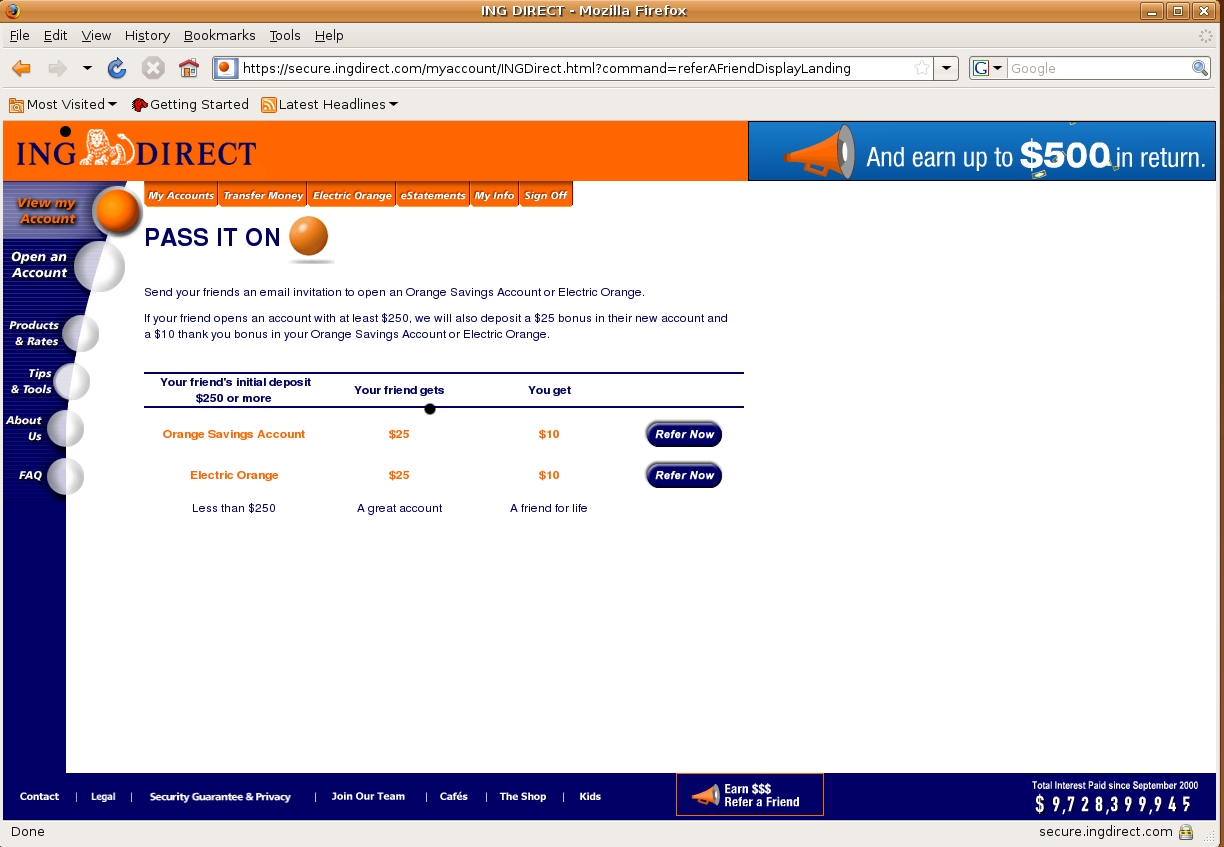
I referred someone to open an account at ING Direct but never received my $10. It is not the $10 that caused me to post this blog, it is the principle and the false advertisement on ING Direct part.
Here is the story:
When the referree got the invitation from me, she was ready to open an account. But the disclosure statement about the Savings Account mentions terms pertaining to an Orange CD account. Concerned that her money might actually end up in a CD, she called ING Direct. The ING agent told her the Orange Savings Account is not a CD and assured her her funds would be liquid. The ING agent proceeded to tell her that an Orange CD account pays at a higher interest rate. When tasked about the $25 bonus, the agent told the referree she wouldn’t get the $25 bonus unless she opens an Orange Savings Account. That was fine and dandy. But the agent continued to tell the referree she should open an Orange CD right away to lock in the interest rate and could open an Orange Savings Account afterwards and still get the bonus. She did.
She opened an Orange CD to lock in the interest rate and then tried to open an Orange savings account later that same day but could not. Another phone call ended with the assurance that only one account can be opened a day and that she should open the Savings after the CD is assured. In the meantime, she was assured there would be no problem about the bonuses if the agent gave the incorrect information as the research department would go over the phone calls to make the determination.
A few days later after the CD was established, the referree called back to open the Savings account and was given the $25 credit instantly but was told I had to call to receive my $10.
When I made the call, another ING Direct agent said the referree was not entitled to the $25 and I was I not entitled to the $10 bonus because she was an existing customer when she opened the Orange Savings Account. The agent threatened to remove the $25 from her account at which point the referree asked to speak to a supervisor and was transferred to Mark, the floor manager, employee #702144, located in Delaware. Mark was rude on the phone and asked many unnecessary personal questions. Those questions had nothing to do with $10 bonus and ING policy. I decided it’s not worth dealing with him or ING Direct anymore. I will be closing my account with them as soon as interest is posted this month.
Candidates' tax plan
http://www.webcpa.com/article.cfm?ARTICLEID=29350
Both Candidates' Plans Would Reduce Tax Liabilities
Washington, D.C. (Sept. 24, 2008)
By WebCPA staff
A study of both presidential candidates' tax plans finds that they will both reduce millions of taxpayers' liability to zero.
According to Internal Revenue Service statistics for 2006, 45.6 million tax filers, or about one-third of all filers, have no tax liability after taking credits and deductions. "For good or ill, this is a 57 percent increase since 2000 in the number of Americans who pay no personal income taxes," wrote Scott A. Hodge, in a study for the Tax Foundation. He estimates that there will be 47 million tax returns with zero income tax liability in 2009 under current law.
The foundation's estimates show that if all of the tax provisions proposed by Sen. Barack Obama, D-Ill, are adopted next year, the number of non-payers would rise by approximately 16 million, to a total of 63 million, or about 44 percent of all tax filers. If all the tax proposals of Sen. John McCain, R-Ariz., were enacted in 2009, the number of taxpayers with zero tax liability would increase a million less, by about 15 million to 62 million overall, or about 42 percent of all tax filers.
The Obama tax plan contains seven new tax provisions, including a Making Work Pay Credit, a Universal Mortgage Credit, and a plan to eliminate income taxes for seniors earning under $50,000, while McCain's health care credit offers incentives for people to buy their own health insurance.
"This tax provision has a bigger impact on cutting people's taxes than any single proposal from either party," wrote Hodge. "Obama uses a longer list of smaller tax credit ideas to reduce a similar number of taxpayers' liability to zero."
___
Here is a Wall Street Journal article on the two presidential candidates' tax plan:
http://online.wsj.com/article/SB122221857642269749.html
The article provided a couple of external links with overview of the two plans:
Grant Thornton has an overview chart.
Deloitte & Touche provides a detailed 14 page summary.
And here is the same WSJ article on Yahoo, http://biz.yahoo.com/wallstreet/080924/sb122221857642269749_id.html.
A friend, Jerry Gropp AIA, from Mercer Island sent me this link, which is excellent:
https://knol.google.com/k/jeffrey-gramlich/the-mccain-and-obama-tax-plans-for/2k7f943jjgete/3#
Both Candidates' Plans Would Reduce Tax Liabilities
Washington, D.C. (Sept. 24, 2008)
By WebCPA staff
A study of both presidential candidates' tax plans finds that they will both reduce millions of taxpayers' liability to zero.
According to Internal Revenue Service statistics for 2006, 45.6 million tax filers, or about one-third of all filers, have no tax liability after taking credits and deductions. "For good or ill, this is a 57 percent increase since 2000 in the number of Americans who pay no personal income taxes," wrote Scott A. Hodge, in a study for the Tax Foundation. He estimates that there will be 47 million tax returns with zero income tax liability in 2009 under current law.
The foundation's estimates show that if all of the tax provisions proposed by Sen. Barack Obama, D-Ill, are adopted next year, the number of non-payers would rise by approximately 16 million, to a total of 63 million, or about 44 percent of all tax filers. If all the tax proposals of Sen. John McCain, R-Ariz., were enacted in 2009, the number of taxpayers with zero tax liability would increase a million less, by about 15 million to 62 million overall, or about 42 percent of all tax filers.
The Obama tax plan contains seven new tax provisions, including a Making Work Pay Credit, a Universal Mortgage Credit, and a plan to eliminate income taxes for seniors earning under $50,000, while McCain's health care credit offers incentives for people to buy their own health insurance.
"This tax provision has a bigger impact on cutting people's taxes than any single proposal from either party," wrote Hodge. "Obama uses a longer list of smaller tax credit ideas to reduce a similar number of taxpayers' liability to zero."
___
Here is a Wall Street Journal article on the two presidential candidates' tax plan:
http://online.wsj.com/article/SB122221857642269749.html
The article provided a couple of external links with overview of the two plans:
Grant Thornton has an overview chart.
Deloitte & Touche provides a detailed 14 page summary.
And here is the same WSJ article on Yahoo, http://biz.yahoo.com/wallstreet/080924/sb122221857642269749_id.html.
A friend, Jerry Gropp AIA, from Mercer Island sent me this link, which is excellent:
https://knol.google.com/k/jeffrey-gramlich/the-mccain-and-obama-tax-plans-for/2k7f943jjgete/3#
Tuesday, September 23, 2008
Tax Provisions in CA Budget
Here is a list of tax-related changes. Provisions that are different or not contained in the original set of budget bills say New.
▸ The LLC fee is accelerated, and calendar-year LLCs must pay their 2008 fee on April 15, 2009, and estimated 2009 fee on June 15, 2009.
▸ Business credits are limited to 50% of tax liability for 2008 and 2009, with an exception for small businesses.
▸ The 12-month rule for use tax on vehicles, vessels, and aircraft purchased outside of California is back, effective the date of enactment.
▸ The NOL deduction is suspended for 2008 and 2009, with an exception for small businesses. However, for taxable years beginning on or after January 1, 2008, NOLs may be carried forward for 20 years; NOLs may be carried back for two years for losses generated in taxable years beginning on or after January 1, 2011.
▸ New For taxable years beginning on or after July 1, 2008, affiliated corporations may share credits.
▸ Beginning January 1, 2009, the first two estimated payments for individuals and corporations are increased from 25% to 30%, and the last two are reduced to 20%.
▸ Individual taxpayers with income over $1 million may no longer use the 110% of prior-year tax as a safe harbor for years beginning in 2009.
▸ New The 1% mental health surcharge will be imposed on California-source taxable income for any electing nonresident partner or director of a corporation included in a group return if the total income is in excess of $1 million.
▸ New There will be a new corporate penalty equal to 20% of an understatement of tax for corporations with understated tax of more than $1 million.
▸ New Certain individuals are required to make tax payments electronically for payments made on or after January 1, 2009.
(Source: http://www.caltax.com/Flash%20E-Mail/Pages/Newbudgetsigned.aspx)
▸ The LLC fee is accelerated, and calendar-year LLCs must pay their 2008 fee on April 15, 2009, and estimated 2009 fee on June 15, 2009.
▸ Business credits are limited to 50% of tax liability for 2008 and 2009, with an exception for small businesses.
▸ The 12-month rule for use tax on vehicles, vessels, and aircraft purchased outside of California is back, effective the date of enactment.
▸ The NOL deduction is suspended for 2008 and 2009, with an exception for small businesses. However, for taxable years beginning on or after January 1, 2008, NOLs may be carried forward for 20 years; NOLs may be carried back for two years for losses generated in taxable years beginning on or after January 1, 2011.
▸ New For taxable years beginning on or after July 1, 2008, affiliated corporations may share credits.
▸ Beginning January 1, 2009, the first two estimated payments for individuals and corporations are increased from 25% to 30%, and the last two are reduced to 20%.
▸ Individual taxpayers with income over $1 million may no longer use the 110% of prior-year tax as a safe harbor for years beginning in 2009.
▸ New The 1% mental health surcharge will be imposed on California-source taxable income for any electing nonresident partner or director of a corporation included in a group return if the total income is in excess of $1 million.
▸ New There will be a new corporate penalty equal to 20% of an understatement of tax for corporations with understated tax of more than $1 million.
▸ New Certain individuals are required to make tax payments electronically for payments made on or after January 1, 2009.
(Source: http://www.caltax.com/Flash%20E-Mail/Pages/Newbudgetsigned.aspx)
Monday, September 22, 2008
"First-time" Home Buyer Credits
The IRS has provided certain guidance on the so called "first-time" home buyer tax credit, see http://www.irs.gov/newsroom/article/0,,id=186831,00.html.
Thursday, September 18, 2008
Record Retention
I often get inquiries on how long records should be kept. My normal answer is to keep tax returns, general ledgers, & financial statements permanently and supporting documents such as cancelled checks, paid invoices, billings, check registers, etc. for 7 years. Remember supporting documents on purchases of real estates, stocks, bonds, etc. should be kept for 7 years beyond the date the underlying assets are sold.
Here is link which includes additional information. While that site recommends a shorter period of some records, there may be other reasons for keeping some records a bit longer.
The IRS also has a page on recommended record retention, http://www.irs.gov/businesses/small/article/0,,id=98513,00.html. But my recommendation is to use the IRS recommendation as a reference only.
Here is link which includes additional information. While that site recommends a shorter period of some records, there may be other reasons for keeping some records a bit longer.
The IRS also has a page on recommended record retention, http://www.irs.gov/businesses/small/article/0,,id=98513,00.html. But my recommendation is to use the IRS recommendation as a reference only.
Estimated 2009 Tax Brackets
http://www.webcpa.com/article.cfm?articleid=29182&pg=ros
Analysts Forecast 2009 Tax Brackets and Deductions
New York (Sept. 18, 2008)
By WebCPA staff
CCH and Thomson Reuters' RIA unit have calculated the inflation-adjusted amounts for tax brackets, standard deductions and exemptions for next tax season.
RIA predicts that the basic standard deduction for 2009 for joint returns and surviving spouses will be $11,400, up from $10,900 in 2008. For single taxpayers, RIA forecasts the standard deduction will be $5,700, up from $5,450 in 2008. For head of household, the amount will be $8,350, up from $8,000.
CCH predicts that a married couple filing jointly with total taxable income of $100,000 will pay $312.50 less in income taxes in 2009 compared to 2008. A single filer with taxable income of $50,000 will save $156.25 next year.
CCH predicted that single taxpayers and married taxpayers filing separately could see a $250 increase over 2008 in their standard deduction, to $5,700, while the standard deduction for joint filers will increase by $500 to $11,400. Heads of households will see an increase in their standard deduction of $350, to $8,350.
The additional standard deduction for those age 65 or older or who are blind, will rise $50 to $1,100 in 2009 for married individuals and surviving spouses, and $50 to $1,400 for single filers. The personal exemption amount will go up in 2009 by $150 to $3,650.
For an individual who can be claimed as a dependent on another's return, RIA predicts that the basic standard deduction for 2009 will be $950, up from $900 in 2008, or $300 (same as in 2008), plus the individual's earned income, whichever is greater. For 2009, the additional standard deduction for married taxpayers 65 or over or blind will be $1,100, up from $1,050 in 2008. For a single taxpayer or head of household who is 65 or over or blind, the additional standard deduction for 2009 will be $1,400, up from $1,350 in 2008.
The personal exemption amount for 2009 will rise to $3,650, up from $3,500 in 2008, according to RIA. The exemption from the kiddie tax for 2009 will be $1,900, up from $1,800 in 2008. A parent will be able to elect to include a child's income on the parent's return for 2009 if the child's income is more than $950 and less than $9,500, up from $900 and $9,000 in 2008. For 2009, CCH predicts the kiddie tax standard deduction will rise to $950.
CCH's projected tax brackets are available here.
RIA's projected tax brackets are below:
FOR MARRIED INDIVIDUALS FILING JOINT RETURNS AND SURVIVING SPOUSES, THE 2009 RATE BRACKETS ARE:
Not over $16,700 - 10% of taxable income
Over $16,700 but not over $67,900 - $1,670.00 plus 15% of the excess over $16,700
Over $67,900 but not over $137,050 - $9,350.00 plus 25% of the excess over $67,900
Over $137,050 but not over $208,850 - $26,637.50 plus 28% of the excess over $137,050
Over $208,850 but not over $372,950 - $46,741.50 plus 33% of the excess over $208,850
Over $372,950 $100,894.50 plus 35% of the excess over $372,950
FOR SINGLE INDIVIDUALS (OTHER THAN HEADS OF HOUSEHOLDS AND SURVIVING SPOUSES), THE 2009 RATE BRACKETS ARE:
Not over $8,350 - 10% of taxable income
Over $8,350 but not over $33,950 - $835.00 plus 15% of the excess over $8,350
Over $33,950 but not over $82,250 - $4,675.00 plus 25% of the excess over $33,950
Over $82,250 but not over $171,550 - $16,750.00 plus 28% of the excess over $82,250
Over $171,550 but not over $372,950 - $41,754.00 plus 33% of the excess over $171,550
Over $372,950 $108,216.00 plus 35% of the excess over $372,950
FOR HEADS OF HOUSEHOLDS, THE 2009 RATE BRACKETS ARE:
Not over $11,950 - 10% of taxable income
Over $11,950 but not over $45,500 - $1,195.00 plus 15% of the excess over $11,950
Over $45,500 but not over $117,450 - $6,227.50 plus 25% of the excess over $45,500
Over $117,450 but not over $190,200 - $24,215.00 plus 28% of the excess over $117,450
Over $190,200 but not over $372,950 - $44,585.00 plus 33% of the excess over $190,200
Over $372,950 $104,892.50 plus 35% of the excess over $372,950
FOR MARRIEDS FILING SEPARATE RETURNS, THE 2009 RATE BRACKETS ARE:
Not over $8,350 - 10% of taxable income
Over $8,350 but not over $33,950 - $835.00 plus 15% of the excess over $8,350
Over $33,950 but not over $68,525 - $4,675.00 plus 25% of the excess over $33,950
Over $68,525 but not over $104,425 - $13,318.75 plus 28% of the excess over $68,525
Over $104,425 but not over $186,475 - $23,370.75 plus 33% of the excess over $104,425
Over $186,475 $50,447.25 plus 35% of the excess over $186,475
FOR ESTATES AND TRUSTS, THE 2009 RATE BRACKETS ARE:
Not over $2,300 15% of taxable income
Over $2,300 but not over $5,350 - $345.00 plus 25% of the excess over $2,300
Over $5,350 but not over $8,200 - $1,107.50 plus 28% of the excess over $5,350
Over $8,200 but not over $11,150 - $1,905.50 plus 33% of the excess over $8,200
Over $11,150 - $2,879.00 plus 35% of the excess over $11,150
For subscribers of the Wall Street Journal, here is an article on the same subject:
http://online.wsj.com/article/SB122161922104346467.html
Analysts Forecast 2009 Tax Brackets and Deductions
New York (Sept. 18, 2008)
By WebCPA staff
CCH and Thomson Reuters' RIA unit have calculated the inflation-adjusted amounts for tax brackets, standard deductions and exemptions for next tax season.
RIA predicts that the basic standard deduction for 2009 for joint returns and surviving spouses will be $11,400, up from $10,900 in 2008. For single taxpayers, RIA forecasts the standard deduction will be $5,700, up from $5,450 in 2008. For head of household, the amount will be $8,350, up from $8,000.
CCH predicts that a married couple filing jointly with total taxable income of $100,000 will pay $312.50 less in income taxes in 2009 compared to 2008. A single filer with taxable income of $50,000 will save $156.25 next year.
CCH predicted that single taxpayers and married taxpayers filing separately could see a $250 increase over 2008 in their standard deduction, to $5,700, while the standard deduction for joint filers will increase by $500 to $11,400. Heads of households will see an increase in their standard deduction of $350, to $8,350.
The additional standard deduction for those age 65 or older or who are blind, will rise $50 to $1,100 in 2009 for married individuals and surviving spouses, and $50 to $1,400 for single filers. The personal exemption amount will go up in 2009 by $150 to $3,650.
For an individual who can be claimed as a dependent on another's return, RIA predicts that the basic standard deduction for 2009 will be $950, up from $900 in 2008, or $300 (same as in 2008), plus the individual's earned income, whichever is greater. For 2009, the additional standard deduction for married taxpayers 65 or over or blind will be $1,100, up from $1,050 in 2008. For a single taxpayer or head of household who is 65 or over or blind, the additional standard deduction for 2009 will be $1,400, up from $1,350 in 2008.
The personal exemption amount for 2009 will rise to $3,650, up from $3,500 in 2008, according to RIA. The exemption from the kiddie tax for 2009 will be $1,900, up from $1,800 in 2008. A parent will be able to elect to include a child's income on the parent's return for 2009 if the child's income is more than $950 and less than $9,500, up from $900 and $9,000 in 2008. For 2009, CCH predicts the kiddie tax standard deduction will rise to $950.
CCH's projected tax brackets are available here.
RIA's projected tax brackets are below:
FOR MARRIED INDIVIDUALS FILING JOINT RETURNS AND SURVIVING SPOUSES, THE 2009 RATE BRACKETS ARE:
Not over $16,700 - 10% of taxable income
Over $16,700 but not over $67,900 - $1,670.00 plus 15% of the excess over $16,700
Over $67,900 but not over $137,050 - $9,350.00 plus 25% of the excess over $67,900
Over $137,050 but not over $208,850 - $26,637.50 plus 28% of the excess over $137,050
Over $208,850 but not over $372,950 - $46,741.50 plus 33% of the excess over $208,850
Over $372,950 $100,894.50 plus 35% of the excess over $372,950
FOR SINGLE INDIVIDUALS (OTHER THAN HEADS OF HOUSEHOLDS AND SURVIVING SPOUSES), THE 2009 RATE BRACKETS ARE:
Not over $8,350 - 10% of taxable income
Over $8,350 but not over $33,950 - $835.00 plus 15% of the excess over $8,350
Over $33,950 but not over $82,250 - $4,675.00 plus 25% of the excess over $33,950
Over $82,250 but not over $171,550 - $16,750.00 plus 28% of the excess over $82,250
Over $171,550 but not over $372,950 - $41,754.00 plus 33% of the excess over $171,550
Over $372,950 $108,216.00 plus 35% of the excess over $372,950
FOR HEADS OF HOUSEHOLDS, THE 2009 RATE BRACKETS ARE:
Not over $11,950 - 10% of taxable income
Over $11,950 but not over $45,500 - $1,195.00 plus 15% of the excess over $11,950
Over $45,500 but not over $117,450 - $6,227.50 plus 25% of the excess over $45,500
Over $117,450 but not over $190,200 - $24,215.00 plus 28% of the excess over $117,450
Over $190,200 but not over $372,950 - $44,585.00 plus 33% of the excess over $190,200
Over $372,950 $104,892.50 plus 35% of the excess over $372,950
FOR MARRIEDS FILING SEPARATE RETURNS, THE 2009 RATE BRACKETS ARE:
Not over $8,350 - 10% of taxable income
Over $8,350 but not over $33,950 - $835.00 plus 15% of the excess over $8,350
Over $33,950 but not over $68,525 - $4,675.00 plus 25% of the excess over $33,950
Over $68,525 but not over $104,425 - $13,318.75 plus 28% of the excess over $68,525
Over $104,425 but not over $186,475 - $23,370.75 plus 33% of the excess over $104,425
Over $186,475 $50,447.25 plus 35% of the excess over $186,475
FOR ESTATES AND TRUSTS, THE 2009 RATE BRACKETS ARE:
Not over $2,300 15% of taxable income
Over $2,300 but not over $5,350 - $345.00 plus 25% of the excess over $2,300
Over $5,350 but not over $8,200 - $1,107.50 plus 28% of the excess over $5,350
Over $8,200 but not over $11,150 - $1,905.50 plus 33% of the excess over $8,200
Over $11,150 - $2,879.00 plus 35% of the excess over $11,150
For subscribers of the Wall Street Journal, here is an article on the same subject:
http://online.wsj.com/article/SB122161922104346467.html
Subscribe to:
Posts (Atom)