Showing posts with label 1040. Show all posts
Showing posts with label 1040. Show all posts
Saturday, April 13, 2013
Friday, April 5, 2013
Proper Support for Charitable Contributions Critical
The IRS has been winning court cases where taxpayers do not follow all the requirements in supporting their charitable contributions. Here are the IRS requirements:
http://www.irs.gov/Charities-&-Non-Profits/Substantiating-Charitable-Contributions
David and Veronda Durden lost their $25,171 donation to their church because the acknowledgment from the church does not have the phrase, "no goods or services were provided in exchange" or "only intangible religious benefits were provided" even though they have all the cancelled checks.
http://www.ustaxcourt.gov/InOpHistoric/DurdenMemo.TCM.WPD.pdf
A Sacramento couple lost an $18.5 million charitable contribution deduction because they did not attach a qualified appraisal to their tax returns:
http://norwalkrealestateblogger.com/3583/california-couple-loses-18-5-million-charitable-deduction-on-technicality/
http://www.ustaxcourt.gov/InOpHistoric/mohamedmemo.TCM.WPD.pdf
http://www.irs.gov/Charities-&-Non-Profits/Substantiating-Charitable-Contributions
David and Veronda Durden lost their $25,171 donation to their church because the acknowledgment from the church does not have the phrase, "no goods or services were provided in exchange" or "only intangible religious benefits were provided" even though they have all the cancelled checks.
http://www.ustaxcourt.gov/InOpHistoric/DurdenMemo.TCM.WPD.pdf
A Sacramento couple lost an $18.5 million charitable contribution deduction because they did not attach a qualified appraisal to their tax returns:
http://norwalkrealestateblogger.com/3583/california-couple-loses-18-5-million-charitable-deduction-on-technicality/
http://www.ustaxcourt.gov/InOpHistoric/mohamedmemo.TCM.WPD.pdf


Thursday, March 21, 2013
12 tax audit red flags
While I don't think #2 is a red flag per se, I pretty much agree these are some of the areas that can cause an IRS audit. But how the IRS selects tax returns for audit is a well kept secret. Nobody really knows.
http://money.cnn.com/gallery/pf/taxes/2013/03/21/tax-audit/index.html
http://money.cnn.com/gallery/pf/taxes/2013/03/21/tax-audit/index.html
- You have foreign assets
- Your ex wants revenge
- Your return has too many zeroes
- You have a home office
- You forgot some income
- You claim fishy deductions
- You're rich
- You say the wrong things
- You do a lot of 'work-related' driving
- You exaggerate donations
- You own a money-losing business
- You have a shady tax preparer
Monday, February 11, 2013
Friday, December 28, 2012

Wednesday, November 14, 2012
IRS Warns AMT Could Affect 60 Million Taxpayers Unless Patched
http://www.accountingtoday.com/news/IRS-Warns-AMT-Taxpayers-Patched-64643-1.html
In a letter to the leaders of the tax-writing House Ways and Means Committee and the Senate Finance Committee, Acting Commissioner Steven T. Miller also warned that tax season could be delayed for up to a month next year if Congress does not act soon.
“A number of other tax provisions affecting individuals also expired at the end of 2011,” he wrote. “These include tax deductions for educators' out-of-pocket classroom expenses, tuition and related fees for higher education, and state and local sales taxes. The last provision is of particular importance to taxpayers in states with no income tax.
"These tax law changes are generally not as complex and do not present anything near the operational risk associated with the AMT patch," Miller added. "Two years ago, Congress enacted legislation extending these provisions retroactively in mid-December 2010. As a result, the IRS made the necessary changes to its forms and systems, and delayed the opening of the 2011 filing season by four weeks for approximately 9 million affected taxpayers. If the IRS were presented with a similar scenario of late enactment of tax extenders legislation this year, I would anticipate a similar outcome. There would be some inconvenience and delayed refunds for a substantial number of taxpayers, but the overall risk to the tax filing season would be manageable.”
Congress has returned to session this week after the elections with taxes among the top items on its agenda. The so-called “fiscal cliff” is looming with the expiration of the Bush-era tax rates and dozens of other traditional “tax extenders” at the end of the year, along with the prospect of automatic cuts in both defense spending and discretionary spending unless Congress and the Obama administration can agree on a deficit reduction plan. The nation is also once again approaching its borrowing limit and Congress will soon need to agree to raise the debt ceiling.
Miller noted that the expiring tax provisions have added uncertainty for next tax season. “This year has been particularly challenging due to several unresolved tax issues,” he wrote. “When Congress takes action well after this planning process is underway, there is potential for substantial disruption to the filing season ahead. As Congress returns this week, I wanted to provide you with a detailed description of the effects on IRS operational planning if the current uncertainty regarding the AMT and extenders continues.”
Miller noted that the AMT applies to individual taxpayers with incomes above specific thresholds set by law, but for many years, Congress has been enacting "patches" to index these income thresholds for inflation in order to prevent millions of taxpayers from being subject to the AMT. The last such patch expired on Dec. 31, 2011.
“More specifically, for tax year 2011, the AMT exemption amount (as indexed for inflation) was $48,450 for individuals and $74,450 for married taxpayers filing jointly,” he explained. “Because of these thresholds, only about 4 million taxpayers paid AMT for tax year 2011. Under current law, however, the thresholds revert to much lower levels for 2012—$33,750 for individuals and $45,000 for married taxpayers filing jointly. At these levels, approximately 33 million taxpayers would pay AMT for tax year 2012 (with returns filed in the spring of 2013). This is about 28 million more taxpayers who would pay the AMT than if the exemption amounts were increased as in the past.”
Miller also pointed out that the AMT patch has historically been accompanied by a special tax credit ordering rule that applies to all taxpayers claiming certain tax credits, whether they owe the AMT or not. “The ordering rules change the order in which a number of popular tax credits are applied against tax liability, and how they may be used to offset both regular and alternative minimum tax,” he explained. “Taken together, the changes to the AMT exemption amount and the special tax credit ordering rules could affect more than 60 million taxpayers—nearly half of all individual income tax filers. In addition, the changes to the tax credit ordering rules that result from a lapse in the AMT patch are highly complex and cut deeply into the core tax processing logic of IRS's critical filing season technology systems.”
In prior years—most recently in 2007 and 2010—Congress allowed the AMT patch to lapse for more than 11 months, but then retroactively reinstated it, Miller observed. “In both 2007 and 2010, the IRS consulted with Congress and was provided with bipartisan, bicameral assurances that Congress was working expeditiously to enact a patch. The IRS, in turn, made a risk-based decision to leave its systems programmed assuming that Congress would continue its historical practice and again enact extensions of both the increased AMT exemption amount and the special tax credit ordering rules.”
To stay consistent with past practice, Miller said he has instructed the IRS staff again this year to leave its core systems "as-is" with respect to the AMT, and hold off on the substantial design and engineering work that would be required in order to revert the core tax systems back to 1998 law, which will otherwise apply for 2012 in the absence of any action by Congress. “Therefore, if Congress enacts an AMT patch, including both increased exemption amounts and the special tax credit ordering rules, before the end of the 2012 calendar year, the IRS would likely be able to open the 2013 tax filing season with minimal delays for most taxpayers,” he said. “However, if there is no AMT patch enacted by the end of the year, the IRS would be forced to operate the 2013 tax filing season based on the expiration of the AMT patch. There would be serious repercussions for taxpayers.”
Without an AMT patch, Miller noted, about 28 million taxpayers would be faced with a very large, unexpected tax liability for the current tax year (2012). “In addition, in order to allow time for the IRS to make the programming changes necessary to conform our processing systems to reflect expiration of the AMT patch and the credit ordering rules, the IRS would, at minimum, need to instruct more than 60 million taxpayers that they may not file their tax returns or receive a refund until the IRS completes the necessary systems changes,” he added.” Because of the magnitude and complexity of the changes, it is entirely possible that these taxpayers would not be able to file until late March 2013, if not even later. Tens of millions of these taxpayers would unexpectedly have to pay additional income tax for 2012, leaving them with a balance due return or a much smaller refund than expected.
For millions of other taxpayers, refunds would be delayed.
“Finally, because the AMT patch already expired at the end of 2011, there is no ability to consider partial year extensions of the AMT (since by the end of 2012 it would have already lapsed for an entire year),” he noted.
Lawmakers greeted the news with dismay. “Congress must act now to address our unfinished business and give middle-class families certainty by extending this expiring relief,” said Ways and Means ranking member Sander Levin, D-Mich., in a statement. “Just as there is no reason not to extend the middle class tax cuts immediately, there is no reason Congress does not act on a bipartisan basis as it has in the past to fix the AMT. The consequences of inaction would be enormous for millions of middle class taxpayers. Extending AMT relief will prevent a substantial and unexpected tax increase on millions of Americans.”
Washington, D.C. (November 13, 2012)
The head of the Internal Revenue Service told lawmakers that if
Congress fails to extend the traditional patch for the Alternative
Minimum Tax, approximately 60 million Americans could be affected and
about 33 million taxpayers could pay the AMT for tax year 2012.In a letter to the leaders of the tax-writing House Ways and Means Committee and the Senate Finance Committee, Acting Commissioner Steven T. Miller also warned that tax season could be delayed for up to a month next year if Congress does not act soon.
“A number of other tax provisions affecting individuals also expired at the end of 2011,” he wrote. “These include tax deductions for educators' out-of-pocket classroom expenses, tuition and related fees for higher education, and state and local sales taxes. The last provision is of particular importance to taxpayers in states with no income tax.
"These tax law changes are generally not as complex and do not present anything near the operational risk associated with the AMT patch," Miller added. "Two years ago, Congress enacted legislation extending these provisions retroactively in mid-December 2010. As a result, the IRS made the necessary changes to its forms and systems, and delayed the opening of the 2011 filing season by four weeks for approximately 9 million affected taxpayers. If the IRS were presented with a similar scenario of late enactment of tax extenders legislation this year, I would anticipate a similar outcome. There would be some inconvenience and delayed refunds for a substantial number of taxpayers, but the overall risk to the tax filing season would be manageable.”
Congress has returned to session this week after the elections with taxes among the top items on its agenda. The so-called “fiscal cliff” is looming with the expiration of the Bush-era tax rates and dozens of other traditional “tax extenders” at the end of the year, along with the prospect of automatic cuts in both defense spending and discretionary spending unless Congress and the Obama administration can agree on a deficit reduction plan. The nation is also once again approaching its borrowing limit and Congress will soon need to agree to raise the debt ceiling.
Miller noted that the expiring tax provisions have added uncertainty for next tax season. “This year has been particularly challenging due to several unresolved tax issues,” he wrote. “When Congress takes action well after this planning process is underway, there is potential for substantial disruption to the filing season ahead. As Congress returns this week, I wanted to provide you with a detailed description of the effects on IRS operational planning if the current uncertainty regarding the AMT and extenders continues.”
Miller noted that the AMT applies to individual taxpayers with incomes above specific thresholds set by law, but for many years, Congress has been enacting "patches" to index these income thresholds for inflation in order to prevent millions of taxpayers from being subject to the AMT. The last such patch expired on Dec. 31, 2011.
“More specifically, for tax year 2011, the AMT exemption amount (as indexed for inflation) was $48,450 for individuals and $74,450 for married taxpayers filing jointly,” he explained. “Because of these thresholds, only about 4 million taxpayers paid AMT for tax year 2011. Under current law, however, the thresholds revert to much lower levels for 2012—$33,750 for individuals and $45,000 for married taxpayers filing jointly. At these levels, approximately 33 million taxpayers would pay AMT for tax year 2012 (with returns filed in the spring of 2013). This is about 28 million more taxpayers who would pay the AMT than if the exemption amounts were increased as in the past.”
Miller also pointed out that the AMT patch has historically been accompanied by a special tax credit ordering rule that applies to all taxpayers claiming certain tax credits, whether they owe the AMT or not. “The ordering rules change the order in which a number of popular tax credits are applied against tax liability, and how they may be used to offset both regular and alternative minimum tax,” he explained. “Taken together, the changes to the AMT exemption amount and the special tax credit ordering rules could affect more than 60 million taxpayers—nearly half of all individual income tax filers. In addition, the changes to the tax credit ordering rules that result from a lapse in the AMT patch are highly complex and cut deeply into the core tax processing logic of IRS's critical filing season technology systems.”
In prior years—most recently in 2007 and 2010—Congress allowed the AMT patch to lapse for more than 11 months, but then retroactively reinstated it, Miller observed. “In both 2007 and 2010, the IRS consulted with Congress and was provided with bipartisan, bicameral assurances that Congress was working expeditiously to enact a patch. The IRS, in turn, made a risk-based decision to leave its systems programmed assuming that Congress would continue its historical practice and again enact extensions of both the increased AMT exemption amount and the special tax credit ordering rules.”
To stay consistent with past practice, Miller said he has instructed the IRS staff again this year to leave its core systems "as-is" with respect to the AMT, and hold off on the substantial design and engineering work that would be required in order to revert the core tax systems back to 1998 law, which will otherwise apply for 2012 in the absence of any action by Congress. “Therefore, if Congress enacts an AMT patch, including both increased exemption amounts and the special tax credit ordering rules, before the end of the 2012 calendar year, the IRS would likely be able to open the 2013 tax filing season with minimal delays for most taxpayers,” he said. “However, if there is no AMT patch enacted by the end of the year, the IRS would be forced to operate the 2013 tax filing season based on the expiration of the AMT patch. There would be serious repercussions for taxpayers.”
Without an AMT patch, Miller noted, about 28 million taxpayers would be faced with a very large, unexpected tax liability for the current tax year (2012). “In addition, in order to allow time for the IRS to make the programming changes necessary to conform our processing systems to reflect expiration of the AMT patch and the credit ordering rules, the IRS would, at minimum, need to instruct more than 60 million taxpayers that they may not file their tax returns or receive a refund until the IRS completes the necessary systems changes,” he added.” Because of the magnitude and complexity of the changes, it is entirely possible that these taxpayers would not be able to file until late March 2013, if not even later. Tens of millions of these taxpayers would unexpectedly have to pay additional income tax for 2012, leaving them with a balance due return or a much smaller refund than expected.
For millions of other taxpayers, refunds would be delayed.
“Finally, because the AMT patch already expired at the end of 2011, there is no ability to consider partial year extensions of the AMT (since by the end of 2012 it would have already lapsed for an entire year),” he noted.
Lawmakers greeted the news with dismay. “Congress must act now to address our unfinished business and give middle-class families certainty by extending this expiring relief,” said Ways and Means ranking member Sander Levin, D-Mich., in a statement. “Just as there is no reason not to extend the middle class tax cuts immediately, there is no reason Congress does not act on a bipartisan basis as it has in the past to fix the AMT. The consequences of inaction would be enormous for millions of middle class taxpayers. Extending AMT relief will prevent a substantial and unexpected tax increase on millions of Americans.”
Tuesday, October 23, 2012
IRS announces inflation adjustments for 2013
http://www.journalofaccountancy.com/News/20126688.htm
On Thursday, the IRS released its annual revenue procedure making inflation adjustments to the gift tax annual exclusion and other items for tax years beginning in 2013 (Rev. Proc. 2012-41).
The gift tax annual exclusion will increase from $13,000 to $14,000 in 2013 and the amount of foreign earned income that taxpayers can exclude increases from $95,100 to $97,600. The amount used to reduce the net unearned income reported on a child’s tax return to calculate the kiddie tax increases from $950 to $1,000. Other inflation-adjusted amounts include the alternative minimum tax exemption for the kiddie tax, the private activity bond volume cap, the limitation on eligible long-term care premiums, high-deductible health plan definitions, the threshold for required reporting of receipt of large gifts from foreign persons, and 20 other provisions.
Rev. Proc. 2012-41 does not include the inflation adjustments for the tax tables, the Sec. 23 adoption credit, the Sec. 24 child tax credit, the Sec. 25A Hope scholarship and lifetime learning credits, the Sec. 32 earned income tax credit, the standard deduction, the Sec. 68 overall limitation on itemized deductions, the Sec. 132(f) qualified transportation fringe benefit, the Sec. 137 adoption-assistance exclusion, the Sec. 151 personal exemption, the Sec. 179 election, the Sec. 221 interest on education loans, and the unified estate credit, all of which will be addressed in separate guidance, the IRS said. Many of these items are scheduled to expire or change at the end of the year, and the IRS may be waiting to see what actions Congress takes in its lame-duck session.
The IRS also announced the 2013 contribution limits and other figures for pension plans and other retirement-related items (IR-2012-77). The elective deferral (contribution) limit for employees who participate in Sec. 401(k), 403(b), or 457(b) plans and the federal government’s Thrift Savings Plan increases from $17,000 to $17,500. The catch-up contribution limit under those plans for those age 50 and over is unchanged at $5,500.
On Tuesday, the Social Security Administration announced that the Social Security wage base for 2013 will be $113,700 (up from $110,100 in 2012).
—Sally P. Schreiber (sschreiber@aicpa.org) is a JofA senior editor
Also see http://www.irs.gov/Retirement-Plans/Plan-Participant,-Employee/Retirement-Topics-IRA-Contribution-Limits
On Thursday, the IRS released its annual revenue procedure making inflation adjustments to the gift tax annual exclusion and other items for tax years beginning in 2013 (Rev. Proc. 2012-41).
The gift tax annual exclusion will increase from $13,000 to $14,000 in 2013 and the amount of foreign earned income that taxpayers can exclude increases from $95,100 to $97,600. The amount used to reduce the net unearned income reported on a child’s tax return to calculate the kiddie tax increases from $950 to $1,000. Other inflation-adjusted amounts include the alternative minimum tax exemption for the kiddie tax, the private activity bond volume cap, the limitation on eligible long-term care premiums, high-deductible health plan definitions, the threshold for required reporting of receipt of large gifts from foreign persons, and 20 other provisions.
Rev. Proc. 2012-41 does not include the inflation adjustments for the tax tables, the Sec. 23 adoption credit, the Sec. 24 child tax credit, the Sec. 25A Hope scholarship and lifetime learning credits, the Sec. 32 earned income tax credit, the standard deduction, the Sec. 68 overall limitation on itemized deductions, the Sec. 132(f) qualified transportation fringe benefit, the Sec. 137 adoption-assistance exclusion, the Sec. 151 personal exemption, the Sec. 179 election, the Sec. 221 interest on education loans, and the unified estate credit, all of which will be addressed in separate guidance, the IRS said. Many of these items are scheduled to expire or change at the end of the year, and the IRS may be waiting to see what actions Congress takes in its lame-duck session.
The IRS also announced the 2013 contribution limits and other figures for pension plans and other retirement-related items (IR-2012-77). The elective deferral (contribution) limit for employees who participate in Sec. 401(k), 403(b), or 457(b) plans and the federal government’s Thrift Savings Plan increases from $17,000 to $17,500. The catch-up contribution limit under those plans for those age 50 and over is unchanged at $5,500.
On Tuesday, the Social Security Administration announced that the Social Security wage base for 2013 will be $113,700 (up from $110,100 in 2012).
—Sally P. Schreiber (sschreiber@aicpa.org) is a JofA senior editor
Also see http://www.irs.gov/Retirement-Plans/Plan-Participant,-Employee/Retirement-Topics-IRA-Contribution-Limits
Sunday, July 22, 2012
2012 tax rates
Internal Revenue Service 2012 tax table:
| Tax Bracket | Married Filing Jointly | Single |
|---|---|---|
| 10% Bracket | $0 – $17,400 | $0 – $8,700 |
| 15% Bracket | $17,400 – $70,700 | $8,700 – $35,350 |
| 25% Bracket | $70,700 – $142,700 | $35,350 – $85,650 |
| 28% Bracket | $142,700 – $217,450 | $85,650 – $178,650 |
| 33% Bracket | $217,450 – $388,350 | $178,650 – $388,350 |
| 35% Bracket | Over $388,350 | Over $388,350 |
And here are a few related points:
- The personal and dependency exemption will rise to $3,800
- The standard deduction for married filing jointly will rise to $11,900
- The standard deduction for singles will rise to $5,950
Monday, July 16, 2012
Healthcare law's surtax could affect a few home sellers in 2013
http://www.latimes.com/business/realestate/la-fi-harney-20120715,0,7914992.story
By Kenneth R. Harney
The vast majority of people who sell their primary residences next year won't be affected by the 3.8% levy, which takes effect Jan. 1.
WASHINGTON — When the Supreme Court upheld the healthcare reform law on federal tax grounds, it re-stoked a housing issue that had been relatively quiet for the last year: The alleged 3.8% "real estate tax" on home sales beginning in 2013 that is buried in the legislation.
Immediately following enactment of the healthcare law, waves of emails hit the Internet with ominous messages aimed at homeowners. A sample: "Did you know that if you sell your house after 2012 you will pay a 3.8% sales tax on it? When did this happen? It's in the healthcare bill. Just thought you should know."
Once litigation challenging the law's constitutionality surfaced in federal courts, the email warnings subsided. But with the law scheduled to take effect less than six months from now, questions are being raised again: Is there really a 3.8% transfer tax on real estate coming in 2013? Does it preempt the existing $250,000 and $500,000 capital gains exclusions for single-filing and joint-filing home sellers, as some emails have claimed?
In case you've heard rumors or received worrisome emails about any of this, here's a quick primer:
Yes, there is a new 3.8% surtax that takes effect Jan. 1 on certain investment income of upper-income individuals — including some of their real estate transactions. But it's not a transfer tax and not likely to affect the vast majority of homeowners who sell their primary residences next year.
In fact, unless you have an adjusted gross income of more than $200,000 as a single-filing taxpayer, or $250,000 for couples filing jointly ($125,000 if you're married filing singly), you probably won't be touched by the surtax at all, though you could be affected by other changes in the code if Congress doesn't extend the Bush tax cuts scheduled to expire at the end of this year.
Even if you do have income greater than these thresholds, you might not be hit with the 3.8% tax unless you have certain types of investment income targeted by the law, specifically dividends, interest, net capital gains and net rental income. If your income is solely "earned" — salary and other compensation derived from active participation in a business — you have nothing to worry about as far as the new surtax.
Where things can get a little complicated, however, is when you sell your home for a substantial profit, and your adjusted gross income for the year exceeds the $200,000 or $250,000 thresholds. The good news: The surtax does not interfere with the current tax-free exclusion on the first $500,000 (joint filers) or $250,000 (single filers) of gain you make on the sale of your principal home. Those exclusions have not changed. But any profits above those limits are subject to federal capital gains taxation and could also expose you to the new 3.8% surtax.
Julian Block, a tax attorney in Larchmont, N.Y., and author of "Julian Block's Home Seller's Guide to Tax Savings," says it will be more important than ever to pull together documentation on the capital improvements you made to the property and expenses connected with the house — including settlement or closing costs, such as title insurance and legal fees — that increase your tax "basis" in order to lower your capital gains.
Since the healthcare law targets capital gains, you could find yourself exposed to the 3.8% levy on the sale of your home next year.
Here's an example provided by the tax staff at the National Assn. of Realtors. Say you and your spouse have adjustable gross income (AGI) of $325,000 and you sell your home at a $525,000 profit. Assuming you qualify, $500,000 of that gain is wiped off the slate for tax purposes. The $25,000 additional gain qualifies as net investment income under the healthcare law, giving you a revised AGI of $350,000. Since the law imposes the 3.8% surtax on the lesser of either the amount your revised AGI exceeds the $250,000 threshold for joint filers ($100,000 in this case) or the amount of your taxable gain ($25,000), you end up owing a surtax of $950 ($25,000 times 0.038).
The 3.8% levy can be confusing and can bite deeper when your taxable capital gains are far larger or you sell a vacation home or a piece of rental real estate, where all the profits could subject you to the investment surtax. Talk to a tax professional for advice on your specific situation.
kenharney@earthlink.net
Distributed by Washington Post Writers Group.
By Kenneth R. Harney
The vast majority of people who sell their primary residences next year won't be affected by the 3.8% levy, which takes effect Jan. 1.
WASHINGTON — When the Supreme Court upheld the healthcare reform law on federal tax grounds, it re-stoked a housing issue that had been relatively quiet for the last year: The alleged 3.8% "real estate tax" on home sales beginning in 2013 that is buried in the legislation.
Immediately following enactment of the healthcare law, waves of emails hit the Internet with ominous messages aimed at homeowners. A sample: "Did you know that if you sell your house after 2012 you will pay a 3.8% sales tax on it? When did this happen? It's in the healthcare bill. Just thought you should know."
Once litigation challenging the law's constitutionality surfaced in federal courts, the email warnings subsided. But with the law scheduled to take effect less than six months from now, questions are being raised again: Is there really a 3.8% transfer tax on real estate coming in 2013? Does it preempt the existing $250,000 and $500,000 capital gains exclusions for single-filing and joint-filing home sellers, as some emails have claimed?
In case you've heard rumors or received worrisome emails about any of this, here's a quick primer:
Yes, there is a new 3.8% surtax that takes effect Jan. 1 on certain investment income of upper-income individuals — including some of their real estate transactions. But it's not a transfer tax and not likely to affect the vast majority of homeowners who sell their primary residences next year.
In fact, unless you have an adjusted gross income of more than $200,000 as a single-filing taxpayer, or $250,000 for couples filing jointly ($125,000 if you're married filing singly), you probably won't be touched by the surtax at all, though you could be affected by other changes in the code if Congress doesn't extend the Bush tax cuts scheduled to expire at the end of this year.
Even if you do have income greater than these thresholds, you might not be hit with the 3.8% tax unless you have certain types of investment income targeted by the law, specifically dividends, interest, net capital gains and net rental income. If your income is solely "earned" — salary and other compensation derived from active participation in a business — you have nothing to worry about as far as the new surtax.
Where things can get a little complicated, however, is when you sell your home for a substantial profit, and your adjusted gross income for the year exceeds the $200,000 or $250,000 thresholds. The good news: The surtax does not interfere with the current tax-free exclusion on the first $500,000 (joint filers) or $250,000 (single filers) of gain you make on the sale of your principal home. Those exclusions have not changed. But any profits above those limits are subject to federal capital gains taxation and could also expose you to the new 3.8% surtax.
Julian Block, a tax attorney in Larchmont, N.Y., and author of "Julian Block's Home Seller's Guide to Tax Savings," says it will be more important than ever to pull together documentation on the capital improvements you made to the property and expenses connected with the house — including settlement or closing costs, such as title insurance and legal fees — that increase your tax "basis" in order to lower your capital gains.
Since the healthcare law targets capital gains, you could find yourself exposed to the 3.8% levy on the sale of your home next year.
Here's an example provided by the tax staff at the National Assn. of Realtors. Say you and your spouse have adjustable gross income (AGI) of $325,000 and you sell your home at a $525,000 profit. Assuming you qualify, $500,000 of that gain is wiped off the slate for tax purposes. The $25,000 additional gain qualifies as net investment income under the healthcare law, giving you a revised AGI of $350,000. Since the law imposes the 3.8% surtax on the lesser of either the amount your revised AGI exceeds the $250,000 threshold for joint filers ($100,000 in this case) or the amount of your taxable gain ($25,000), you end up owing a surtax of $950 ($25,000 times 0.038).
The 3.8% levy can be confusing and can bite deeper when your taxable capital gains are far larger or you sell a vacation home or a piece of rental real estate, where all the profits could subject you to the investment surtax. Talk to a tax professional for advice on your specific situation.
kenharney@earthlink.net
Distributed by Washington Post Writers Group.
Friday, April 13, 2012
Monday, March 26, 2012
IRS Commissioner Shulman Addresses Tax Delays
http://www.accountingtoday.com/news/IRS-Commissioner-Shulman-Addresses-Tax-Delays-62087-1.html
Internal Revenue Service Commissioner Doug Shulman warned Thursday of a delayed tax season next year unless Congress resolves questions over the alternative minimum tax patch and other tax extender items, and talked about the tax refund delays this tax season.
" I would be remiss if I did not acknowledge that in the first few weeks of the tax filing season, we experienced some delays in processing a subset of e-filed returns,” Shulman said in his prepared remarks for a hearing before the House Ways and Means Oversight Subcommitee. “These were temporary issues that affected a subset of taxpayers who filed in late January and early February, and the issues were resolved by mid-February. And, even with the delays, the IRS was generally delivering refunds in our normal 10- to 21-day time frame. I recognize that this group of taxpayers encountered delays this filing season and we regret the inconveniences caused.”
However, Shulman noted that even with the initial issues during tax season, the overall average refund timeline remained steady in fiscal year 2012 when compared to fiscal year 2011. “In other words, the delays were isolated to early issues in the filing season, and after that IRS was processing tax returns according to normal refund timelines,” he said.
Some Accounting Today readers have reported much longer delays beyond the first few weeks (see IRS Experiences Further Tax Refund Delay Problems and Tax Preparers Threatened over Tax Refund Delays).
According to a report released Thursday by the Government Accountability Office, between Jan. 17 and Jan. 26, the IRS delayed about 6 million returns because of a programming error. As a result, the GAO estimated that approximately 5.5 million refunds were delayed for about one week over what had been planned, while the IRS identified, isolated, and resolved the programming error.
The Commissioner also discussed various other topics such as AMT, the new tax preparer registration, ID theft, new technology at the Service and the IRS budget cut. Clock on the link above to read the whole article.
The refund delay really hasn't been completely solved, but it's better than earlier in the tax season.
Internal Revenue Service Commissioner Doug Shulman warned Thursday of a delayed tax season next year unless Congress resolves questions over the alternative minimum tax patch and other tax extender items, and talked about the tax refund delays this tax season.
" I would be remiss if I did not acknowledge that in the first few weeks of the tax filing season, we experienced some delays in processing a subset of e-filed returns,” Shulman said in his prepared remarks for a hearing before the House Ways and Means Oversight Subcommitee. “These were temporary issues that affected a subset of taxpayers who filed in late January and early February, and the issues were resolved by mid-February. And, even with the delays, the IRS was generally delivering refunds in our normal 10- to 21-day time frame. I recognize that this group of taxpayers encountered delays this filing season and we regret the inconveniences caused.”
However, Shulman noted that even with the initial issues during tax season, the overall average refund timeline remained steady in fiscal year 2012 when compared to fiscal year 2011. “In other words, the delays were isolated to early issues in the filing season, and after that IRS was processing tax returns according to normal refund timelines,” he said.
Some Accounting Today readers have reported much longer delays beyond the first few weeks (see IRS Experiences Further Tax Refund Delay Problems and Tax Preparers Threatened over Tax Refund Delays).
According to a report released Thursday by the Government Accountability Office, between Jan. 17 and Jan. 26, the IRS delayed about 6 million returns because of a programming error. As a result, the GAO estimated that approximately 5.5 million refunds were delayed for about one week over what had been planned, while the IRS identified, isolated, and resolved the programming error.
The Commissioner also discussed various other topics such as AMT, the new tax preparer registration, ID theft, new technology at the Service and the IRS budget cut. Clock on the link above to read the whole article.
The refund delay really hasn't been completely solved, but it's better than earlier in the tax season.
Tuesday, January 24, 2012
GOP Candidate's tax returns
Now that both leading GOP candidates have released their 2010 income tax returns, here are links to them. Romney has released many more tax returns than Gingrich. Gingrich should have released his Gingrich Holdings S corporation tax return as well since most of his transactions are taking place there. He also did not release his Form 2210 for the underpayment penalty calculation.
While Gingrich paid over $8,000 to prepare his 2010 tax return, Romney appeared to have paid none. And that's probably because his CPA billed the fees to one of his businesses.
Romney deducted his self-employed health insurance premium of $14,176 on Schedule A instead of on line 29 of page 1 of his Form 1040, as allowed by law. Both Romney and Gingrich included a Schedule H for household employees.
Gingrich was not subject to the dreadful alternative minimum tax while Romney was.
Mitt Romney
http://mittromney.com/learn/mitt/tax-return/main
Newt Gingrich
http://www.newt.org/sites/newt.org/files/GingrichIncomeTaxReturn.pdf
While Gingrich paid over $8,000 to prepare his 2010 tax return, Romney appeared to have paid none. And that's probably because his CPA billed the fees to one of his businesses.
Romney deducted his self-employed health insurance premium of $14,176 on Schedule A instead of on line 29 of page 1 of his Form 1040, as allowed by law. Both Romney and Gingrich included a Schedule H for household employees.
Gingrich was not subject to the dreadful alternative minimum tax while Romney was.
Mitt Romney
http://mittromney.com/learn/mitt/tax-return/main
Newt Gingrich
http://www.newt.org/sites/newt.org/files/GingrichIncomeTaxReturn.pdf
Monday, January 9, 2012
What You Need to Know for Your 2011 Tax Filing and What’s New for 2012
http://finance.yahoo.com/news/what-you-need-to-know-for-your-2011-tax-filing-and-what%E2%80%99s-new-for-2012.html
By Bonnie Lee | Fox Business
Tax season is here again! While the filing deadline might be a couple of months away, this month you will receive all required third-party reporting documents: W2s, 1099s for interest and dividends, 1099s for nonemployee compensation if you are an independent contractor, 1099-Bs from your broker reporting proceeds from the sale of stocks and bonds, 1098s from your mortgage holder, K-1s from partnerships, S Corps, estates, and trusts. Hopefully, you’ve set up a file to store all these documents to make data gathering for tax preparation a snap. If not, now’s the time to create one.
Note that the due date for filing this year is April 17. If a tax due date falls on a weekend or a holiday, the next business day becomes the due date. This year April 15 is a Sunday and Monday, April 16 is a federal holiday so the due date falls on Tuesday, April 17. If you are unable to file by the deadline, you may obtain an extension to Oct. 15. Bear in mind that the extension is for filing, not paying. All taxes must be paid by April 17 otherwise you may suffer penalties and interest.
If you pay estimated tax payments throughout the year, the due date for your next quarterly installment for prepayment of 2011 income taxes is Tuesday, Jan. 17. Estimated tax payments for 2012 will be due on April 17, June 15, Sept. 17 and Jan. 15, 2013.
Beginning in 2011, brokerage firms are required to report to the IRS not only proceeds from sales of stocks and mutual funds, but also the cost basis of the investments that are sold. The IRS has designed a new Form 8949 for reporting capital gains and losses. A summary of the information listed on this form is carried over Schedule D. A couple of new columns are added to Form 8949 reporting – one for adjustments to basis (in case your broker has an incorrect figure) and one for coding the transaction to identify the type of sale.
Business mileage rates for 2011 were changed mid-year, so when calculating your mileage for 2011 use the rate of 51 cents per mile for miles driven up to June 30, 2011 and 55 ½ cents per mile from July 1 to Dec. 31.
Mileage rates for 2012 are as follows: 55 ½ cents per mile for business, 23 cents per mile for moving and medical, and 14 cents per mile for charitable purposes.
The temporary payroll tax cut has been extended to Feb. 29; employees will enjoy a continued savings of 2% of wages withheld for Social Security – from 6.2% to 4.2%. The Social Security wage base for 2012 is $110,100 up from $106,800 in 2011. Once your wages exceed this amount, Social Security will not be withheld but Medicare will continue to be withheld.
The self-employment health insurance deduction no longer offsets the self-employment tax. In 2010 only, self-employed workers were able to reduce the amount subject to self-employment tax on Schedule SE by the amounts paid for health insurance premiums. You can still take the deduction on Form 1040 as an adjustment to income.
Foreign financial assets are reported on a new Form 8938. The foreign asset disclosure form is separate and different from the foreign bank account report. Taxpayers with foreign assets may need to file both documents.
The first-time home buyer’s credit is now only available to members of the military or Foreign Service. If you are repaying the first-time home buyer’s credit, you may not need to complete and attach Form 5405.
Also gone for 2011 is the Making Work Pay Credit. For the past few years we enjoyed $400 per year single and $800 married filing joint credit against our tax liabilities.
By Bonnie Lee | Fox Business
Tax season is here again! While the filing deadline might be a couple of months away, this month you will receive all required third-party reporting documents: W2s, 1099s for interest and dividends, 1099s for nonemployee compensation if you are an independent contractor, 1099-Bs from your broker reporting proceeds from the sale of stocks and bonds, 1098s from your mortgage holder, K-1s from partnerships, S Corps, estates, and trusts. Hopefully, you’ve set up a file to store all these documents to make data gathering for tax preparation a snap. If not, now’s the time to create one.
Note that the due date for filing this year is April 17. If a tax due date falls on a weekend or a holiday, the next business day becomes the due date. This year April 15 is a Sunday and Monday, April 16 is a federal holiday so the due date falls on Tuesday, April 17. If you are unable to file by the deadline, you may obtain an extension to Oct. 15. Bear in mind that the extension is for filing, not paying. All taxes must be paid by April 17 otherwise you may suffer penalties and interest.
If you pay estimated tax payments throughout the year, the due date for your next quarterly installment for prepayment of 2011 income taxes is Tuesday, Jan. 17. Estimated tax payments for 2012 will be due on April 17, June 15, Sept. 17 and Jan. 15, 2013.
Beginning in 2011, brokerage firms are required to report to the IRS not only proceeds from sales of stocks and mutual funds, but also the cost basis of the investments that are sold. The IRS has designed a new Form 8949 for reporting capital gains and losses. A summary of the information listed on this form is carried over Schedule D. A couple of new columns are added to Form 8949 reporting – one for adjustments to basis (in case your broker has an incorrect figure) and one for coding the transaction to identify the type of sale.
Business mileage rates for 2011 were changed mid-year, so when calculating your mileage for 2011 use the rate of 51 cents per mile for miles driven up to June 30, 2011 and 55 ½ cents per mile from July 1 to Dec. 31.
Mileage rates for 2012 are as follows: 55 ½ cents per mile for business, 23 cents per mile for moving and medical, and 14 cents per mile for charitable purposes.
The temporary payroll tax cut has been extended to Feb. 29; employees will enjoy a continued savings of 2% of wages withheld for Social Security – from 6.2% to 4.2%. The Social Security wage base for 2012 is $110,100 up from $106,800 in 2011. Once your wages exceed this amount, Social Security will not be withheld but Medicare will continue to be withheld.
The self-employment health insurance deduction no longer offsets the self-employment tax. In 2010 only, self-employed workers were able to reduce the amount subject to self-employment tax on Schedule SE by the amounts paid for health insurance premiums. You can still take the deduction on Form 1040 as an adjustment to income.
Foreign financial assets are reported on a new Form 8938. The foreign asset disclosure form is separate and different from the foreign bank account report. Taxpayers with foreign assets may need to file both documents.
The first-time home buyer’s credit is now only available to members of the military or Foreign Service. If you are repaying the first-time home buyer’s credit, you may not need to complete and attach Form 5405.
Also gone for 2011 is the Making Work Pay Credit. For the past few years we enjoyed $400 per year single and $800 married filing joint credit against our tax liabilities.
Wednesday, January 4, 2012
Tax Relief and Health Care Acts Shape 2011 Returns
http://www.journalofaccountancy.com/Issues/2012/Jan/20114539.htm
Return preparers face new regulations; information reporting expands.
By Paul Bonner
As CPAs gear up for tax season, they’ll find the Form 1040 series for 2011 looking much the same as that of the previous year, but only because of Congress’ 11th-hour compromise late in 2010 to keep it so. Nonetheless, a number of new features affecting individuals and businesses, such as new information reporting forms, are debuting, so return preparers should be aware of developments in the past year that will affect 2011 tax returns.
For 2011 inflation-adjusted tax rates and updated amounts of various credits and other items, see the “Quick Guide” (click here to download). For inflation-adjusted items for the 2012 tax year, see the sidebar, “Looking Ahead to the 2012 Tax Year,” below.

The most significant event affecting 2011 returns was the signing on Dec. 17. 2010, of the Tax Relief, Unemployment Insurance Reauthorization, and Job Creation Act of 2010 (Tax Relief Act), P.L. 111-312, which extended the ordinary income tax rates introduced by the Economic Growth and Tax Relief Reconciliation Act of 2001 (EGTRRA), P.L. 107-16, and the capital gain tax rates introduced by the Jobs and Growth Tax Relief Reconciliation Act of 2003 (JGTRRA), P.L. 108-27. The Tax Relief Act also extended a large number of other expired or expiring provisions.
Many of the tax provisions enacted in EGTRRA and JGTRRA had been set to expire after 2010. The Tax Relief Act amended EGTRRA and JGTRRA to postpone the sunset of the affected provisions until after 2012 and extended many other provisions to 2011 or 2012.
PRACTICE AND PROCEDURE
PTINs. This tax season is the second for which tax preparers must register with the IRS and obtain or renew preparer tax identification numbers (PTINs). The IRS required preparers who registered and obtained a PTIN for the 2011 filing season to renew it for 2012 by the end of 2011. For more on PTIN renewal procedures, see Tax Matters on page 60.
Mandatory e-filing. This tax season, the threshold above which preparers must e-file most individual and fiduciary income tax returns drops from 100 returns they or their firm reasonably expect to file during the year to 11. A transitional rule allowing return preparers to paper file upon written request from the taxpayer expired at the end of calendar 2011 (Notice 2011-27). EITC due diligence. The U.S.-Korea Free Trade Agreement Implementation Act, P.L. 112-41, increased the preparer penalty under Sec. 6695(g) from $100 to $500 for each failure to exercise due diligence with respect to the earned income tax credit. The higher penalty is effective for returns required to be filed after Dec. 31, 2011.
EXTENSION OF EGTRRA AND JGTRRA PROVISIONS
Tax rates. EGTRRA introduced a 10% tax bracket below the 15% bracket for individuals and reduced the other tax brackets to 25%, 28%, 33% and 35%. Those changes were scheduled to sunset after 2010 so that in 2011 the 10% rate would disappear (with income in that bracket reverting to the 15% bracket) and the other rates would revert to 28%, 31%, 36% and 39.6%, respectively. With the Tax Relief Act’s postponement of the EGTRRA sunset, those rates are scheduled to continue through 2012.
Capital gains. In 2003, JGTRRA also lowered the capital gain tax rate to 15% (0% for taxpayers in the 10% and 15% ordinary income tax brackets). These rate changes also had been scheduled to expire after 2010. The Tax Relief Act’s postponement of JGTRRA’s sunset continues the lowered capital gain tax rate through 2012.
Itemized deductions and personal exemptions. The Tax Relief Act also extended EGTRRA’s repeal of the itemized deduction phaseout and the personal exemption phaseout for two years through 2012.
PAYROLL TAX REDUCTION
For 2011 only, the Tax Relief Act also reduced the rate for the Social Security portion of payroll taxes to 10.4% by reducing the employee rate from 6.2% to 4.2% (the employer’s portion remained at 6.2%). The payroll tax reduction replaced the former making work pay credit, which expired at the end of 2010. However, while the making work pay credit was phased out for higher-income taxpayers, the payroll tax reduction applied to all workers who paid payroll taxes, regardless of income level, and should be reflected in box 4 on the taxpayer’s 2011 Form W-2, Wage and Tax Statement.
AMT PROVISIONS
The Tax Relief Act increased the alternative minimum tax (AMT) exemption amounts for 2010 and 2011 (also known as the AMT patch). For 2011, the amounts are $48,450 for unmarried individuals; $74,450 for married individuals filing jointly; and $37,225 for married individuals filing separately.
In addition, the Tax Relief Act extended through 2012 the 0% and 15% capital gain rates for the AMT; the AMT offset of the child tax credit; and the 7% AMT preference for excluded gain on the disposition of qualified small business stock. It also extended the offset of nonrefundable personal credits against the AMT, but only through 2011.
EXTENSION OF EXPIRED INDIVIDUAL PROVISIONS
The Tax Relief Act extended a variety of temporary individual tax provisions that had expired at the end of 2009 or were scheduled to expire at the end of 2010. They include tax credits, deductions and various tax incentives.
All of the following were extended for two years through 2012:
HEALTH CARE TAX PROVISIONS
Although most of its major provisions will take effect in subsequent years, the health care reform legislation passed in 2010 contained some provisions that were effective in 2011.
Employees may see some new information on their Forms W-2 for 2011. The Patient Protection and Affordable Care Act (PPACA), P.L. 111-148, requires employers to disclose on each employee’s annual Form W-2 the value of the employee’s health insurance coverage sponsored by the employer. This provision was originally mandatory for tax years beginning after Dec. 31, 2010; however, in Notice 2010-69, the IRS announced that employers will not be required to report the cost of employer- sponsored coverage on W-2s issued for 2011, due to the difficulty in preparing payroll systems for the requirement. However, employers have the option to report such costs in 2011, so some employees may see this information. It will appear in box 12 of the W-2, with a code DD. This reporting is strictly informational; the amount reported will not affect the individual’s tax liability.
Over-the-counter medications. Under the PPACA, amounts paid or incurred after Dec. 31, 2010, for medications obtained without a prescription (except for insulin) are no longer reimbursable from health savings accounts (HSAs), Archer medical savings accounts (MSAs), health FSAs or health reimbursement arrangements.
Tax on HSA distributions. The additional tax on distributions from an HSA or an Archer MSA that are not used for qualified medical expenses was increased to 20% of the disbursed amount, effective for disbursements made during tax years starting after Dec. 31, 2010. (Under prior law, the tax was 10% of the disbursed amount for HSAs and 15% for Archer MSAs.)
SIMPLE cafeteria plans. Starting in 2011, small businesses could start offering SIMPLE cafeteria plans. Under the provision, an eligible small employer is provided with a safe harbor from the nondiscrimination requirements for cafeteria plans as well as from the nondiscrimination requirements for specified qualified benefits offered under a cafeteria plan, including group term life insurance, benefits under a self-insured medical expense reimbursement plan and benefits under a dependent care assistance program. Under the safe harbor, a cafeteria plan and the specified qualified benefits are treated as meeting the specified nondiscrimination rules if the cafeteria plan satisfies minimum eligibility and participation requirements and minimum contribution requirements.
BUSINESS PROVISIONS
Self-employment. The self-employment tax rate for 2011 dropped from 15.3% to 13.3%, reflecting the one-year cut in the Social Security tax also applicable to employees. However, taxpayers taking the above-the-line deduction for one-half of self-employment tax can still claim the same 7.65% amount as in 2010—making the deduction equal to 57.51% of self-employment tax for 2011. However, a provision that for 2010 allowed self-employed individuals to deduct health insurance premiums from self-employment income for purposes of determining self-employment tax (Sec. 162(l)(4)) was not extended for 2011.
Depreciation. Property acquired and placed in service between Sept. 9, 2010, and Dec. 31, 2011, may be eligible for 100% depreciation.
Work opportunity tax credit. Employers who hire certain military veterans, young people and members of other targeted groups by Dec. 31, 2011, may claim a credit based on the employee’s wages (Sec. 51).
NEW INFORMATION REPORTING PROVISIONS
Stock basis reporting. Individual taxpayers should also see more information on Form 1099-B, Proceeds From Broker and Barter Exchange Transactions, which has been expanded to include the cost or other basis of stock and mutual fund shares sold or exchanged during the year. Stockbrokers and mutual fund companies will use Form 1099-B to report this information at year-end. They will also use the expanded form to report whether gain or loss realized on these transactions qualifies as long-term or short-term gain or loss. The payer is required to file the expanded Form 1099-B with the IRS by Feb. 28, 2012 (or April 2, 2012, if the payer files electronically) and provide it to investors by Feb. 15, 2012. Box 3 will show the cost or other basis of securities sold.
Credit card transactions. Beginning with calendar year 2011, payment settlement entities for traditional and online merchants will be required to report to a payee, as well as to the IRS, the gross amount of the payee’s reportable payment transactions within a calendar year. The payee is the party that accepts a payment card as payment or establishes an account with a third-party settlement organization to settle transactions. In a payment card transaction, the payee is generally the merchant or seller. This provision was enacted as Sec. 6050W by the Housing and Economic Recovery Act of 2008, P.L. 110-289, but became effective only in 2011. These payments are reported on Form 1099-K, Merchant Card and Third Party Network Payments, which may be furnished electronically.
The IRS in Notice 2011-89 provided transitional relief for 2012 from penalties under Secs. 6721 and 6722 for Forms 1099-K that are incorrect or incomplete, as long as the payer makes a good-faith effort to file and issue them correctly. The IRS also postponed until 2013 backup withholding with respect to amounts reportable under Sec. 6050W (Notice 2011-88). Form 1040, schedules C and E for 2011 tax years includes a line for payee taxpayers to report amounts reported to them on Form 1099-K, but the schedules direct taxpayers to enter a zero on the line.
Basis of inherited property. While most commentary and guidance has focused on the changes in estate and gift taxes for 2010 and 2011 as they relate to gift and estate returns, CPA practitioners may see effects of the 2010 modified carryover basis election on capital gains for 2011 reported by inheritors of the estates of 2010 decedents that made the election. Under these rules, the heirs receive inherited property with a basis equal to the lesser of the decedent’s basis or the property’s fair market value (FMV) as of the date of death (Sec. 1022(a)), plus any basis increase (up to the FMV of the property at the decedent’s date of death) allocated to the property by the executor of the estate.
The maximum amount of basis increase that the executor can allocate among all of the decedent’s assets is $1.3 million ($60,000 for estates of nonresidents who were not citizens), plus certain losses and loss carryovers of the decedent. Property transferred outright to the decedent’s spouse and qualified terminable interest property is eligible for an additional $3 million of basis increase. If the executor has made the Sec. 1022 election, the heir should receive from the estate a Form 8939, Schedule A, containing information about the property’s basis, date acquired, whether any gain on its sale would be ordinary, the amount of basis increase allocated to it and its FMV on the decedent’s date of death.
Individuals who inherited property from 2010 decedents may have already disposed of it before the estate made the carryover basis election and assumed that their basis was the FMV at the time of death. The estate’s subsequent election to apply the modified carryover basis rules may result in such individuals’ owing capital gain tax, due to the now lower basis of the property. The IRS has said that, in such cases, it will presume the recipient’s reasonable cause and good faith for any increase in the recipient’s tax liability due to the application of Sec. 1022 and will not impose failure-to-pay or accuracy-related penalties (Notice 2011-76). The IRS advises affected taxpayers to write at the top of an amended return “IR Notice 2011-76” to obtain the relief.
__________
Looking Ahead to the 2012 Tax Year
The IRS made inflation adjustments to the income tax tables and many tax credits and other items for tax years beginning in 2012 in Rev. Proc. 2011-52.
Separately, the IRS announced the 2012 contribution limits and other figures for pension plans and other retirement-related items (IR-2011-103).
The increases are greater than in the previous two years, when inflation was lower.
Besides revised income tax tables, the new revenue procedure included updated amounts for various items such as the personal exemption (which increases from $3,700 to $3,800) and standard deduction. The revenue procedure also gave new figures for the child tax credit, American opportunity and lifetime learning credits and the earned income tax credit—40 items in all.
The $13,000 annual gift exclusion is unchanged for 2012, although the estate and gift lifetime exclusion for decedents dying during 2012 goes up from $5 million to $5.12 million.
The elective deferral (contribution) limit for employees who participate in section 401(k), 403(b) or 457(b) plans and the federal government’s Thrift Savings Plan increases from $16,500 to $17,000. The catch-up contribution limit under those plans for those age 50 and over is unchanged at $5,500.
The Social Security Administration announced that the Social Security wage base for 2012 is $110,100 (up from $106,800 in 2011).
__________
Expanded Toolkit Offers 360 Degrees of Outreach Resources, 365 Days a Year
In the midst of a difficult economy, and facing potential consumer confusion in the wake of the registered tax preparer program, firms of all sizes are confronting the dual challenge of holding on to current clients while successfully landing new ones.
To help CPAs meet these challenges and differentiate themselves from other tax preparers, the AICPA is building on a multiyear marketing and client-retention campaign launched in 2010 to assist members with their marketing and client-retention efforts. This year, the AICPA is expanding the toolkit to include materials to help CPAs explain and promote their value to clients.
“Many CPAs aren’t used to actively promoting themselves,” said Edward Karl, AICPA vice president–Tax. “In today’s climate, CPAs can’t afford to miss any opportunity to solidify their practices and build on their strengths.”
The enhanced toolkit includes customizable materials that allow members to reach clients and prospective clients from many different angles. These include short articles and concise, impactful messages for firm newsletters, sample social media posts and tax brochures that CPAs can use to stay connected with current clients and enhance client-retention efforts.
For potential clients and referral sources, tools such as a “Tax Saving Strategies” presentation provide a framework for in-house meetings and presentations to outside groups. CPAs can use them to highlight specific tax updates for 2012, while also incorporating the underlying message of how a CPA can add value.
One important feature of the toolkit is that many of the materials can be tailored for use by firms of different sizes. The importance of this is reflected in the results of the 2011 PCPS CPA Firm Top Issues Survey–growth and client retention clearly are on every firm’s agenda.
“We are sensitive to the fact that how firms attract and retain clients will vary by firm size,” explained Mark Koziel, AICPA vice president–Firm Services & Global Alliances. “We will be taking this into account in the development of these resources in order to better meet the needs of our members.”
Just as important, the toolkit has been designed with a busy, multitasking end user in mind. It comes with tips on making the best use of each resource and features an implementation checklist for incorporating the materials into a firm’s overall client-retention and acquisition strategies.
The AICPA is taking a direct role in getting the word out. “We’re here to support our members, and again this year, one of the things that means is continuing our advertising campaign,” said Jim Metzler, AICPA vice president–Small Firm Interests. “We’re placing radio spots and Web banners, using messages consistent with the materials we’re including in the toolkit that educate our audience on the value of working with CPAs and their distinguishing qualifications.”
Those efforts continue all the way through to the 360 Degrees of Taxes website: 360taxes.org. This public service resource is an extension of the 360 Degrees of Financial Literacy site. It has a more specific focus on supporting the position of CPAs as the premier providers of tax services, as well as enabling interaction with consumers throughout the year. The site serves as a forum for addressing individual tax questions and needs, a place to educate the public on the differences between CPAs and registered tax return preparers, and a guide pointing visitors toward a CPA in their local community.
The CPA value and tax services toolkit is available at aicpa.org/tax-toolkit.
Paul Bonner is a JofA senior editor–tax. To comment on this article or to suggest an idea for another article, contact him at pbonner@aicpa.org or 919-402-4434.
Return preparers face new regulations; information reporting expands.
By Paul Bonner
As CPAs gear up for tax season, they’ll find the Form 1040 series for 2011 looking much the same as that of the previous year, but only because of Congress’ 11th-hour compromise late in 2010 to keep it so. Nonetheless, a number of new features affecting individuals and businesses, such as new information reporting forms, are debuting, so return preparers should be aware of developments in the past year that will affect 2011 tax returns.
For 2011 inflation-adjusted tax rates and updated amounts of various credits and other items, see the “Quick Guide” (click here to download). For inflation-adjusted items for the 2012 tax year, see the sidebar, “Looking Ahead to the 2012 Tax Year,” below.
The most significant event affecting 2011 returns was the signing on Dec. 17. 2010, of the Tax Relief, Unemployment Insurance Reauthorization, and Job Creation Act of 2010 (Tax Relief Act), P.L. 111-312, which extended the ordinary income tax rates introduced by the Economic Growth and Tax Relief Reconciliation Act of 2001 (EGTRRA), P.L. 107-16, and the capital gain tax rates introduced by the Jobs and Growth Tax Relief Reconciliation Act of 2003 (JGTRRA), P.L. 108-27. The Tax Relief Act also extended a large number of other expired or expiring provisions.
Many of the tax provisions enacted in EGTRRA and JGTRRA had been set to expire after 2010. The Tax Relief Act amended EGTRRA and JGTRRA to postpone the sunset of the affected provisions until after 2012 and extended many other provisions to 2011 or 2012.
PRACTICE AND PROCEDURE
PTINs. This tax season is the second for which tax preparers must register with the IRS and obtain or renew preparer tax identification numbers (PTINs). The IRS required preparers who registered and obtained a PTIN for the 2011 filing season to renew it for 2012 by the end of 2011. For more on PTIN renewal procedures, see Tax Matters on page 60.
Mandatory e-filing. This tax season, the threshold above which preparers must e-file most individual and fiduciary income tax returns drops from 100 returns they or their firm reasonably expect to file during the year to 11. A transitional rule allowing return preparers to paper file upon written request from the taxpayer expired at the end of calendar 2011 (Notice 2011-27). EITC due diligence. The U.S.-Korea Free Trade Agreement Implementation Act, P.L. 112-41, increased the preparer penalty under Sec. 6695(g) from $100 to $500 for each failure to exercise due diligence with respect to the earned income tax credit. The higher penalty is effective for returns required to be filed after Dec. 31, 2011.
EXTENSION OF EGTRRA AND JGTRRA PROVISIONS
Tax rates. EGTRRA introduced a 10% tax bracket below the 15% bracket for individuals and reduced the other tax brackets to 25%, 28%, 33% and 35%. Those changes were scheduled to sunset after 2010 so that in 2011 the 10% rate would disappear (with income in that bracket reverting to the 15% bracket) and the other rates would revert to 28%, 31%, 36% and 39.6%, respectively. With the Tax Relief Act’s postponement of the EGTRRA sunset, those rates are scheduled to continue through 2012.
Capital gains. In 2003, JGTRRA also lowered the capital gain tax rate to 15% (0% for taxpayers in the 10% and 15% ordinary income tax brackets). These rate changes also had been scheduled to expire after 2010. The Tax Relief Act’s postponement of JGTRRA’s sunset continues the lowered capital gain tax rate through 2012.
Itemized deductions and personal exemptions. The Tax Relief Act also extended EGTRRA’s repeal of the itemized deduction phaseout and the personal exemption phaseout for two years through 2012.
PAYROLL TAX REDUCTION
For 2011 only, the Tax Relief Act also reduced the rate for the Social Security portion of payroll taxes to 10.4% by reducing the employee rate from 6.2% to 4.2% (the employer’s portion remained at 6.2%). The payroll tax reduction replaced the former making work pay credit, which expired at the end of 2010. However, while the making work pay credit was phased out for higher-income taxpayers, the payroll tax reduction applied to all workers who paid payroll taxes, regardless of income level, and should be reflected in box 4 on the taxpayer’s 2011 Form W-2, Wage and Tax Statement.
AMT PROVISIONS
The Tax Relief Act increased the alternative minimum tax (AMT) exemption amounts for 2010 and 2011 (also known as the AMT patch). For 2011, the amounts are $48,450 for unmarried individuals; $74,450 for married individuals filing jointly; and $37,225 for married individuals filing separately.
In addition, the Tax Relief Act extended through 2012 the 0% and 15% capital gain rates for the AMT; the AMT offset of the child tax credit; and the 7% AMT preference for excluded gain on the disposition of qualified small business stock. It also extended the offset of nonrefundable personal credits against the AMT, but only through 2011.
EXTENSION OF EXPIRED INDIVIDUAL PROVISIONS
The Tax Relief Act extended a variety of temporary individual tax provisions that had expired at the end of 2009 or were scheduled to expire at the end of 2010. They include tax credits, deductions and various tax incentives.
All of the following were extended for two years through 2012:
- Marriage penalty relief (the increased standard deduction and expanded 15% bracket for married taxpayers filing jointly);
- The $1,000 child tax credit amount (previously scheduled to revert to $500 after 2010) and the expanded refundability of the credit;
- The increased starting and ending points for the earned income credit and the increase in the credit amount for families with three or more qualifying children;
- The liberalized child and dependent care credit rules (allowing the credit to be calculated based on up to $3,000 of expenses for one dependent or up to $6,000 for more than one);
- The American opportunity tax credit;
- The higher contribution amount and other EGTRRA changes to Coverdell education savings accounts;
- The enhanced rules for student loan deductions introduced by EGTRRA;
- The exclusion for employer-provided educational assistance (Sec. 127); and
- The exclusion for National Health Services Corps and Armed Forces Health Professions Scholarships (Sec. 117(c)(2)).
- The treatment of mortgage insurance premiums as interest (Sec. 163(h)(3)(E));
- The parity for exclusion from income for employer-provided mass transit passes and parking benefits (Sec. 132);
- The allowance for tax-free distributions from individual retirement plans for charitable purposes (Sec. 408(d)(8));
- The temporary 100% exclusion of gain from the sale of certain small business stock under Sec. 1202, enacted by the Small Business Jobs Act of 2010, P.L. 111-240;
- The deduction for tuition and related expenses (Sec. 222);
- The state and local sales tax deduction (Sec. 164);
- The deduction for elementary and secondary school teachers (Sec. 62(a)(2)(D));
- The nonbusiness energy property credit (under the rules in effect before the American Recovery and Reinvestment Act of 2009, P.L. 111-5) (Sec. 25C);
- The credit for first-time Washington, D.C., homebuyers (Sec. 1400C); and
- The special rules for qualified conservation contributions by individuals (Sec. 170(b)(1)(E)).
HEALTH CARE TAX PROVISIONS
Although most of its major provisions will take effect in subsequent years, the health care reform legislation passed in 2010 contained some provisions that were effective in 2011.
Employees may see some new information on their Forms W-2 for 2011. The Patient Protection and Affordable Care Act (PPACA), P.L. 111-148, requires employers to disclose on each employee’s annual Form W-2 the value of the employee’s health insurance coverage sponsored by the employer. This provision was originally mandatory for tax years beginning after Dec. 31, 2010; however, in Notice 2010-69, the IRS announced that employers will not be required to report the cost of employer- sponsored coverage on W-2s issued for 2011, due to the difficulty in preparing payroll systems for the requirement. However, employers have the option to report such costs in 2011, so some employees may see this information. It will appear in box 12 of the W-2, with a code DD. This reporting is strictly informational; the amount reported will not affect the individual’s tax liability.
Over-the-counter medications. Under the PPACA, amounts paid or incurred after Dec. 31, 2010, for medications obtained without a prescription (except for insulin) are no longer reimbursable from health savings accounts (HSAs), Archer medical savings accounts (MSAs), health FSAs or health reimbursement arrangements.
Tax on HSA distributions. The additional tax on distributions from an HSA or an Archer MSA that are not used for qualified medical expenses was increased to 20% of the disbursed amount, effective for disbursements made during tax years starting after Dec. 31, 2010. (Under prior law, the tax was 10% of the disbursed amount for HSAs and 15% for Archer MSAs.)
SIMPLE cafeteria plans. Starting in 2011, small businesses could start offering SIMPLE cafeteria plans. Under the provision, an eligible small employer is provided with a safe harbor from the nondiscrimination requirements for cafeteria plans as well as from the nondiscrimination requirements for specified qualified benefits offered under a cafeteria plan, including group term life insurance, benefits under a self-insured medical expense reimbursement plan and benefits under a dependent care assistance program. Under the safe harbor, a cafeteria plan and the specified qualified benefits are treated as meeting the specified nondiscrimination rules if the cafeteria plan satisfies minimum eligibility and participation requirements and minimum contribution requirements.
BUSINESS PROVISIONS
Self-employment. The self-employment tax rate for 2011 dropped from 15.3% to 13.3%, reflecting the one-year cut in the Social Security tax also applicable to employees. However, taxpayers taking the above-the-line deduction for one-half of self-employment tax can still claim the same 7.65% amount as in 2010—making the deduction equal to 57.51% of self-employment tax for 2011. However, a provision that for 2010 allowed self-employed individuals to deduct health insurance premiums from self-employment income for purposes of determining self-employment tax (Sec. 162(l)(4)) was not extended for 2011.
Depreciation. Property acquired and placed in service between Sept. 9, 2010, and Dec. 31, 2011, may be eligible for 100% depreciation.
Work opportunity tax credit. Employers who hire certain military veterans, young people and members of other targeted groups by Dec. 31, 2011, may claim a credit based on the employee’s wages (Sec. 51).
NEW INFORMATION REPORTING PROVISIONS
Stock basis reporting. Individual taxpayers should also see more information on Form 1099-B, Proceeds From Broker and Barter Exchange Transactions, which has been expanded to include the cost or other basis of stock and mutual fund shares sold or exchanged during the year. Stockbrokers and mutual fund companies will use Form 1099-B to report this information at year-end. They will also use the expanded form to report whether gain or loss realized on these transactions qualifies as long-term or short-term gain or loss. The payer is required to file the expanded Form 1099-B with the IRS by Feb. 28, 2012 (or April 2, 2012, if the payer files electronically) and provide it to investors by Feb. 15, 2012. Box 3 will show the cost or other basis of securities sold.
Credit card transactions. Beginning with calendar year 2011, payment settlement entities for traditional and online merchants will be required to report to a payee, as well as to the IRS, the gross amount of the payee’s reportable payment transactions within a calendar year. The payee is the party that accepts a payment card as payment or establishes an account with a third-party settlement organization to settle transactions. In a payment card transaction, the payee is generally the merchant or seller. This provision was enacted as Sec. 6050W by the Housing and Economic Recovery Act of 2008, P.L. 110-289, but became effective only in 2011. These payments are reported on Form 1099-K, Merchant Card and Third Party Network Payments, which may be furnished electronically.
The IRS in Notice 2011-89 provided transitional relief for 2012 from penalties under Secs. 6721 and 6722 for Forms 1099-K that are incorrect or incomplete, as long as the payer makes a good-faith effort to file and issue them correctly. The IRS also postponed until 2013 backup withholding with respect to amounts reportable under Sec. 6050W (Notice 2011-88). Form 1040, schedules C and E for 2011 tax years includes a line for payee taxpayers to report amounts reported to them on Form 1099-K, but the schedules direct taxpayers to enter a zero on the line.
Basis of inherited property. While most commentary and guidance has focused on the changes in estate and gift taxes for 2010 and 2011 as they relate to gift and estate returns, CPA practitioners may see effects of the 2010 modified carryover basis election on capital gains for 2011 reported by inheritors of the estates of 2010 decedents that made the election. Under these rules, the heirs receive inherited property with a basis equal to the lesser of the decedent’s basis or the property’s fair market value (FMV) as of the date of death (Sec. 1022(a)), plus any basis increase (up to the FMV of the property at the decedent’s date of death) allocated to the property by the executor of the estate.
The maximum amount of basis increase that the executor can allocate among all of the decedent’s assets is $1.3 million ($60,000 for estates of nonresidents who were not citizens), plus certain losses and loss carryovers of the decedent. Property transferred outright to the decedent’s spouse and qualified terminable interest property is eligible for an additional $3 million of basis increase. If the executor has made the Sec. 1022 election, the heir should receive from the estate a Form 8939, Schedule A, containing information about the property’s basis, date acquired, whether any gain on its sale would be ordinary, the amount of basis increase allocated to it and its FMV on the decedent’s date of death.
Individuals who inherited property from 2010 decedents may have already disposed of it before the estate made the carryover basis election and assumed that their basis was the FMV at the time of death. The estate’s subsequent election to apply the modified carryover basis rules may result in such individuals’ owing capital gain tax, due to the now lower basis of the property. The IRS has said that, in such cases, it will presume the recipient’s reasonable cause and good faith for any increase in the recipient’s tax liability due to the application of Sec. 1022 and will not impose failure-to-pay or accuracy-related penalties (Notice 2011-76). The IRS advises affected taxpayers to write at the top of an amended return “IR Notice 2011-76” to obtain the relief.
__________
Looking Ahead to the 2012 Tax Year
The IRS made inflation adjustments to the income tax tables and many tax credits and other items for tax years beginning in 2012 in Rev. Proc. 2011-52.
Separately, the IRS announced the 2012 contribution limits and other figures for pension plans and other retirement-related items (IR-2011-103).
The increases are greater than in the previous two years, when inflation was lower.
Besides revised income tax tables, the new revenue procedure included updated amounts for various items such as the personal exemption (which increases from $3,700 to $3,800) and standard deduction. The revenue procedure also gave new figures for the child tax credit, American opportunity and lifetime learning credits and the earned income tax credit—40 items in all.
The $13,000 annual gift exclusion is unchanged for 2012, although the estate and gift lifetime exclusion for decedents dying during 2012 goes up from $5 million to $5.12 million.
The elective deferral (contribution) limit for employees who participate in section 401(k), 403(b) or 457(b) plans and the federal government’s Thrift Savings Plan increases from $16,500 to $17,000. The catch-up contribution limit under those plans for those age 50 and over is unchanged at $5,500.
The Social Security Administration announced that the Social Security wage base for 2012 is $110,100 (up from $106,800 in 2011).
__________
Expanded Toolkit Offers 360 Degrees of Outreach Resources, 365 Days a Year
In the midst of a difficult economy, and facing potential consumer confusion in the wake of the registered tax preparer program, firms of all sizes are confronting the dual challenge of holding on to current clients while successfully landing new ones.
To help CPAs meet these challenges and differentiate themselves from other tax preparers, the AICPA is building on a multiyear marketing and client-retention campaign launched in 2010 to assist members with their marketing and client-retention efforts. This year, the AICPA is expanding the toolkit to include materials to help CPAs explain and promote their value to clients.
“Many CPAs aren’t used to actively promoting themselves,” said Edward Karl, AICPA vice president–Tax. “In today’s climate, CPAs can’t afford to miss any opportunity to solidify their practices and build on their strengths.”
The enhanced toolkit includes customizable materials that allow members to reach clients and prospective clients from many different angles. These include short articles and concise, impactful messages for firm newsletters, sample social media posts and tax brochures that CPAs can use to stay connected with current clients and enhance client-retention efforts.
For potential clients and referral sources, tools such as a “Tax Saving Strategies” presentation provide a framework for in-house meetings and presentations to outside groups. CPAs can use them to highlight specific tax updates for 2012, while also incorporating the underlying message of how a CPA can add value.
One important feature of the toolkit is that many of the materials can be tailored for use by firms of different sizes. The importance of this is reflected in the results of the 2011 PCPS CPA Firm Top Issues Survey–growth and client retention clearly are on every firm’s agenda.
“We are sensitive to the fact that how firms attract and retain clients will vary by firm size,” explained Mark Koziel, AICPA vice president–Firm Services & Global Alliances. “We will be taking this into account in the development of these resources in order to better meet the needs of our members.”
Just as important, the toolkit has been designed with a busy, multitasking end user in mind. It comes with tips on making the best use of each resource and features an implementation checklist for incorporating the materials into a firm’s overall client-retention and acquisition strategies.
The AICPA is taking a direct role in getting the word out. “We’re here to support our members, and again this year, one of the things that means is continuing our advertising campaign,” said Jim Metzler, AICPA vice president–Small Firm Interests. “We’re placing radio spots and Web banners, using messages consistent with the materials we’re including in the toolkit that educate our audience on the value of working with CPAs and their distinguishing qualifications.”
Those efforts continue all the way through to the 360 Degrees of Taxes website: 360taxes.org. This public service resource is an extension of the 360 Degrees of Financial Literacy site. It has a more specific focus on supporting the position of CPAs as the premier providers of tax services, as well as enabling interaction with consumers throughout the year. The site serves as a forum for addressing individual tax questions and needs, a place to educate the public on the differences between CPAs and registered tax return preparers, and a guide pointing visitors toward a CPA in their local community.
The CPA value and tax services toolkit is available at aicpa.org/tax-toolkit.
Paul Bonner is a JofA senior editor–tax. To comment on this article or to suggest an idea for another article, contact him at pbonner@aicpa.org or 919-402-4434.
Friday, February 11, 2011
Monday, January 24, 2011
What's New on the 2010 Form 1040
http://finance.yahoo.com/taxes/article/111872/whats-new-on-1040-in-2010
by Bill Bischoff
Monday, January 24, 2011
By now, some of you may already have your 2010 W-2 and 1099s in hand. If not, it won't be long. So it's not too soon to think about starting your 2010 Form 1040. Before you begin, there are some key changes to note. Here's what you need to know.
Due Date is April 18
Even though April 15 falls on a Friday this year, the deadline for your 2010 Form 1040 is Monday April 18. Reason: Emancipation Day is a District of Columbia holiday, and it falls on April 15. So the tax filing deadline for the whole nation is deferred to April 18 . If your return won't be ready by then, you can extend the deadline all the way out to October 17 by filing Form 4868 on or before April 18.
No More Phase-Outs for Itemized Deductions and Exemptions
For years, high-income folks have seen their write-offs for the most popular itemized deduction items (including mortgage interest, state and local income and property taxes, and charitable donations) reduced by a nasty phase-out rule. Another nasty phase-out rule reduced or eliminated personal and dependent exemption deductions. Thankfully, both phase-outs were completely repealed for 2010 as part of the Bush-era tax cuts. So you can write off the full amount of your itemized deductions and exemptions on your 2010 Form 1040 without any worries and without having to fill out phase-out worksheets to penalize yourself. More good news: the recent tax cut extension legislation repealed the phase-outs for 2011 and 2012 as well.
Liberalized Adoption Credit
For 2010, the maximum adoption credit was increased to $13,170 (up from $12,150 in 2009). In addition, the credit was made 100% refundable for the 2010 tax year (previously, it was nonrefundable). That means you'll receive a check for any leftover adoption credit after your federal income tax bill has been reduced to zero. To claim the credit, fill out Form 8839 (Qualified Adoption Expenses), and enter the credit on line 71 of Form 1040.
One-Time Break for Self-Employed Individuals
Self-employed folks can generally deduct their health insurance premiums on page 1 of Form 1040 (use line 29 for 2010). The deduction reduces their federal income tax bills, which is nice. However, the self-employed have never been allowed to deduct those premiums when calculating their self-employment tax bills on Schedule SE. Good news: for 2010 only, you can deduct health insurance premiums on line 3 of Schedule SE. So those premiums will reduce both your income tax bill and your SE tax bill. Unfortunately, this break will not be available for 2011 and beyond unless Congress extends it.
Homebuyer Credit Repayment Rules Kick In
As I explained in an earlier column, you may have to repay part or all of the credit claimed for a 2008 or 2009 home purchase with your 2010 Form 1040.
In most cases, however, only those who purchased homes in 2008 will be affected. They will generally have to repay 1/15 of the credit with the 2010 Form 1040. If this rule impacts you, fill out Form 5405 (First-Time Homebuyer Credit and Repayment of the Credit), and enter the repayment amount as an addition to your tax bill on line 59 of Form 1040.
Real Estate Tax Deduction for Non-Itemizers is Gone
For 2008 and 2009, unmarried individuals who did not itemize could write off up to $500 of state and local real property taxes by claiming an increased standard deduction. Married joint-filing couples could write off up to $1,000. This add-on standard deduction deal for real estate taxes expired at the end of 2009, and it was not reinstated for 2010.
Deductions for Sales Taxes on New Vehicle Purchases Are Gone
The 2009 Stimulus Act created a temporary write-off for non-itemizers who paid state and local sales taxes on new vehicles purchased between 2/17/09 and 12/31/09. The write-off came in the form of an additional standard deduction allowance. Similarly, itemizers were allowed to claim an extra itemized deduction for such taxes. Both breaks lapsed at the end of 2009, and they were not reinstated for 2010.
Break for Unemployment Benefits Is Gone
In 2009, the first $2,400 of unemployment benefits was federal-income-tax-free. This break was not continued for 2010. Therefore, 100% of 2010 unemployment benefits generally must be reported as income on Form 1040 (use line 19).
Your Tax Preparer Might E-File Your Return This Time
Over the last few years, Congress has made tax-law changes that place increasing pressure on professional return preparers to electronically file more and more returns. As a result, your preparer might be forced to e-file your 2010 Form 1040 even if your returns for earlier years have always been done on paper. Get used to it.
by Bill Bischoff
Monday, January 24, 2011
By now, some of you may already have your 2010 W-2 and 1099s in hand. If not, it won't be long. So it's not too soon to think about starting your 2010 Form 1040. Before you begin, there are some key changes to note. Here's what you need to know.
Due Date is April 18
Even though April 15 falls on a Friday this year, the deadline for your 2010 Form 1040 is Monday April 18. Reason: Emancipation Day is a District of Columbia holiday, and it falls on April 15. So the tax filing deadline for the whole nation is deferred to April 18 . If your return won't be ready by then, you can extend the deadline all the way out to October 17 by filing Form 4868 on or before April 18.
No More Phase-Outs for Itemized Deductions and Exemptions
For years, high-income folks have seen their write-offs for the most popular itemized deduction items (including mortgage interest, state and local income and property taxes, and charitable donations) reduced by a nasty phase-out rule. Another nasty phase-out rule reduced or eliminated personal and dependent exemption deductions. Thankfully, both phase-outs were completely repealed for 2010 as part of the Bush-era tax cuts. So you can write off the full amount of your itemized deductions and exemptions on your 2010 Form 1040 without any worries and without having to fill out phase-out worksheets to penalize yourself. More good news: the recent tax cut extension legislation repealed the phase-outs for 2011 and 2012 as well.
Liberalized Adoption Credit
For 2010, the maximum adoption credit was increased to $13,170 (up from $12,150 in 2009). In addition, the credit was made 100% refundable for the 2010 tax year (previously, it was nonrefundable). That means you'll receive a check for any leftover adoption credit after your federal income tax bill has been reduced to zero. To claim the credit, fill out Form 8839 (Qualified Adoption Expenses), and enter the credit on line 71 of Form 1040.
One-Time Break for Self-Employed Individuals
Self-employed folks can generally deduct their health insurance premiums on page 1 of Form 1040 (use line 29 for 2010). The deduction reduces their federal income tax bills, which is nice. However, the self-employed have never been allowed to deduct those premiums when calculating their self-employment tax bills on Schedule SE. Good news: for 2010 only, you can deduct health insurance premiums on line 3 of Schedule SE. So those premiums will reduce both your income tax bill and your SE tax bill. Unfortunately, this break will not be available for 2011 and beyond unless Congress extends it.
Homebuyer Credit Repayment Rules Kick In
As I explained in an earlier column, you may have to repay part or all of the credit claimed for a 2008 or 2009 home purchase with your 2010 Form 1040.
In most cases, however, only those who purchased homes in 2008 will be affected. They will generally have to repay 1/15 of the credit with the 2010 Form 1040. If this rule impacts you, fill out Form 5405 (First-Time Homebuyer Credit and Repayment of the Credit), and enter the repayment amount as an addition to your tax bill on line 59 of Form 1040.
Real Estate Tax Deduction for Non-Itemizers is Gone
For 2008 and 2009, unmarried individuals who did not itemize could write off up to $500 of state and local real property taxes by claiming an increased standard deduction. Married joint-filing couples could write off up to $1,000. This add-on standard deduction deal for real estate taxes expired at the end of 2009, and it was not reinstated for 2010.
Deductions for Sales Taxes on New Vehicle Purchases Are Gone
The 2009 Stimulus Act created a temporary write-off for non-itemizers who paid state and local sales taxes on new vehicles purchased between 2/17/09 and 12/31/09. The write-off came in the form of an additional standard deduction allowance. Similarly, itemizers were allowed to claim an extra itemized deduction for such taxes. Both breaks lapsed at the end of 2009, and they were not reinstated for 2010.
Break for Unemployment Benefits Is Gone
In 2009, the first $2,400 of unemployment benefits was federal-income-tax-free. This break was not continued for 2010. Therefore, 100% of 2010 unemployment benefits generally must be reported as income on Form 1040 (use line 19).
Your Tax Preparer Might E-File Your Return This Time
Over the last few years, Congress has made tax-law changes that place increasing pressure on professional return preparers to electronically file more and more returns. As a result, your preparer might be forced to e-file your 2010 Form 1040 even if your returns for earlier years have always been done on paper. Get used to it.
Wednesday, December 1, 2010
Capitalization vs Repairs
The IRS recently issued an audit guide on capitalization vs repairs
http://www.irs.gov/businesses/article/0,,id=231440,00.html
From KBKG, Inc:
Author: Gian Pazzia, CCSP - Principal
The IRS recently released its Audit Techniques Guide related to issue of Capitalization vs. Repairs. This issue has received a significant amount of attention by the IRS over the last couple of years as many taxpayers have filed for Changes in Accounting Method to take advantage of missed deductions. Because the amount of deductions can be significant and because the determination of appropriate treatment involves intense evaluation of facts and circumstances, the IRS raised this to a "Tier 1" audit issue.
The current IRS proposed regulations have broadened and clarified the definition of "repair and maintenance" costs. Application of the existing law requires an in-depth understanding of the various tax cases and "tests" that must be met. Thorough documentation is necessary to sustain audit and must show the application of existing law for each asset reclassified.
Currently, this opportunity relates to all prior, current, and future tax years. However, in order to take advantage of the tax laws for prior years, taxpayers should act quickly as the IRS is considering rules that would limit the opportunity for prior years.
Taxpayers utilizing the book method of accounting - with respect to (Repair and Maintenance) R&M - should consider the potential to accelerate cash flow by 1) changing their method of accounting and 2) engaging in an R&M study. By using the book method, taxpayers miss out on the opportunity to accelerate cash flow through the current-year deduction for R&M expense.
It is important to note that under Rev. Proc. 2009-39, the change in accounting method of reclassifying previously capitalized repair and maintenance expenses as deductions is now considered automatic. In order to implement the automatic method, a section 481(a) adjustment is needed, along with specific representations in an attachment to Form 3115. This change in accounting method can be filed any time before the extended tax return due date in the year of change.
http://www.irs.gov/businesses/article/0,,id=231440,00.html
From KBKG, Inc:
Author: Gian Pazzia, CCSP - Principal
The IRS recently released its Audit Techniques Guide related to issue of Capitalization vs. Repairs. This issue has received a significant amount of attention by the IRS over the last couple of years as many taxpayers have filed for Changes in Accounting Method to take advantage of missed deductions. Because the amount of deductions can be significant and because the determination of appropriate treatment involves intense evaluation of facts and circumstances, the IRS raised this to a "Tier 1" audit issue.
The current IRS proposed regulations have broadened and clarified the definition of "repair and maintenance" costs. Application of the existing law requires an in-depth understanding of the various tax cases and "tests" that must be met. Thorough documentation is necessary to sustain audit and must show the application of existing law for each asset reclassified.
Currently, this opportunity relates to all prior, current, and future tax years. However, in order to take advantage of the tax laws for prior years, taxpayers should act quickly as the IRS is considering rules that would limit the opportunity for prior years.
Taxpayers utilizing the book method of accounting - with respect to (Repair and Maintenance) R&M - should consider the potential to accelerate cash flow by 1) changing their method of accounting and 2) engaging in an R&M study. By using the book method, taxpayers miss out on the opportunity to accelerate cash flow through the current-year deduction for R&M expense.
It is important to note that under Rev. Proc. 2009-39, the change in accounting method of reclassifying previously capitalized repair and maintenance expenses as deductions is now considered automatic. In order to implement the automatic method, a section 481(a) adjustment is needed, along with specific representations in an attachment to Form 3115. This change in accounting method can be filed any time before the extended tax return due date in the year of change.
Sunday, September 26, 2010
Tax cut stew for Christmas
http://money.cnn.com/2010/09/26/news/economy/tax_breaks_extensions/index.htm
By Jeanne Sahadi, senior writerSeptember 26, 2010: 6:41 PM ET
NEW YORK (CNNMoney.com) -- It's official: Now that resolution on the Bush tax cuts has been postponed until after the Nov. 2 mid-term elections, lawmakers have punted nearly every major time-sensitive tax issue until the end of the year.
All told, there are more than 100 tax provisions that have expired or are about to lapse. Here are some of the big ones:
Bush tax cuts: The Dec. 31 expiration of the 2001 and 2003 income and investment tax cuts.
AMT: The absence of a "patch" to protect non-wealthy Americans from having to pay the Alternative Minimum Tax for tax year 2010.
Estate tax: The reinstatement on Jan. 1 of the estate tax at levels nobody likes.
Tax extenders: The evergreen package of smaller breaks that regularly get extended every year, such as the option for individuals to deduct their state and local sales taxes on their federal return.
Making Work Pay: And the expiration of the Making Work Pay Credit for middle-class families, which President Obama wants extended for at least one more year.
Leaving big tax decisions to the last minute isn't unusual: Congress often waits for "the two-minute warning" before voting on so-called tax extenders, tax expert Ed Kleinbard said.
"The process is frustrating on a lot of levels," said Kleinbard, a law professor at the University of Southern California and a former chief of staff at the Joint Committee on Taxation.
But that frustration is likely to be more widespread this year because more of the general public will be affected.
What's the likely endgame?
Excellent question. Unfortunately, there's no clear answer yet.
Some have suggested there might be one big omnibus tax bill passed by Christmas that wraps together a lot of the outstanding tax provisions into one package.
Others say gridlock on some of the issues is a possibility.
"I think it possible that they have too much trouble [figuring out how to pay for some of the tax breaks] and end up kicking the extenders and estate tax into next year," said Clint Stretch, managing principal of tax policy at Deloitte Tax LLC. "It is also possible that a kitchen-sink bill starts by adding goodies to get votes ends up losing as many votes as it gets."
Take the CNNMoney debt quiz
If any provisions don't get dealt with in 2010, lawmakers could pass them early next year and make them retroactive. But prolonging the uncertainty is not without consequence.
The uncertainty makes tax planning difficult and could harm the economy.
"If you believe these tax breaks are useful programs, you significantly undercut their utility by creating an environment where taxpayers don't know for sure if they can rely on them. You undercut their economic value," Kleinbard said.
By Jeanne Sahadi, senior writerSeptember 26, 2010: 6:41 PM ET
NEW YORK (CNNMoney.com) -- It's official: Now that resolution on the Bush tax cuts has been postponed until after the Nov. 2 mid-term elections, lawmakers have punted nearly every major time-sensitive tax issue until the end of the year.
All told, there are more than 100 tax provisions that have expired or are about to lapse. Here are some of the big ones:
Bush tax cuts: The Dec. 31 expiration of the 2001 and 2003 income and investment tax cuts.
AMT: The absence of a "patch" to protect non-wealthy Americans from having to pay the Alternative Minimum Tax for tax year 2010.
Estate tax: The reinstatement on Jan. 1 of the estate tax at levels nobody likes.
Tax extenders: The evergreen package of smaller breaks that regularly get extended every year, such as the option for individuals to deduct their state and local sales taxes on their federal return.
Making Work Pay: And the expiration of the Making Work Pay Credit for middle-class families, which President Obama wants extended for at least one more year.
Leaving big tax decisions to the last minute isn't unusual: Congress often waits for "the two-minute warning" before voting on so-called tax extenders, tax expert Ed Kleinbard said.
"The process is frustrating on a lot of levels," said Kleinbard, a law professor at the University of Southern California and a former chief of staff at the Joint Committee on Taxation.
But that frustration is likely to be more widespread this year because more of the general public will be affected.
What's the likely endgame?
Excellent question. Unfortunately, there's no clear answer yet.
Some have suggested there might be one big omnibus tax bill passed by Christmas that wraps together a lot of the outstanding tax provisions into one package.
Others say gridlock on some of the issues is a possibility.
"I think it possible that they have too much trouble [figuring out how to pay for some of the tax breaks] and end up kicking the extenders and estate tax into next year," said Clint Stretch, managing principal of tax policy at Deloitte Tax LLC. "It is also possible that a kitchen-sink bill starts by adding goodies to get votes ends up losing as many votes as it gets."
Take the CNNMoney debt quiz
If any provisions don't get dealt with in 2010, lawmakers could pass them early next year and make them retroactive. But prolonging the uncertainty is not without consequence.
The uncertainty makes tax planning difficult and could harm the economy.
"If you believe these tax breaks are useful programs, you significantly undercut their utility by creating an environment where taxpayers don't know for sure if they can rely on them. You undercut their economic value," Kleinbard said.
Friday, September 24, 2010
IRS stops mailing out tax packages
Individual and business taxpayers will no longer receive paper income tax packages in the mail from the IRS. These tax packages contained the forms, schedules and instructions for filing a paper income tax return.
The IRS is taking this step because of the continued growth in electronic filing and the availability of free options to taxpayers, as well as to help reduce costs. In early October, the IRS will send a postcard to individuals who filed paper returns last year and did not use a tax preparer or tax software. The information will explain how to get the tax forms and instructions they need for filing their tax year 2010 return. The forms and instructions will be available in early January 2011.
Beginning January 1, 2011, most tax preparers will be required to e-file their clients' individual and fiduciary income tax returns.
I believe this is a positive step to reduce use of papers.
The IRS is taking this step because of the continued growth in electronic filing and the availability of free options to taxpayers, as well as to help reduce costs. In early October, the IRS will send a postcard to individuals who filed paper returns last year and did not use a tax preparer or tax software. The information will explain how to get the tax forms and instructions they need for filing their tax year 2010 return. The forms and instructions will be available in early January 2011.
Beginning January 1, 2011, most tax preparers will be required to e-file their clients' individual and fiduciary income tax returns.
I believe this is a positive step to reduce use of papers.
Sunday, September 19, 2010
Economists: Extend Bush tax cuts for everyone
http://money.cnn.com/2010/09/19/news/economy/what_to_do_economists_survey/index.htm

By Chris Isidore, senior writer, September 19, 2010: 7:00 PM ET
NEW YORK (CNNMoney.com) -- With income tax rates set to go up on Dec. 31, Congress is hotly debating what to do next. But most economists agree: Keep them where they are.
One option, to let the tax cuts passed during the Bush administration expire for only the richest 3% of taxpayers while renewing them for everyone else, is popular among Democrats and the choice of the Obama administration.
But a panel of leading economists surveyed by CNNMoney.com disagreed.
The first in a series of economic surveys revealed that extending the tax cuts for all taxpayers is the most important thing Congress can do to help the economy. Of the 31 economists surveyed, 18 chose that from a list of options now being debated on Capitol Hill.
"Extend tax cuts for all income levels and do nothing else," said Sean Snaith, economics professor at the University of Central Florida. "More of the same piecemeal, patchwork policies put forth by this administration will undermine confidence and do little to change the path the economy is on."
Three economists surveyed endorsed the Obama administration's plan to extend the tax cuts only for the lower- and middle-income taxpayers, but allow it to go up on those in the top two brackets -- individuals making more than $200,000 a year or couples earning $250,000 or more. That limited increase in taxes would raise an estimated $700 billion over the next 10 years.
See the full survey results
Some experts, such as former Federal Reserve chairman Alan Greenspan, argue that with the size of U.S. budget deficit, the government can't afford to extend anyone's tax break.
But economists surveyed were in broad agreement that the recovery is still too fragile to allow taxes to go up for the 97% of taxpayers not in the top brackets.
"If those tax cuts expire for everybody, we go into a double-dip recession," said Mark Zandi, chief economist of Moody's Analytics.
Zandi and some of the economists calling for an extension of cuts for the wealthy want to phase out the lower rates for those taxpayers after a couple of years to limit the cost to the Treasury.
Higher taxes are generally believed to be a drag on the economy since it leaves consumers and businesses with less money to spend. Those who argue for extending the tax cuts for the wealthy say that raising those tax rates would hit many small businesses and could put a crimp in hiring.
Those who want to allow the rates to rise for the top earners argue they are more likely to save the money rather than spend it, and thus the tax cut would have less of an economic impact than would lowering the taxes for most other taxpayers.
"I would prefer that the tax cuts for the two upper brackets would also be extended, but there is much more spending [that needs to be done] and much more of an economic impact from extending the tax cuts for everybody else," said Dana Johnson of Comerica Bank, one of those who endorsed the Obama plan to let taxes rise on the top earners.
Four of the economists surveyed backed the plan that passed the Senate Thursday to provide funding and other incentives to spur more lending to small businesses.
Another five suggested other choices of their own, including taking more steps to stop home foreclosures, reforming the overall tax system, resuming drilling for oil in the Gulf of Mexico and having the Federal Reserve do more to provide credit directly to businesses and consumers.
Only two cited additional help for long-term unemployed and more help to cash-strapped state and local governments as their top priorities. To top of page
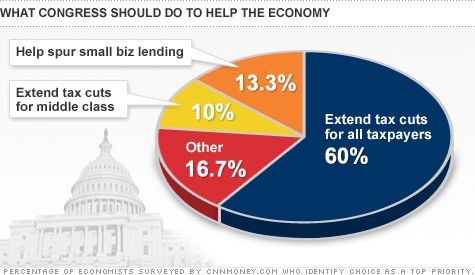
By Chris Isidore, senior writer, September 19, 2010: 7:00 PM ET
NEW YORK (CNNMoney.com) -- With income tax rates set to go up on Dec. 31, Congress is hotly debating what to do next. But most economists agree: Keep them where they are.
One option, to let the tax cuts passed during the Bush administration expire for only the richest 3% of taxpayers while renewing them for everyone else, is popular among Democrats and the choice of the Obama administration.
But a panel of leading economists surveyed by CNNMoney.com disagreed.
The first in a series of economic surveys revealed that extending the tax cuts for all taxpayers is the most important thing Congress can do to help the economy. Of the 31 economists surveyed, 18 chose that from a list of options now being debated on Capitol Hill.
"Extend tax cuts for all income levels and do nothing else," said Sean Snaith, economics professor at the University of Central Florida. "More of the same piecemeal, patchwork policies put forth by this administration will undermine confidence and do little to change the path the economy is on."
Three economists surveyed endorsed the Obama administration's plan to extend the tax cuts only for the lower- and middle-income taxpayers, but allow it to go up on those in the top two brackets -- individuals making more than $200,000 a year or couples earning $250,000 or more. That limited increase in taxes would raise an estimated $700 billion over the next 10 years.
See the full survey results
Some experts, such as former Federal Reserve chairman Alan Greenspan, argue that with the size of U.S. budget deficit, the government can't afford to extend anyone's tax break.
But economists surveyed were in broad agreement that the recovery is still too fragile to allow taxes to go up for the 97% of taxpayers not in the top brackets.
"If those tax cuts expire for everybody, we go into a double-dip recession," said Mark Zandi, chief economist of Moody's Analytics.
Zandi and some of the economists calling for an extension of cuts for the wealthy want to phase out the lower rates for those taxpayers after a couple of years to limit the cost to the Treasury.
Higher taxes are generally believed to be a drag on the economy since it leaves consumers and businesses with less money to spend. Those who argue for extending the tax cuts for the wealthy say that raising those tax rates would hit many small businesses and could put a crimp in hiring.
Those who want to allow the rates to rise for the top earners argue they are more likely to save the money rather than spend it, and thus the tax cut would have less of an economic impact than would lowering the taxes for most other taxpayers.
"I would prefer that the tax cuts for the two upper brackets would also be extended, but there is much more spending [that needs to be done] and much more of an economic impact from extending the tax cuts for everybody else," said Dana Johnson of Comerica Bank, one of those who endorsed the Obama plan to let taxes rise on the top earners.
Four of the economists surveyed backed the plan that passed the Senate Thursday to provide funding and other incentives to spur more lending to small businesses.
Another five suggested other choices of their own, including taking more steps to stop home foreclosures, reforming the overall tax system, resuming drilling for oil in the Gulf of Mexico and having the Federal Reserve do more to provide credit directly to businesses and consumers.
Only two cited additional help for long-term unemployed and more help to cash-strapped state and local governments as their top priorities. To top of page
Subscribe to:
Posts (Atom)